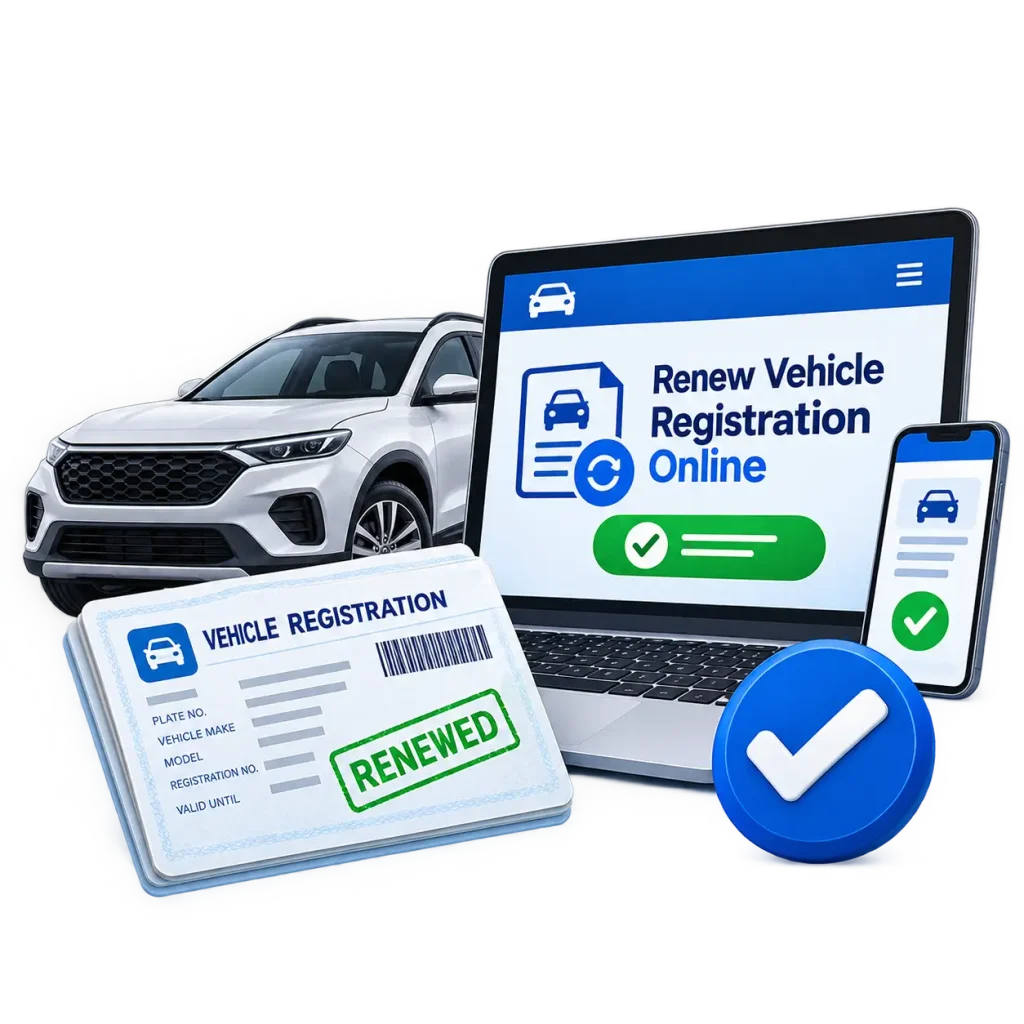
Renew Vehicle Registration Online: Requirements, Fees, and Step-by-Step Process
Renewing your vehicle registration is one of the few DMV tasks that most people can finish in about ten minutes from a phone or computer. It is also one of the easiest to get wrong, because a missing inspection, an insurance mismatch.
You will also find a troubleshooting section, a checklist, and answers to the questions people ask most. Rules differ by state and sometimes by county, so confirm the details on your state’s official .gov website.
What Is Vehicle Registration Renewal?
Vehicle registration renewal is the process of extending your car’s legal permission to be driven on public roads for another term. You pay a fee, confirm that your vehicle meets your state’s requirements, and receive a new sticker or tab for your license plate. The term is usually one or two years, though some states offer other options.
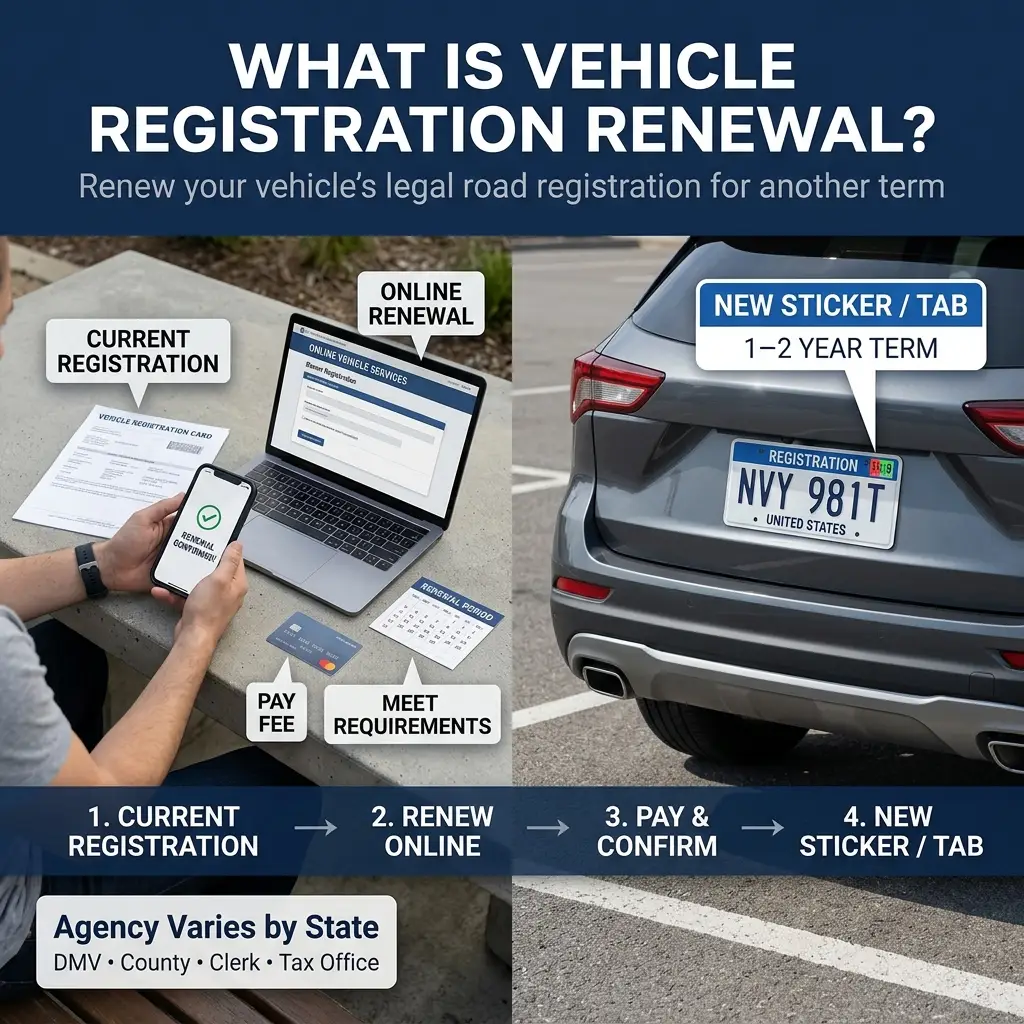
People search for this in many ways, including “renew car registration online,” “online registration renewal,” “renew my vehicle registration,” and “renewing auto registration.” They all describe the same step. Your state may handle it through the DMV, a county tax office, a county clerk, or another agency, so the website you need may have a different name.
Registration is different from your driver’s license. The license shows that you are allowed to drive, while the registration shows that your vehicle is legally on the road. If your license also needs attention, see our page on driver’s license renewal, and if your license status is unclear, our page on how to check your driver’s license status explains how.
Can You Renew Your Vehicle Registration Online?
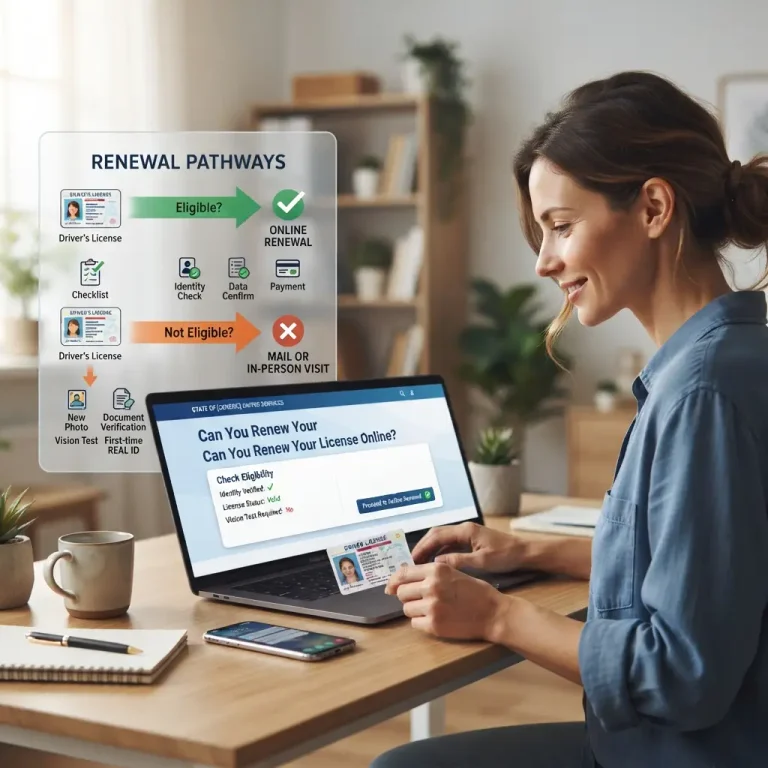
Yes, in nearly every state you can renew online if your vehicle and record meet the eligibility rules. Online renewal is the fastest option, and some states encourage it by charging less or by skipping an office visit entirely. In a few places, renewals are designed to be done online, by mail, or at a kiosk instead of in person.
To be eligible, your registration usually must not be suspended or revoked, and your personal details must match the state’s records. Online renewal may also be blocked if your vehicle needs an inspection, if your insurance is not on file, or if you owe fines or fees. If the website says you cannot renew, that is a signal to fix the problem, not a sign of an error.
Some vehicles may need a different process. Leased or company vehicles, vehicles with special plates, and some commercial vehicles can have extra steps. Check your state’s page for exceptions.
When Should You Renew?
Renew as soon as your renewal window opens, and no later than your expiration date. Most states mail or email a notice a month or two before your registration expires. The renewal usually becomes available online at the same time, though the exact window varies.
Grace periods differ a lot. In Colorado, you can renew up to the last day of the month after expiration without late fees, while a Texas county office notes that drivers have five business days after expiration to renew without penalty. Check the DMV fee calculator to estimate your renewal cost. Many states have no grace period, and driving with an expired registration can lead to a ticket right away.
Do not rely on a grace period. Even where one exists, your sticker may still be considered expired for traffic enforcement. Put a reminder on your calendar a month before your expiration date, and renew as soon as you can.
What You Need to Renew Online
You usually need your license plate number, a few vehicle details, and a payment card. The exact items depend on your state. A Texas county page lists the plate number, the last four digits of the VIN, and a credit or debit card as the basics.
| Item | Why you need it |
|---|---|
| License plate number | Identifies your vehicle |
| Last digits of the VIN | Confirms you own the car |
| Renewal notice number or PIN | Some states use it to log you in |
| Proof of insurance on file | Many states check it automatically |
| Inspection or emissions result | Required in some states |
| Payment card | For the fee |
| Current address | Must match your record |
| Email address | For your receipt |
Keep your renewal notice if you got one, since it may contain a PIN or renewal ID. If you lost it, most states let you look up your registration using your plate number and VIN. Have your insurance card handy too, in case the system asks for the policy number.
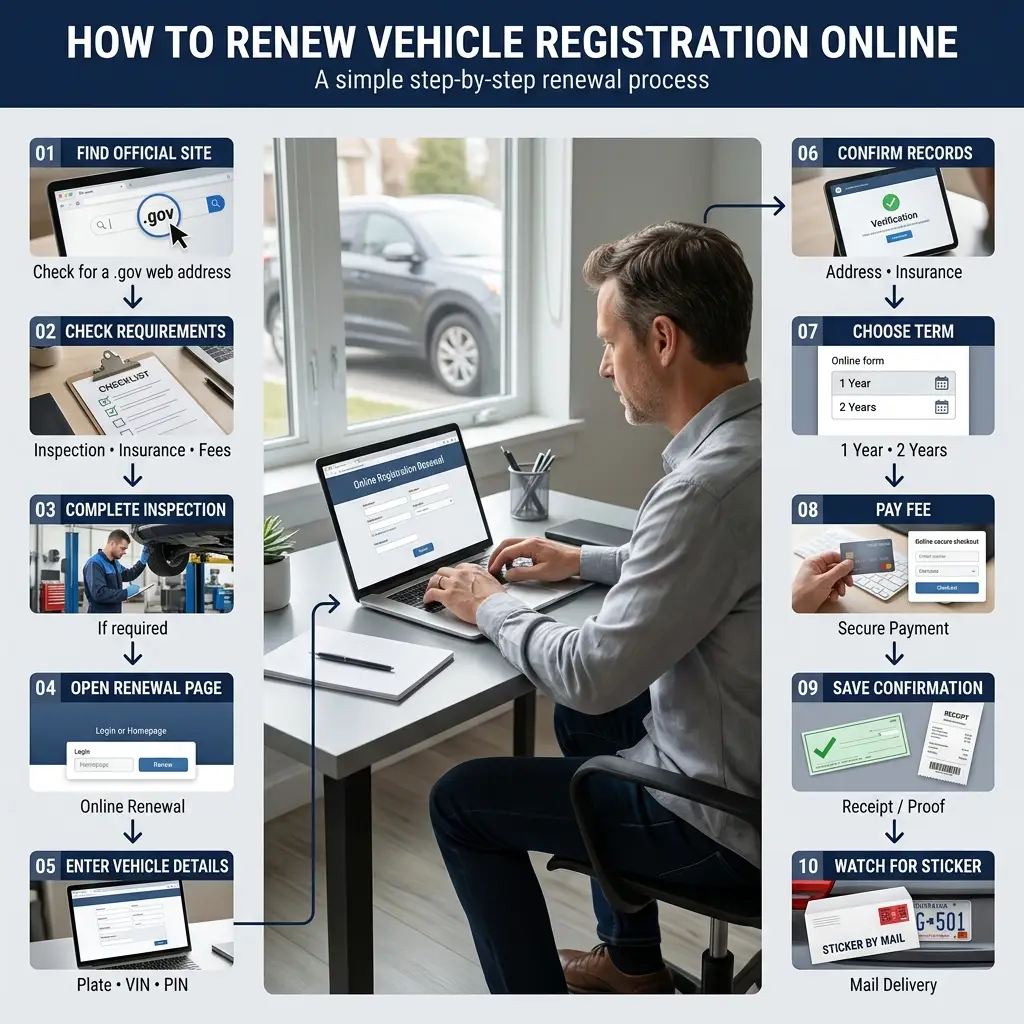
How to Renew Vehicle Registration Online: Step by Step
The process takes about ten minutes once your vehicle meets your state’s requirements. These steps work in most states, with small differences in names and layout.
- Find your state’s official site. Search for your state plus “renew vehicle registration” and open the result that ends in .gov. Avoid ads and sites that charge extra.
- Check your requirements. Look for notes about inspection, emissions, insurance, and fees.
- Complete any inspection first. If your state requires one, finish it before you renew, and wait for the result to reach the system.
- Open the online renewal page. It may be called “Renew Registration,” “Renew Your Tags,” or sit inside an account.
- Enter your plate number and vehicle details. Use your VIN digits or renewal PIN if asked.
- Confirm your address and insurance. Make sure they match your records.
- Choose your renewal term. Some states offer one-year or two-year options.
- Pay the fee. Save your receipt.
- Print or save your confirmation. It may serve as temporary proof of renewal.
- Watch for your sticker. It arrives by mail, and you place it on your plate as instructed.
If you need to change your address first, see our page on how to change the address on your driver’s license, since many states update both records at once. A wrong address can send your sticker to the wrong place.
Inspection, Emissions, and Insurance Checks
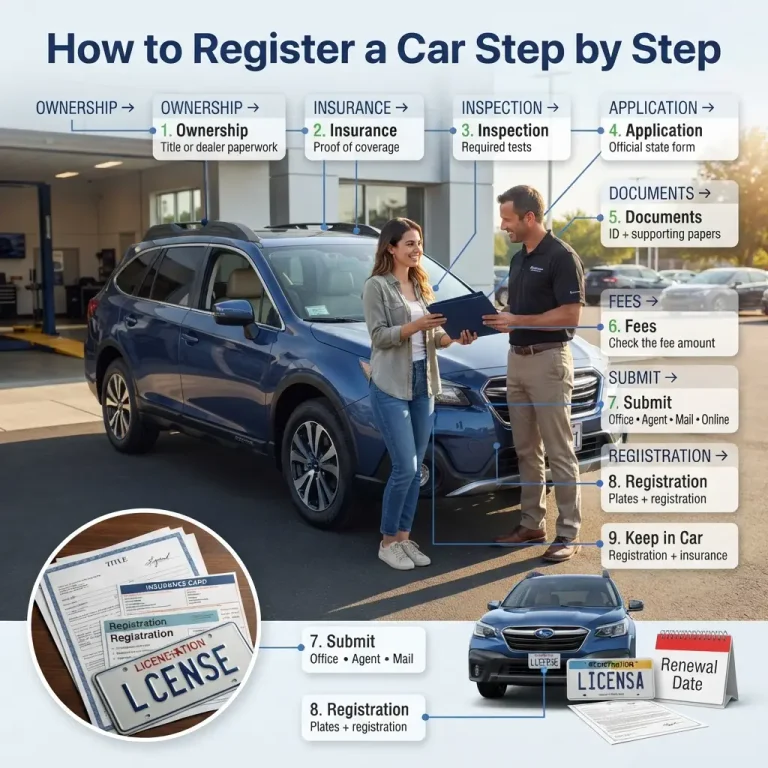
Many states check your inspection and insurance automatically, and a failed check can stop the renewal. Requirements differ widely. Some states require safety inspections, some require emissions tests, some require both, and some require neither. If you’re registering a new vehicle instead, see our guide to register a car.
In Texas, for example, county offices explain that a vehicle subject to inspection must pass before registration can be renewed, and the system checks the inspection and insurance status electronically. Texas also advises waiting until the day after an inspection to renew online, since some stations send reports late in the evening. In Colorado, vehicles that need an emissions test must pass before renewal, and the state asks drivers to wait 24 hours for the test to appear in the system.
For insurance, many states link their records to insurers. If your policy was recently updated, give the insurer time to send the information, which can take a day or more. If you changed insurance companies, ask the new one to confirm that your policy appears in the state system. If you have had a serious violation, our page on SR-22 insurance explains how required coverage and filings work.
If the system says it cannot find your insurance, do not renew by guessing. Contact your insurer and ask them to update the state record, or ask the DMV how to submit proof by another method.
Fees and Late Penalties
Renewal fees vary widely by state, vehicle type, weight, and age. Some states charge a flat fee, while others add taxes based on vehicle value or weight. Online renewals may carry a small processing or convenience fee, and some states discount online renewals.
| Cost item | What to expect |
|---|---|
| Base registration fee | Set by your state, often based on weight, class, or value |
| Taxes or local fees | May apply, depending on state and county |
| Inspection or emissions fees | Separate, paid at the test or at renewal |
| Online processing fee | Small charge in some states, discount in others |
| Late fee | Often applies after a short grace period |
| Replacement sticker | Small fee if lost or damaged |
Late fees add up quickly. One Colorado county notes a $25 late fee per month, plus back ownership taxes, after the grace period ends. A Texas county asks people who renew after the grace period to disclose whether anyone received a citation for the vehicle and whether it was driven while expired.
Check your state’s fee page before you pay. Avoid any site that adds a “service fee” on top of the state’s price unless it is clearly the official site. A few dollars may be a convenience charge, but large add-ons are a warning sign.
Proof of Registration While You Wait
Save your confirmation or temporary permit right away, because your sticker takes time to arrive. Many states give you a receipt, an email, or a printable temporary permit that serves as proof of renewal until the sticker comes. Keep it in your vehicle.
Texas, for example, emails a notice showing your registration is current, and says it serves as proof for 31 days. Colorado offers a printable temporary permit you can place on your front dashboard. Other states ask you to print the confirmation page and keep it with you.
If you are stopped before your sticker arrives, show the receipt or temporary permit. Do not remove your old sticker until your state tells you to, unless the instructions say otherwise. Place the new sticker exactly where the instructions say, usually on the license plate or windshield.
When Will Your Sticker Arrive?
Most stickers arrive by mail in about one to three weeks. Colorado says stickers arrive in one to two weeks, while a Texas county says about ten to fifteen days. Some states take longer, especially at busy times of year.
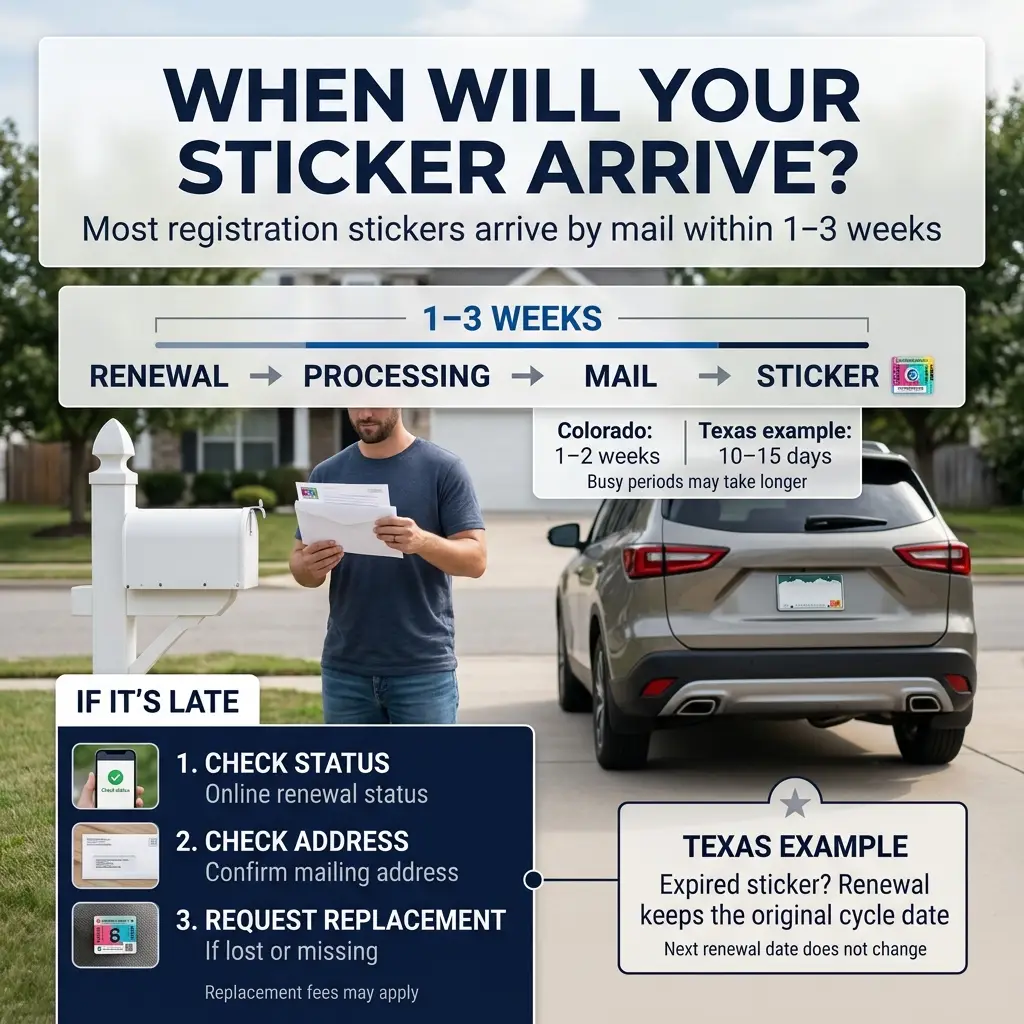
If your sticker has not arrived after the time your state gave you, check your renewal status online or call the office. Confirm that your mailing address is correct. If the sticker was lost or never came, you may need to request a replacement, which can carry a small fee.
One detail surprises many people. In Texas, a sticker can be renewed after it has expired, but the new sticker keeps the original cycle date, so your next renewal date does not change. Some drivers may also need SR22 insurance before renewal is approved. Check your own state’s rule so you know when the next renewal is due.
Other Ways to Renew
If online renewal does not work for you, you have other options. Each one has trade-offs.
| Method | Best for | Watch out for |
|---|---|---|
| Online | Fast, easy renewals | Eligibility and inspection checks |
| People who prefer paper | Slower, use a trackable service | |
| Kiosk | Quick renewal without a computer | Not available for every case, such as proof of insurance |
| In person | Complex cases, document problems | Time at the office, may need an appointment |
| Authorized third-party partner | Convenience | Extra fees, must be approved by the state |
Some states do not offer in-person renewal at all, and instead direct people to online, mail, drop box, or kiosk options. If you need to visit an office, our page on how to book a DMV appointment explains how to reserve a slot, and our page on finding a DMV near you helps you compare offices.
Be careful with third-party services. Make sure they are listed on your state’s official site, and compare their fees with the state’s own price. If a business is not clearly authorized, do not give it your personal details.
Special Situations
Some situations change how you renew.
Moved to a new address. Update your address first, or during renewal, so your sticker and notices reach you.
Moved to a new state. You do not renew your old registration. You register the vehicle in your new state within its deadline, which usually means a visit and new plates.
Vehicle is out of state. Some states let you self-certify that the vehicle is out of state if you cannot complete a required inspection. Check the rules before you renew.
Lost renewal notice. Look up your registration with your plate number and VIN on the official site.
Registration expired a long time ago. Fees may add up, and some states require extra steps or a visit. Check your state’s page for expired registrations.
Vehicle you no longer own. If you sold or gave away the car, follow your state’s steps to cancel or transfer the registration, rather than renewing.
Vehicle not in use. Some states require registration even for vehicles that are not driven, and others offer a non-operating status. Ask your state.
Leased or company vehicle. The leasing company may handle renewal. Ask them before you pay.
Military members. Some states offer extensions or special rules for service members stationed away. Ask your state’s DMV.
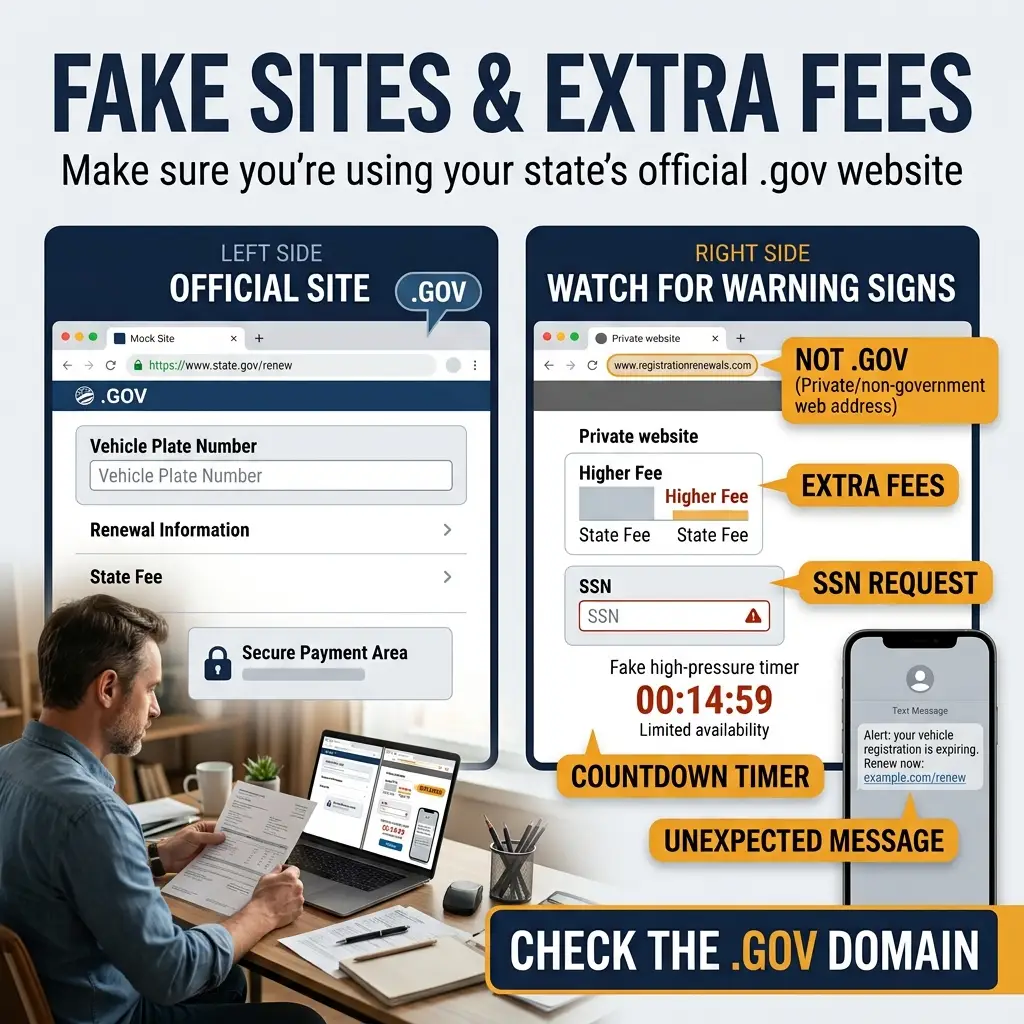
Fake Sites and Extra Fees
The official website for your state ends in .gov. Many search results for “renew vehicle registration online” lead to private companies that look official. Some charge large fees for the same service, collect personal data, or sell “priority” renewals that do not exist.
Warning signs include:
If you get a message that says your registration is about to expire and asks for payment through a link, treat it as suspicious. Go to your state’s DMV website directly instead. If you already paid a fake site, contact your card issuer and report the site to the Federal Trade Commission.
Common Mistakes When Renewing Online
Most problems are easy to prevent. You can also check your driver’s license status while you’re at it.
Waiting until the last day. Inspections, insurance updates, and mail delays can push you past the deadline.
Skipping the inspection. If your state requires one, the renewal will not go through without it.
Renewing right after changing insurance. The state may not see your new policy yet.
Using the wrong address. Your sticker will go to the address on file.
Using an unofficial website. Private sites may charge extra or collect your information.
Throwing away the receipt. It may be your only proof until the sticker arrives.
Forgetting to place the sticker correctly. Follow your state’s instructions about where to put it.
Driving with an expired sticker and counting on a grace period. Even where a grace period exists, a ticket is still possible.
Troubleshooting Online Renewal Problems
Most problems have a simple fix.
The system says it cannot find your vehicle. Check your plate number, VIN digits, and renewal PIN. Try your registration card or the title for the correct details. If it still fails, call the DMV.
The system says your insurance is not on file. Contact your insurer and ask them to update the state system. Give it a day or two, then try again. Ask the DMV how to submit proof by another method.
The system says your inspection is missing. Check that the inspection station sent the result, and wait at least a day. Keep your inspection report as proof. If it does not appear, ask the station or the DMV.
You owe fines or fees. Some states block renewal until you pay tolls, tickets, or taxes. Check the notice for details, and pay the amount before you try again.
Your address does not match. Update your address first, and then renew. Allow time for the change to appear in the system.
The payment was declined. Try another card, check your billing address, and call your bank if needed. Do not retry many times, since it can lock your account.
Your sticker has not arrived. Check your status online or call with your confirmation number. Confirm the mailing address. Ask about a replacement if it does not come.
You renewed but did not get a confirmation. Check your spam folder and your online account. Call the DMV before assuming it went through.
Registration Renewal Checklist and Tips
Use this list before you start.
- ☐ Checked my expiration date and renewal window
- ☐ Found my state’s official .gov renewal page
- ☐ Plate number and VIN digits ready
- ☐ Renewal notice or PIN, if I received one
- ☐ Inspection or emissions test completed, if required
- ☐ Insurance policy active and on file with the state
- ☐ Address up to date
- ☐ Payment card ready
- ☐ Saved my receipt or temporary permit
- ☐ Marked the date my sticker should arrive
A few tips help in practice. Renew as soon as your window opens, since a few days of margin protect you from delays. Set a reminder on your phone each year. Keep your insurance card, registration card, and receipts in the glove box so you can show them if asked.
If you share a car with a family member, decide who handles renewal and keep a copy of the paperwork. If you manage a vehicle for an older relative, make sure their mailing address and insurance are current before you start.
Registration Renewal Terms Explained
| Term | Meaning |
|---|---|
| Vehicle registration | The record that allows your car on public roads |
| Renewal notice | A reminder from your state before registration expires |
| Sticker or tab | A label that shows your registration is current |
| VIN | The vehicle identification number unique to your car |
| Grace period | Extra time after expiration before late fees start |
| Emissions test | A check of your vehicle’s exhaust, required in some areas |
| Safety inspection | A check of brakes, lights, and other equipment |
| Proof of insurance | A document or record showing your policy is active |
| Temporary permit | A printable document that serves as proof until the sticker arrives |
| Convenience fee | A small charge for online or card payments |
Frequently Asked Questions
Conclusion
Renewing your vehicle registration online is quick when you prepare. Check your expiration date, find your state’s official .gov page, complete any required inspection, and make sure your insurance and address are current. Then enter your plate and VIN details, pay the fee, and keep your receipt until the sticker arrives.
Most problems come from missing inspections, insurance that has not reached the state system, and unofficial websites with extra fees. Use the checklist on this page, renew before your window closes, and save your proof of registration. A few minutes of preparation keeps your vehicle legal and your drive worry-free.