DMV Phone Number: Contact Numbers by State
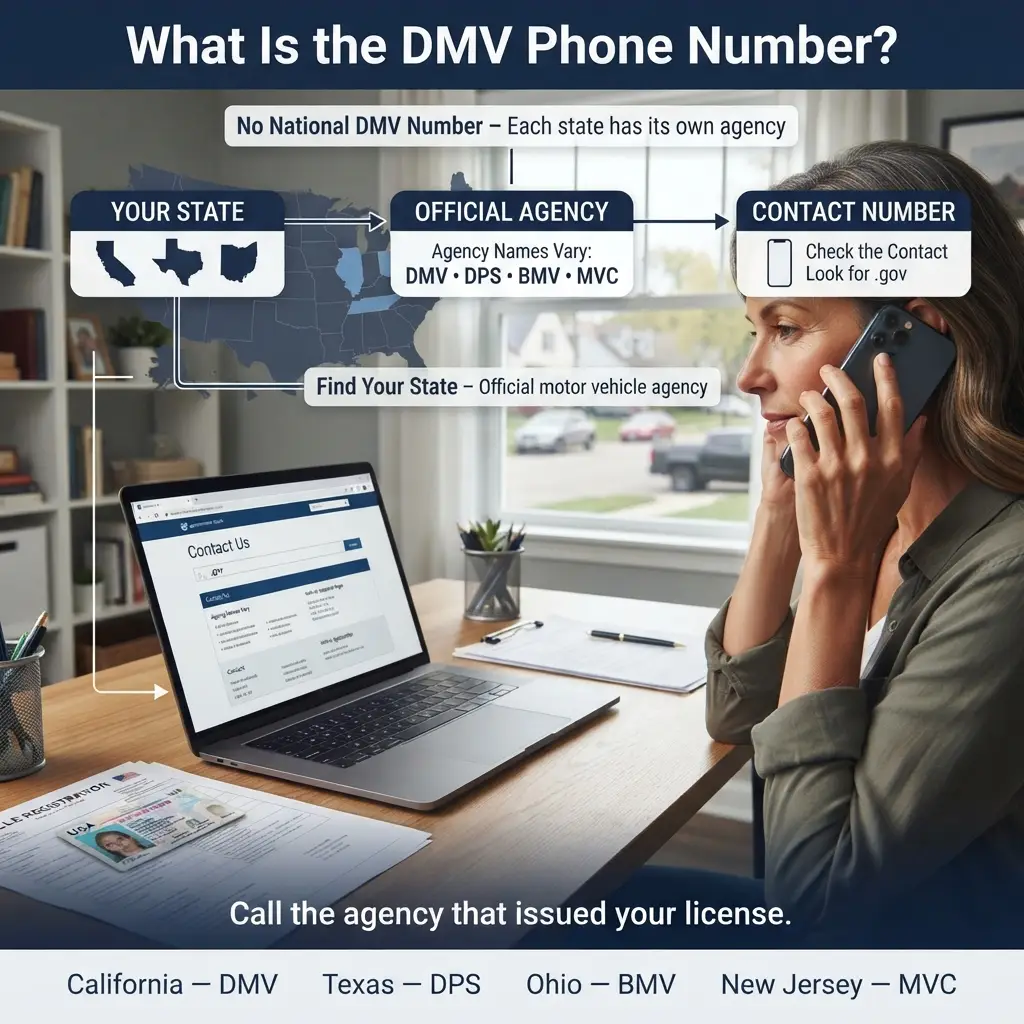
There is no single DMV phone number for the whole country. Every state runs its own motor vehicle agency, so the number you need depends on where your license or vehicle is registered.
This page lists main phone numbers for ten large states, explains what each line is meant for, and shows how to find the right number if your state is not listed. It also covers the best times to call, what to have ready, how to reach a real person, and how to avoid fake DMV numbers that appear in search results. Use the numbers below as a starting point, then confirm them on your state’s official website, because agencies change lines and hours from time to time.
What Is the DMV Phone Number?
The DMV phone number is different in every state. California’s general line is 1-800-777-0133, New York’s is 518-486-9786 or 1-800-698-2931, and Texas driver license customer service is 512-424-2600. If your state is not listed on this page, search for your state’s official motor vehicle agency and open its Contact Us page.
Why There Is No National DMV Number
The federal government does not issue driver licenses or register cars. Those jobs belong to the states, and each state decides how many phone lines to run, which departments answer them, and when they are staffed. A call center in one state may handle licenses, registrations, and titles together, while another state splits them across separate lines.
This also explains why friends in different states give you different answers. A number that works perfectly for a driver in Ohio will not help someone whose license was issued in Georgia. Always call the agency that issued your license or registered your vehicle.
Different Names for the Same Agency
“DMV” is the common nickname, but the official name changes by state. California, New York, and Virginia use the Department of Motor Vehicles. Texas driver licenses fall under the Department of Public Safety, Ohio uses the Bureau of Motor Vehicles, and New Jersey uses the Motor Vehicle Commission. Georgia uses the Department of Driver Services, Florida uses the Department of Highway Safety and Motor Vehicles, and Pennsylvania runs Driver and Vehicle Services through PennDOT.
Searching for the official agency name along with “contact us” usually brings up the right page faster than searching “DMV phone number” alone. Look for a web address that ends in .gov. That small check keeps you away from copycat sites.
DMV Phone Numbers by State
The table below shows the main customer service number for each state, taken from the agency’s own contact page. The hours shown are the phone hours each agency published, which can differ from office counter hours. Confirm the number and hours on the official site before you call, since they can change.
| State | Agency | Main phone number | Published phone hours |
|---|---|---|---|
| California | DMV | 1-800-777-0133 | Monday to Friday, 8 a.m. to 5 p.m. |
| New York | DMV | 518-486-9786 or 1-800-698-2931 | Weekdays except state holidays, 8 a.m. to 4 p.m. ET |
| Texas | DPS (driver license) | 512-424-2600 | Monday to Friday, 7 a.m. to 5:30 p.m., except holidays |
| Florida | FLHSMV | (850) 617-2000 | Monday to Friday, 7 a.m. to 5:45 p.m. ET; automated information 24/7 |
| Pennsylvania | PennDOT Driver and Vehicle Services | 717-412-5300 | Monday to Friday, 8 a.m. to 5 p.m. ET, except holidays |
| Ohio | BMV | (844) 644-6268 | Monday to Friday, 8 a.m. to 5 p.m. |
| New Jersey | MVC | 609-292-6500 | Hours not listed on the phone page |
| Georgia | DDS | (678) 413-8400 | Monday to Friday, 8 a.m. to 5 p.m. |
| North Carolina | NCDMV | (919) 715-7000 | Weekdays, 8 a.m. to 5 p.m. |
| Virginia | DMV | (804) 497-7100 | Monday to Friday, 8 a.m. to 5 p.m. ET; Saturday, 8 a.m. to noon ET |
Drivers in Illinois should use the Secretary of State’s Contact page, since driver services there sit under that office rather than a department called the DMV. The same site lists the numbers for each driver services unit, so scan it for the one that fits your task. Texas also has a separate agency for vehicle titles and registration, so a vehicle question may need the Texas Department of Motor Vehicles or your county tax office instead of the DPS line above.
Some states pass part of the work to counties, which means the local counter has its own number. In Florida, for example, county tax collectors run many license and registration offices, and the Hillsborough County Tax Collector lists 813-635-5200 for customer service. If your question is about a specific office, check whether your state uses county offices before you call the state line.
Time zones matter more than people expect. New York’s phone lines close at 4 p.m. Eastern, which is 1 p.m. in California, and Virginia’s Saturday hours end at noon Eastern. Convert the hours to your own time zone before you dial. Some toll-free numbers are meant for callers inside the state, so if a toll-free number fails from your phone, try the local number the agency lists.
How to Find Your State’s DMV Phone Number in Two Minutes
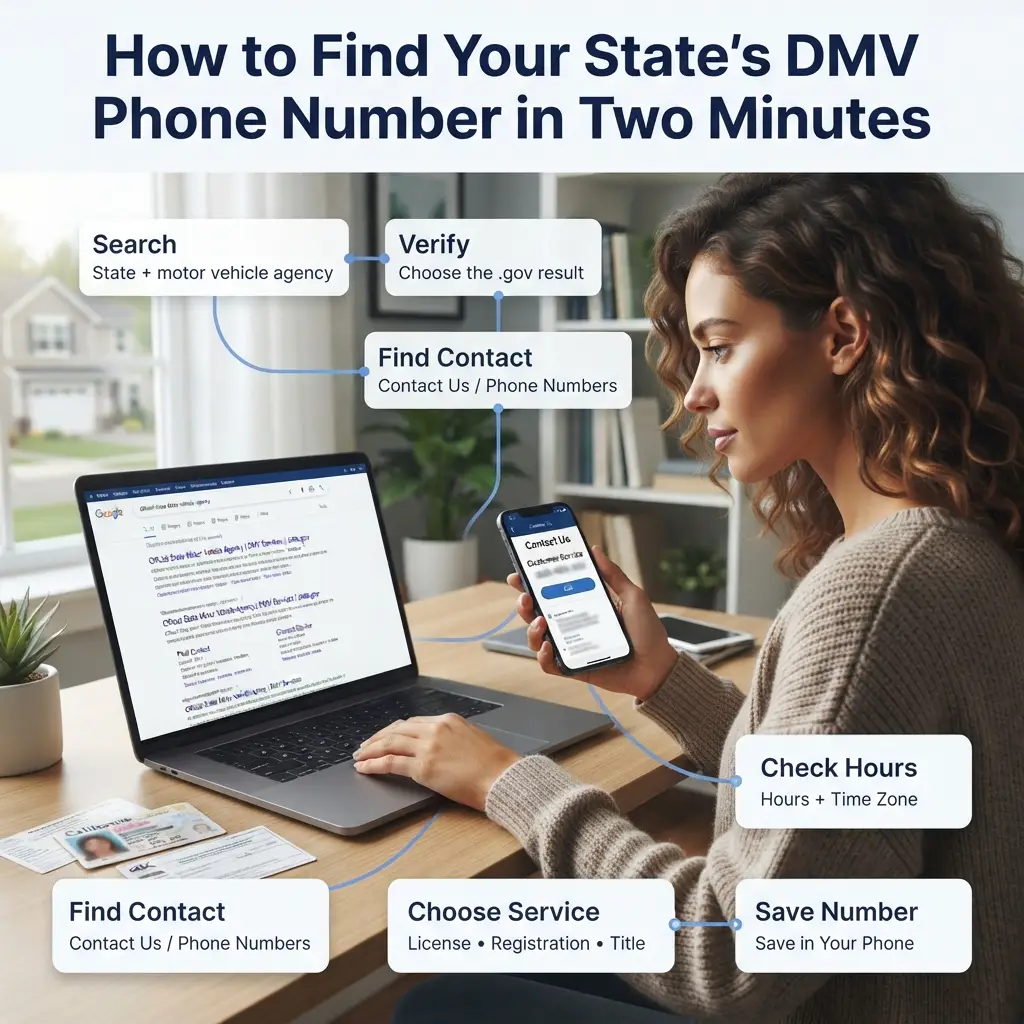
If your state is not in the table, you can find the correct number quickly by going to the source. Follow these steps:
- Search for your state name plus “motor vehicle agency” or the agency name, such as “Illinois Secretary of State driver services.”
- Open the result that ends in .gov, not a paid ad or a directory page.
- Look for “Contact Us,” “Customer Service,” or “Phone Numbers” in the main menu or footer.
- Choose the line that matches your task, such as driver licenses, vehicle registration, titles, or insurance.
- Note the phone hours and time zone, then check whether the agency also offers email or online chat.
- Save the number in your phone with the agency name so you can call back easily.
Some agencies do not publish numbers for individual offices. Pennsylvania, for instance, notes that PennDOT does not list phone numbers for each Driver License Center and sends callers to its main call center. If you cannot find an office number, the main line is the right place to start.
Can I Call the DMV? What Phone Support Can and Cannot Do
Yes, you can call the DMV in nearly every state, and the main line is the quickest way to ask a general question. Phone agents can explain requirements, confirm which documents you need, and point you to the right service. They have limits, though, so it helps to know which tasks are worth a call.
What a Call Can Help With
Phone support works best for questions and short account checks. Common reasons to call include:
What Usually Cannot Be Done by Phone
Many transactions need you in person. Agents generally cannot take your photo, give you a vision or knowledge test, or confirm your identity documents from a description over the phone. They also cannot waive fees or make exceptions to document rules, even if the situation feels unfair.
If your task needs a counter visit, the call is still useful for confirming what to bring. Ask the agent to list the exact documents and any fees you should expect. Write down the name or reference number of the person who helped you, since it makes any follow-up call easier.
Specialty DMV Phone Numbers
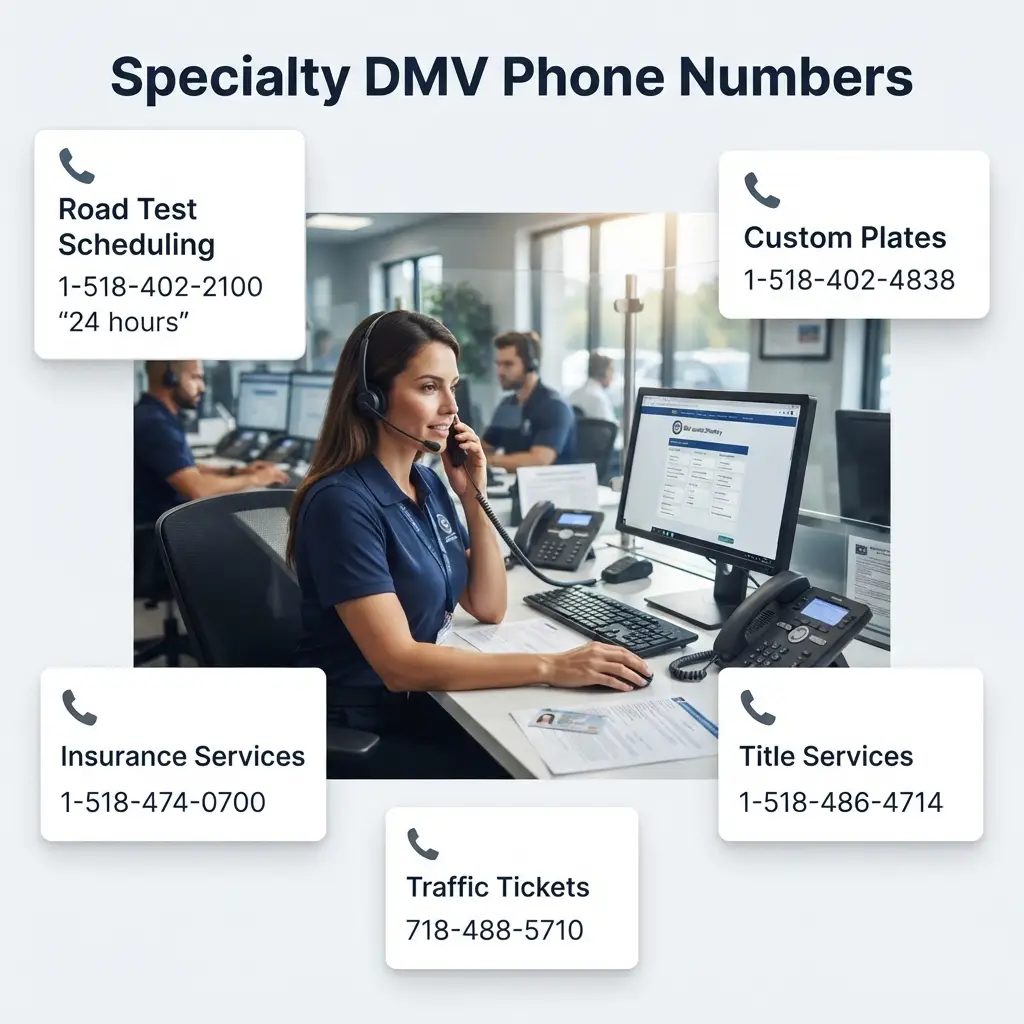
Some agencies run separate lines for specific services, which can save you time on hold. New York publishes the most detailed list among the states checked for this page. Its road test scheduling line, 1-518-402-2100, is listed as available 24 hours a day, and other published numbers include:
- Insurance Services Bureau: 1-518-474-0700
- Personalized and custom plates: 1-518-402-4838
- Title Services Bureau: 1-518-486-4714
- Traffic tickets: 718-488-5710
Other states offer similar shortcuts. Florida lists (850) 617-3416 for crash report requests, Ohio lists (614) 752-7671 for vehicle titles, and Georgia lists (404) 657-9300 for checking license status at any hour. Look at your agency’s full phone directory before you call the main line, because a specialty number often reaches the right team faster.
DMV Phone Numbers for Deaf and Hard-of-Hearing Callers
Most agencies support relay or TTY services. California lists a TTY line at 1-800-368-4327. New York lists 711 or 1-800-662-1220 for TDD users, and Pennsylvania supports TTY by dialing 711. Virginia lists 711 or (800) 828-1120 for its relay service, with the same hours as its main line.
If your agency does not list a TTY number, dialing 711 connects you to a relay operator in most areas. Tell the operator the agency’s main number and they will place the call for you. Relay calls take a little longer, so allow extra time before the line closes.
What to Have Ready Before You Call
A prepared caller gets answers faster and avoids a second call. Keep these items within reach:
- Your driver license or ID number
- Your vehicle plate number and VIN, if the call is about a car
- Your date of birth and the address on file
- Any letter, notice, or reference number you received from the agency
- A pen and paper, or a notes app, to record names, dates, and instructions
- Documents related to your question, such as insurance cards or titles
Agents often confirm identity before sharing account details. Expect questions about your date of birth, address, or part of an identification number. If you are calling for someone else, such as a parent or a family member, ask what authorization the agency requires first.
Best Time to Call the DMV
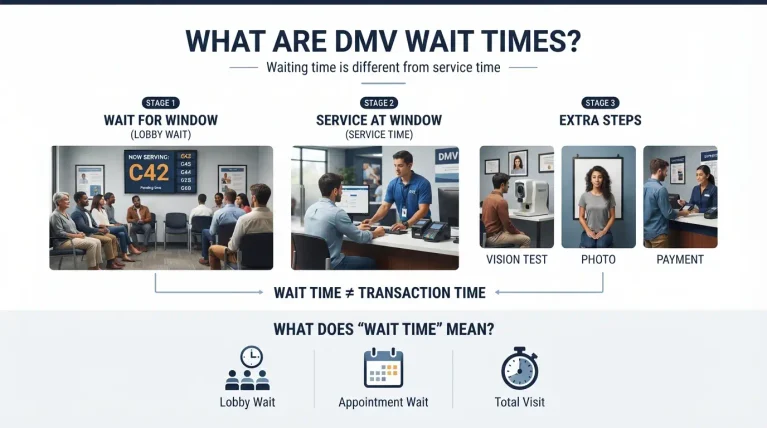
The best time to call the DMV is usually early in the morning on a midweek day, away from holidays. Several agencies give their own hints. Texas says Fridays and the hour from 7 a.m. to 8 a.m. tend to be faster, Georgia notes that Tuesday is its busiest day, and New Jersey’s suspension and restoration lines suggest calling Tuesday through Friday while avoiding 12:00 to 2:00 p.m.
These tips point to a common pattern. Mondays, lunch hours, and the days after a holiday bring the most calls. If you must call at a busy time, expect a longer wait, and consider using online services or email for simple questions.
Time zones can work in your favor or against you. If you live in the Pacific time zone and call a state that closes at 4 p.m. Eastern, your window ends at 1 p.m. your time. Calling right when lines open often gives the shortest hold, so set an alarm if you need an answer the same day.
How to Get a Real Person on the Line
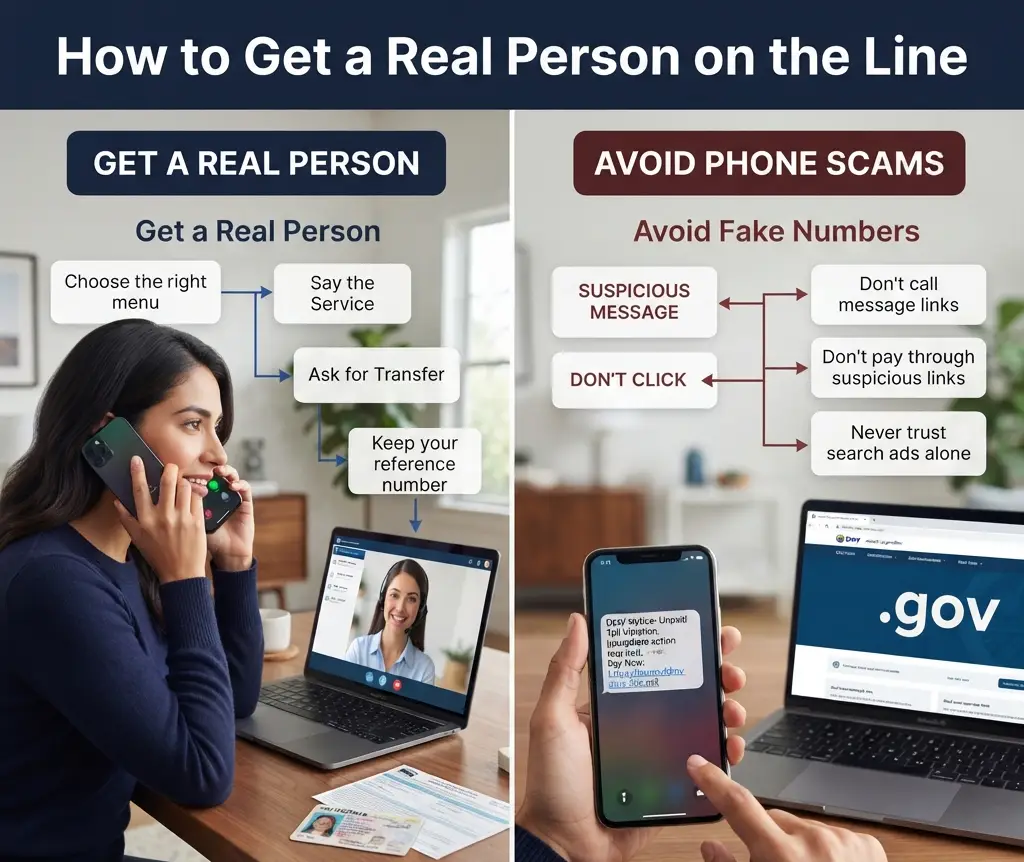
Automated menus can feel endless, but a few habits shorten the process. Listen to the full list of options before you press anything, because menus change and the option you need may not be the first. Choose the category closest to your task, and if the system offers voice commands, say the service you need in a few clear words, such as “driver license.”
If you reach a dead end, call back and try a different menu path rather than staying on hold. Ask the agent to transfer you instead of hanging up when you land in the wrong department. Keep your reference number handy, since a transferred call may need it. If your agency offers email, chat, or an online help center, use those for non-urgent questions and keep the phone for time-sensitive problems.
DMV Phone Scams and Fake Numbers: How to Stay Safe
Use only numbers listed on your state’s official .gov website. Search results and ads sometimes show third-party “DMV helpline” numbers that connect to private businesses, and these services may charge fees for help that the agency provides for free. A number that looks official in a search snippet is not proof that it belongs to the agency.
Scam messages are also common. Be careful with texts or emails that claim you owe a fee, a ticket, or an unpaid toll and push you to pay right away through a link or gift cards. Do not click the link, and do not call a number inside the message. Open your state’s official site yourself and look up the number there.
Georgia runs a helpful example of this idea: its 1-800-GEORGIA line lets residents confirm whether a website is an official state site. Other states may offer similar tools, so check your agency’s contact page. When in doubt, hang up and call the number you found on the .gov site.
When Calling Is Not the Fastest Option
A phone call is not always the quickest route. Many states let you renew a registration, update an address, or request records online, and these tasks often take only a few minutes. Online accounts also let you check your status without waiting for an agent.
Email works for questions that are not urgent, but replies can take days. Texas, for example, states that email responses take four to five working days. If you need a service that requires a visit, book an appointment where your state offers one, and use the main phone line only to confirm what to bring.
Common Mistakes When Calling the DMV
A few repeat errors waste time on the phone. Avoid these:
Troubleshooting: Problems When Calling the DMV
If your call does not go as planned, these steps usually help.
The line is busy or the hold is very long. Try again early the next morning, and use online services or email if your question is simple. Some agencies post expected wait times on their contact page, as Texas does with its note about waits of up to 20 minutes.
The call drops. Call back right away and ask for a supervisor if you have to repeat your story. Keep your reference number ready.
You reached the wrong department. Ask the agent for the correct number, or ask to be transferred. Write down the new department name.
The agent says you must visit an office. Ask exactly which documents or steps you need and whether an appointment is required. Then check the office page for hours and services.
The number does not work. Check the official contact page for an updated number. Phone lines and menu options are sometimes changed.
You need language or accessibility support. Ask for an interpreter, or use the relay options listed earlier. Pennsylvania, for instance, lists language translation and TTY support on its main line.
Frequently Asked Questions
Final Word on DMV Phone Numbers
The right DMV phone number depends on your state, your task, and the hour you call. Start with the official .gov contact page, confirm the phone hours and time zone, and pick the line that matches your question. That single habit protects you from fake numbers and wrong departments.
A short call goes better when you have your license number, vehicle details, and any notice in hand. Call early in the morning on a midweek day, write down the agent’s name and a reference number, and use online services or email when your question is not urgent. A little preparation turns a long wait into a quick answer.