DMV Hours: Opening Times, Weekend Hours, Holidays
Most DMV offices in the United States open somewhere between 7:30 a.m. and 9:00 a.m. and close between 4:00 p.m. and 5:00 p.m., Monday through Friday. That is the short answer, but the exact schedule depends on your state, your county, and even the specific branch you plan to visit.
There is no national DMV. Every state runs its own motor vehicle agency, and some states hand part of the work to county offices, tax collectors, or private agents. This is why a friend in another state can tell you the DMV opens at 8:00 a.m. and be completely right, while your local office opens at 8:30 a.m. and shuts down at 4:00 p.m.
This page explains typical DMV hours, how to find the real schedule for your office today, what happens on holidays, and how to avoid the most common reasons people get turned away. It also covers Saturday service, late hours, last-entry cutoffs, appointments, and the services you can finish online. Use it as a planning page, then confirm the final details on your state’s official website before you drive anywhere.
What Are the Typical DMV Hours in the United States?
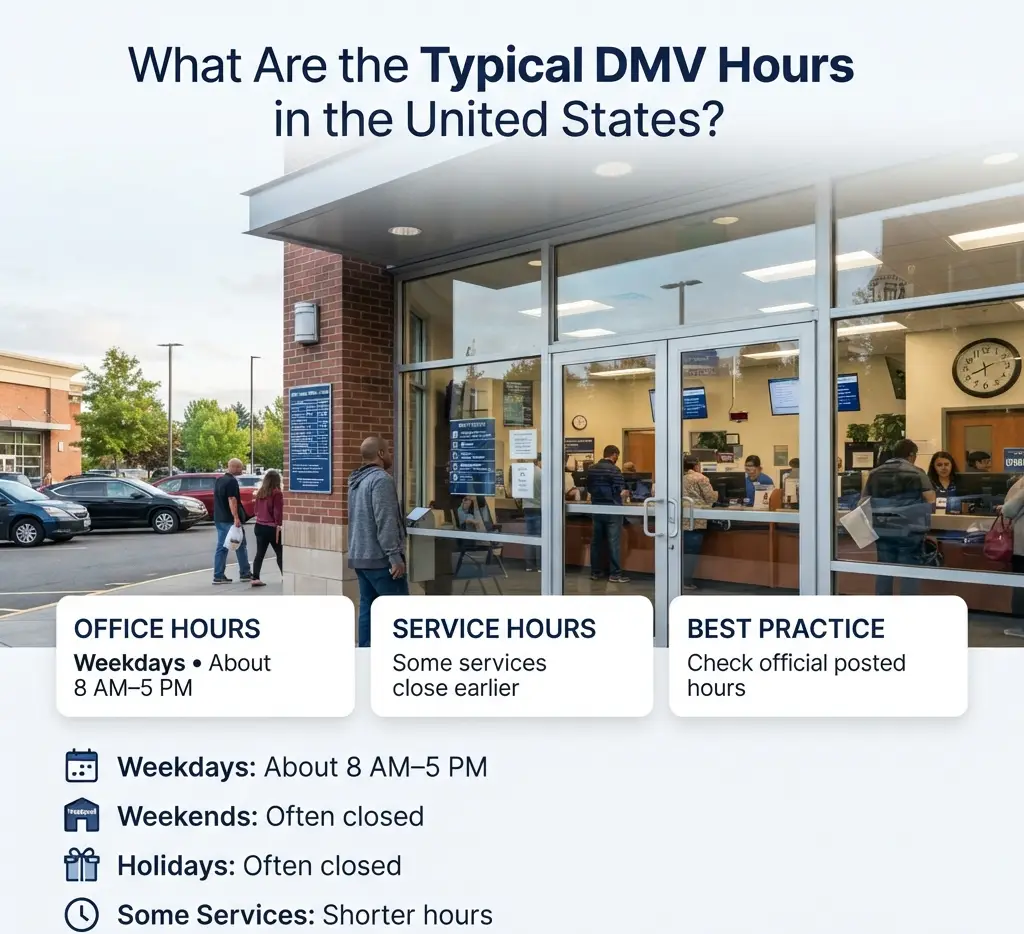
Typical DMV hours are Monday through Friday, roughly 8:00 a.m. to 5:00 p.m., with offices closed on weekends and state holidays. Many offices shorten the window for certain services, so the front door may stay open longer than the counter that handles driver licenses. Always treat the posted hours as the outer limit, not the time you should arrive.
Standard Weekday Hours
Most offices follow a pattern that looks similar even when the details change. Doors open early in the morning, a lunch period keeps staffing thinner, and the last customers are accepted before the official closing time. Some states also stagger one weekday for staff training or a later start.
Here is what a typical week often looks like:
Why DMV Hours Are Different in Every State
The agency that issues your license has a different name depending on where you live. California, New York, and Delaware use a DMV. Texas uses the Department of Public Safety for driver licenses, Maryland uses the Motor Vehicle Administration, and Pennsylvania splits services between PennDOT and private partners. In Illinois the Secretary of State handles driver services, and in Florida many counties let the local tax collector run the licensing counter.
Each of these agencies sets its own calendar, budget, and staffing rules. A branch in a busy city can justify longer hours than a small-town office that serves a few hundred drivers a month. Staffing shortages and building repairs also change the schedule without much warning, which is why the posted hours on a website sometimes differ from what a third-party directory shows.
DMV Hours by State: Real Examples
The table below uses hours published by official or local government sources to show how much the schedule can vary. These are examples to help you understand the pattern, not a full state directory. Hours change, so confirm your own office before you go.
| Location | Published hours example | What to notice |
|---|---|---|
| New York City (Manhattan offices) | Monday to Friday, 7:30 a.m. to 5:00 p.m.; Saturday and Sunday closed | Early opening, no weekend service at these offices |
| Hillsborough County, FL (tax collector offices) | Monday to Friday, 8:00 a.m. to 5:00 p.m.; Wednesday opens at 9:00 a.m. | Driver license services stop earlier, around 4:30 p.m. at larger offices and 3:30 p.m. at Plant City |
| Miami-Dade County, FL (select tax collector offices) | Monday to Friday, 8:00 a.m. to 5:00 p.m.; Saturday 8:00 a.m. to 1:00 p.m. | A rare example of regular Saturday service |
| Monroe County, NY (Rochester area) | Typically 8:30 a.m. to 4:30 p.m., with one late night until 6:30 p.m. at some branches | Late night varies by branch |
| Delaware | Public hours shortened by 30 minutes at closing starting February 2026, with Monday and Tuesday ending at 4:00 p.m. | Hours can change midyear |
| Texas | Driver license offices run on an appointment system, with extended hours at some high-volume offices | Booking ahead matters more than the clock |
Two lessons come from this table. First, the same agency can show different hours at different branches, so a statewide number is only a rough guide. Second, the time the building closes is not always the time services stop, which is the point many first-time visitors miss.
What Time Does the DMV Open and Close?
Most DMV offices open between 7:30 a.m. and 9:00 a.m. and close between 4:00 p.m. and 5:00 p.m. A few large urban offices open earlier, and many small county branches open later or on fewer days. Your office page on the state website is the only source that gives the exact answer for your branch.
Opening Time
Opening time is usually the easiest part to plan around. If your office opens at 8:00 a.m., a line can already form 20 to 30 minutes earlier at busy locations, especially on Mondays and after holidays. Arriving about 15 minutes before opening often gets you through the door before the first rush builds.
Closing Time vs. Last Service Time
This is where many people get caught. An office that closes at 5:00 p.m. may stop starting driver license transactions at 4:30 p.m., and a road test may need to begin much earlier. In the Hillsborough County examples above, driver license services end 30 minutes before general closing at several offices, and one branch stops 90 minutes early.
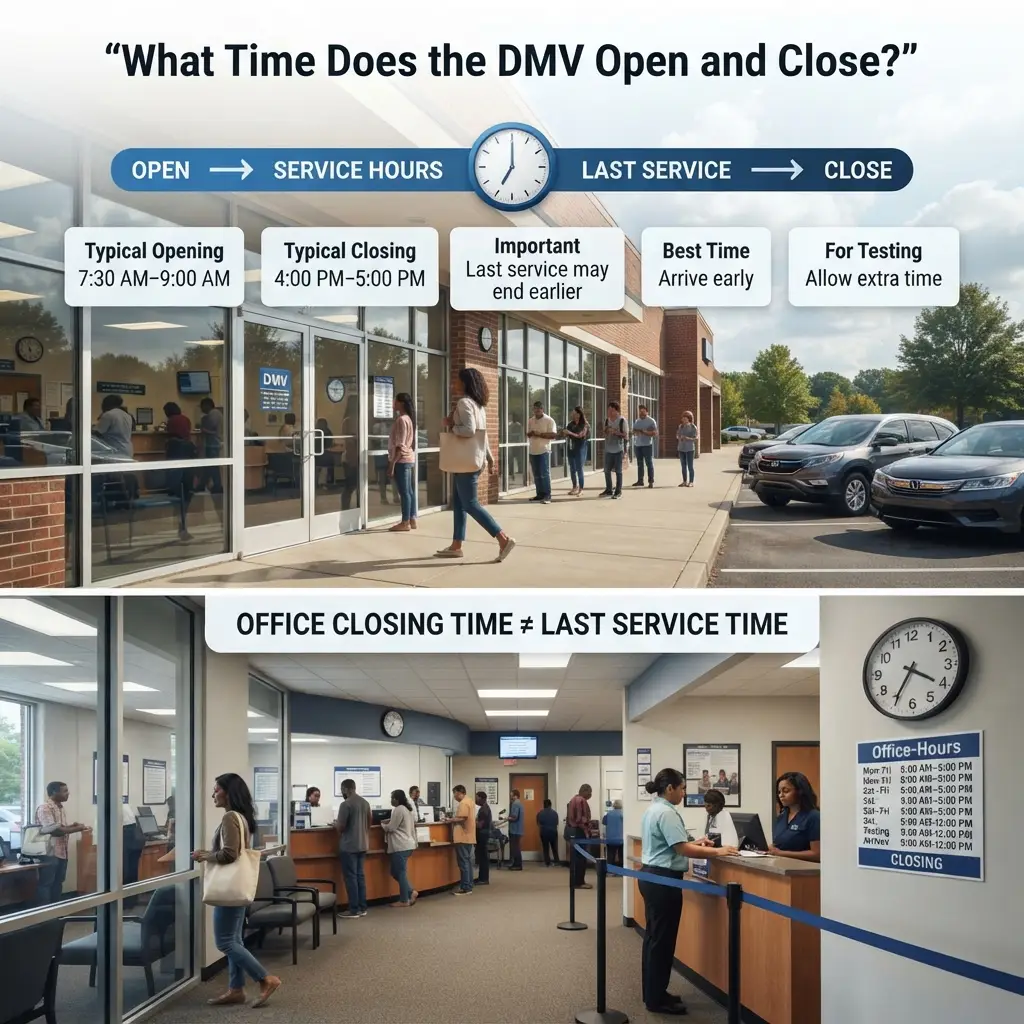
Some offices hand out a ticket or queue number and stop issuing new numbers before closing. Others lock the door at closing time but finish everyone already inside. Because the rule changes by office, read the “services” or “hours” section of the branch page and look for any note that says “last customer” or “services end at.”
A safe habit is to plan your arrival at least one hour before the posted closing time for a driver license task, and two hours before for anything that involves testing. For registration and title work, 30 to 45 minutes is usually enough, but busy days can stretch that. When in doubt, go in the morning.
Is the DMV Open on Saturday or Sunday?
Most DMV offices are closed on Saturday and Sunday, but a limited number of locations offer Saturday service, usually for part of the day. Sunday service is very rare and, in most states, does not exist at all. If you need a weekend visit, expect to book ahead and to find fewer services than on a weekday.
Saturday hours show up in a few common forms. Some counties run a handful of offices on Saturday mornings, such as the 8:00 a.m. to 1:00 p.m. window published for certain Miami-Dade locations. Other states have tried temporary programs, rotating Saturdays, or pilot offices that open when demand spikes. Texas, for example, has used extra Saturday appointments at select driver license offices to clear backlogs, and California has run Saturday programs at selected offices in the past.
Because these programs start, stop, and move, an article from two years ago can be wrong today. If a site says an office is open Saturday, check the state’s official office locator and look for the Saturday line on that specific branch page. Then confirm whether walk-ins are accepted, since many weekend slots are appointment only.
Does the DMV Have Late Hours or Early Opening?
Yes, some offices stay open later on one or two weekdays, and a few open earlier than normal. These extended schedules are not universal. They tend to appear in larger cities, at high-volume branches, and in states that have tried to reduce backlogs.
Examples from public sources show the range. Several Monroe County, New York, branches stay open until 6:30 p.m. on a single weekday, a Syracuse-area office has listed 6:00 p.m. closings Monday through Thursday, and some New York City offices open at 7:30 a.m. Texas DPS has also tried extended hours at selected offices, with appointments running from 7:00 a.m. to 7:00 p.m. on certain days during past programs.
How to Check DMV Hours Today and Open Now
The fastest way to confirm DMV hours today is to use your state’s official office locator and open the page for your exact branch. Third-party directories often copy old hours, so they should be a backup rather than your main source. A two-minute check can save you a wasted drive.
Follow these steps:
- Search for your state’s official motor vehicle website. Look for a web address ending in .gov to avoid copycat sites.
- Open the “Locations,” “Find an Office,” or “Office Hours” page.
- Enter your ZIP code or city and select the branch you plan to visit.
- Read the hours for the day of your visit, not just the weekly summary.
- Look for banners or alerts about closures, weather delays, system outages, or staff shortages.
- Check whether the service you need is available at that branch. Not every office handles every task.
- If the page is unclear, call the number listed for that office and ask directly.
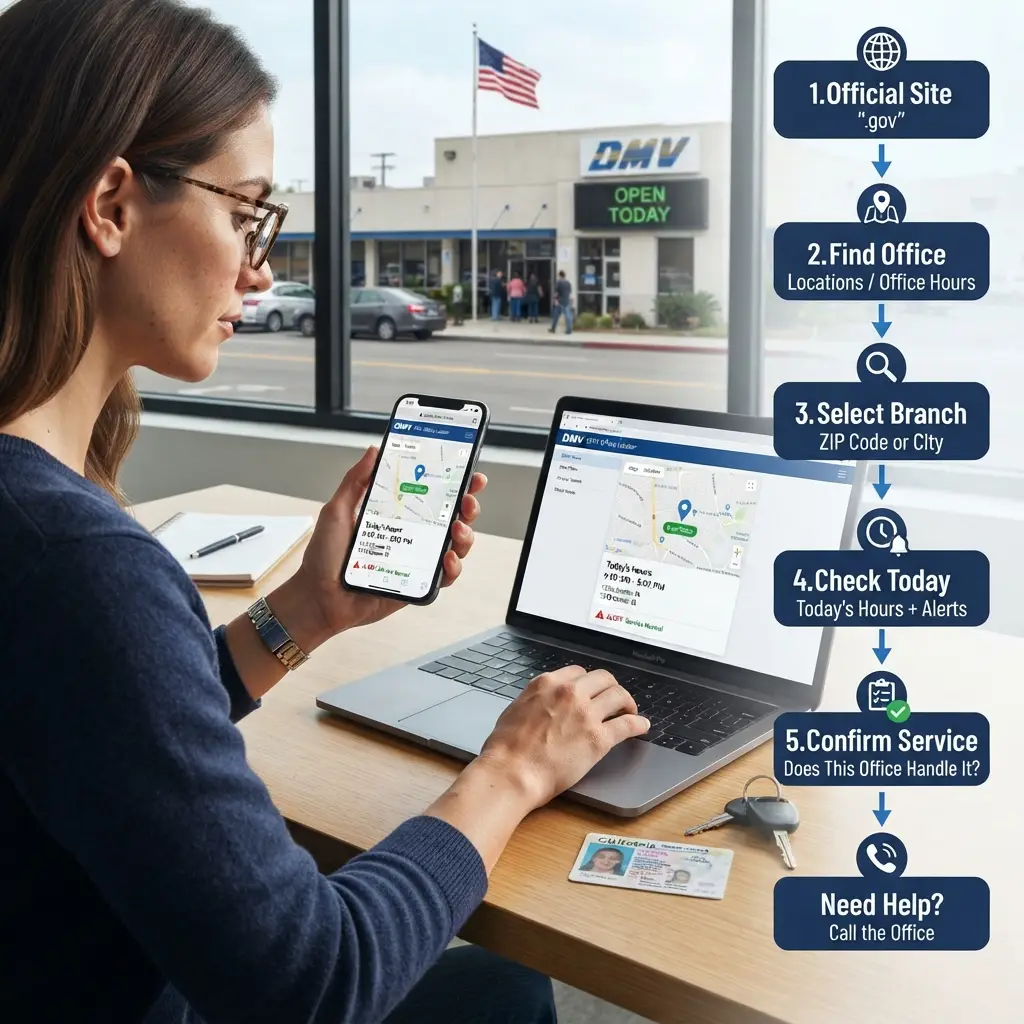
Search results that say “open now” are not always reliable, especially for government buildings. A map pin can show a business as open when the DMV counter has already stopped service. Use the map as a direction tool and the official branch page as the final answer.
DMV Holiday Hours for the Rest of 2026
DMV offices are closed on federal and state , and they may also close early on holiday eves or the day after Thanksgiving. The exact list depends on the state, so use the table below as a planning guide and verify your state calendar.
| Holiday | 2026 date | Typical DMV status |
|---|---|---|
| Columbus Day / Indigenous Peoples’ Day | Monday, October 12 | Closed in many states, open in some |
| Veterans Day | Wednesday, November 11 | Closed in many states |
| Thanksgiving Day | Thursday, November 26 | Closed everywhere |
| Day after Thanksgiving | Friday, November 27 | Closed in some states, open in others |
| Christmas Day | Friday, December 25 | Closed everywhere |
| Christmas Eve and New Year’s Eve | December 24 and 31 | May close early in some states |
| New Year’s Day | Friday, January 1, 2027 | Closed everywhere |
Holiday weeks create a squeeze. When Monday is a holiday, Tuesday often feels like a double Monday, with long lines and fast-filling appointments. The same happens on the day before and after a long weekend, so try to schedule your visit in the middle of the week when you can.
Appointment or Walk-In: Which Works Better?
An appointment usually works better because it gives you a set time and a shorter wait, but walk-ins are still allowed in many states. Some states now require appointments for certain services, such as road tests or specific license transactions. Others let you choose between both options and may serve walk-ins when they have capacity.
Texas driver license offices, for instance, have moved services to an appointment system with same-day slots and a check-in process using a kiosk or phone. In Florida, many county offices accept walk-ins but also offer appointments for those who want to plan ahead. In California, appointments are offered online and by phone and can save a long wait compared with walking in.
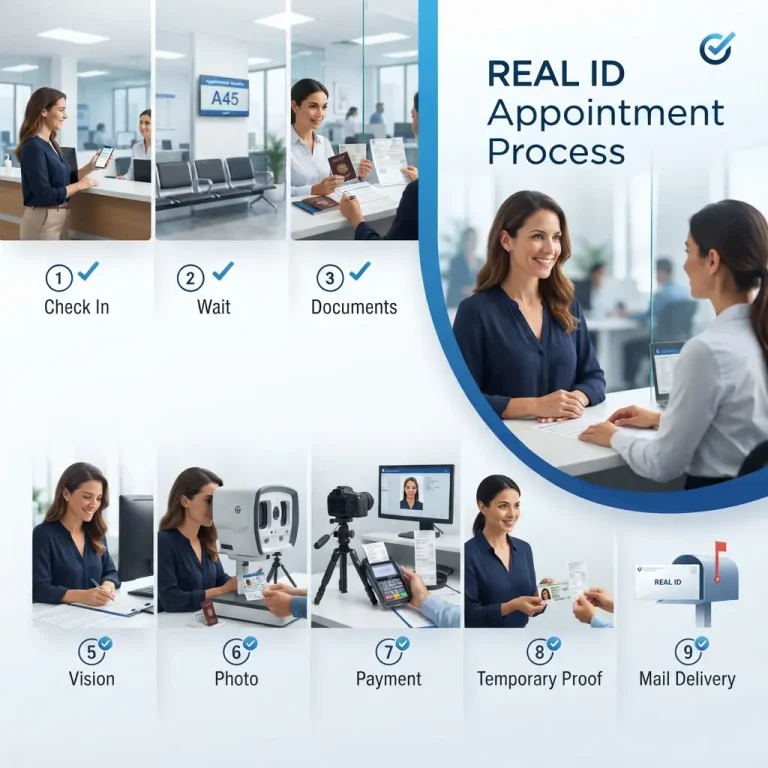
Pick an appointment when your task involves a REAL ID, a new resident license, a road test, or any visit where a missed step would force a second trip. Choose a walk-in only if the service is quick, your office posts short wait times, and you can be flexible. Whichever option you choose, arrive with every document in one folder.
If no appointments are open, do not give up on the first search. Check other branches within a reasonable drive, look at the cancellation list if your state offers one, and refresh the scheduling page early in the morning when new slots often appear. Some states release appointments in batches, so a full calendar today may open up tomorrow.
Best Time to Go to the DMV
The best time to go to the DMV is usually mid-morning to early afternoon on a Tuesday, Wednesday, or Thursday, away from holidays and the end of the month. These windows tend to avoid the Monday rush, the Friday crowd, and the lunch-hour staffing dip. Offices still differ, so use this as a starting point.
Several patterns hold up in most places:
What to Bring So You Are Not Sent Home
Bring original or certified documents, not photocopies, and confirm the exact list on your state’s website before you leave. Document rules differ by state and by task, and a missing paper is one of the top reasons people are turned away at the counter. A REAL ID application is stricter than a standard renewal.
For a REAL ID or first-time license, most states ask for:

Registration and title work usually add other items, such as proof of insurance, the vehicle title or registration, a bill of sale, an odometer statement, and emissions or safety inspection results where required. If you are transferring a car from another state, bring the out-of-state title and any lien information. Fees and accepted payment types change by state, so check whether your office takes cards, cash, or checks.
Since REAL ID enforcement began on May 7, 2025, travelers who want to fly domestically with a state ID generally need a REAL ID or another accepted document such as a passport. If you have not upgraded and plan to travel, treat your DMV visit as time-sensitive. A passport can also work for flights, so compare the cost and the wait for each option.
DMV Services You Can Finish Without Visiting an Office
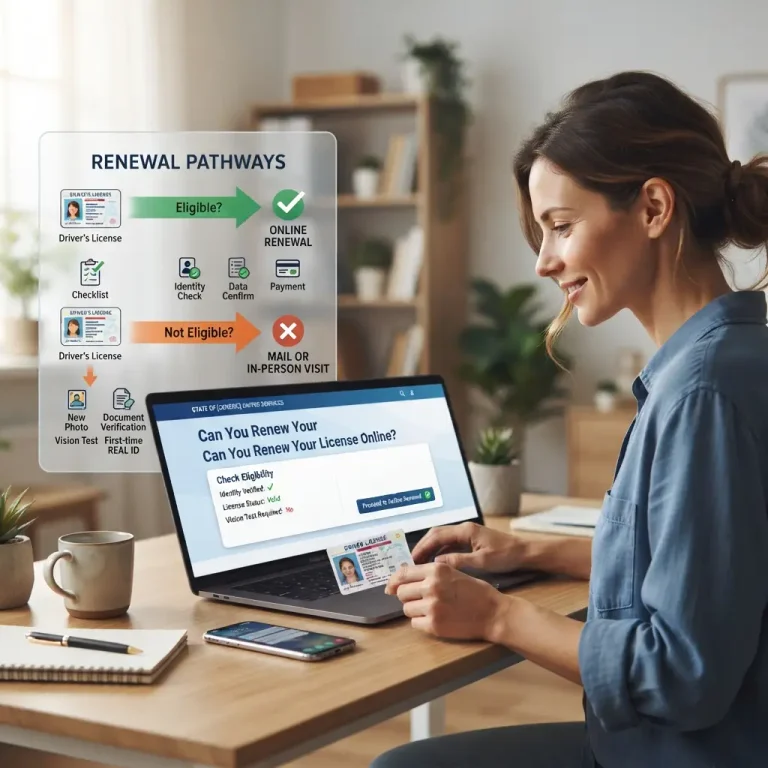
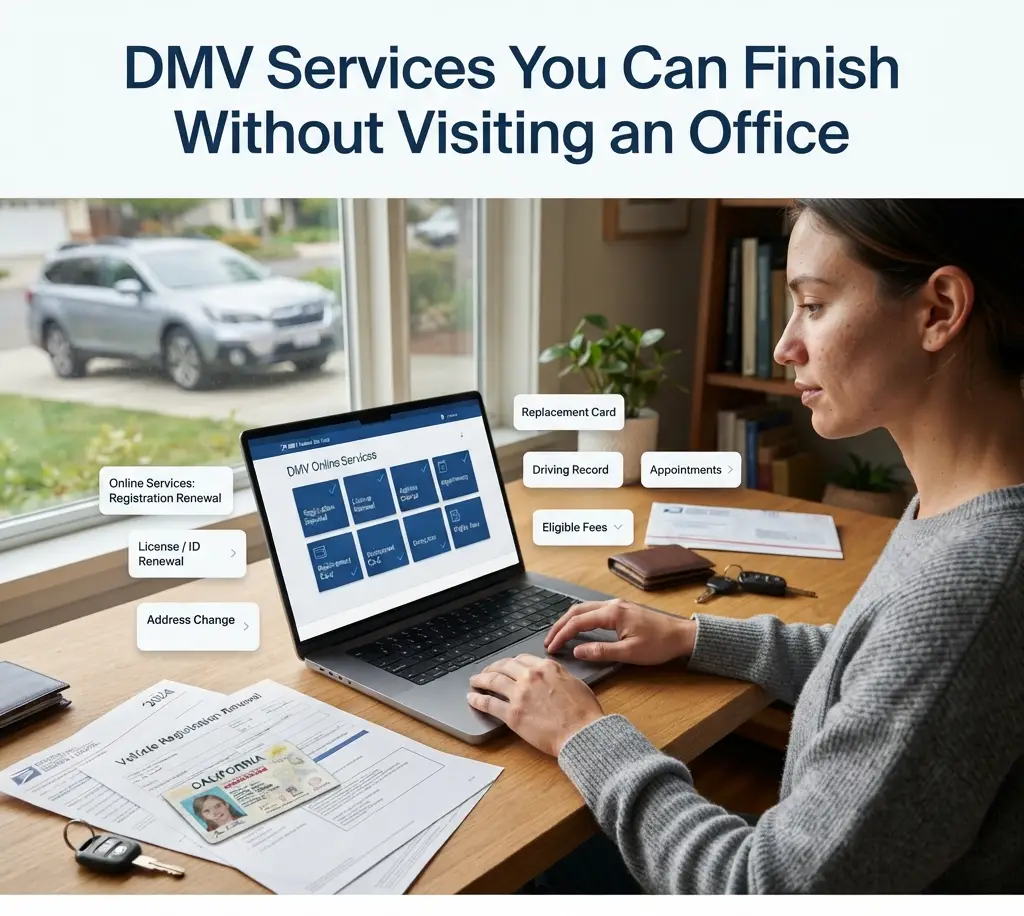
Many DMV tasks, including vehicle registration renewal, can be handled online, by mail, at a kiosk, or through an authorized partner. Doing so avoids office hours altogether, which is helpful if your schedule or distance makes an in-person visit hard. Eligibility depends on your state and your situation.
Services often available online include:
Vehicle registration renewal
Driver license or ID renewal for eligible drivers
Address changes
Duplicate or replacement cards in some cases
Driving record requests
Appointment scheduling and rescheduling
Payment of certain fees and reinstatement costs
Common Mistakes That Waste a DMV Trip
Most failed DMV trips come from a few repeat errors that are easy to avoid. Knowing them in advance makes your visit smoother and often cuts the time you spend there in half.
- Relying on a search snippet for hours. Snippets can show old data. Check the official branch page.
- Arriving near closing time. Last-service cutoffs can end your visit before it starts.
- Skipping the document checklist. One missing proof of residency can force a second appointment.
- Bringing photocopies. Many offices only accept originals or certified copies.
- Assuming every office offers every service. Road tests, CDL work, and specialty plates may be limited to certain branches.
- Ignoring holiday weeks. The days around a holiday are the busiest of the year.
- Forgetting payment rules. Some offices do not take all card types or personal checks.
- Missing an appointment and not rescheduling. No-shows can make it harder to book again and waste a slot others needed.
Troubleshooting Problems With DMV Hours
If the DMV hours you found do not match what you see on arrival, stay calm and use the steps below to fix it quickly. Most issues come from outdated listings, short-notice closures, or a misunderstanding about which service ends when.
The office is closed even though the listing said open. Check the official site for a closure alert, then call the branch or look for a nearby office. Do not keep driving between offices without confirming each one first. If a weather or equipment problem is the cause, the state site usually lists the reopening date.
Your appointment was canceled or moved. Look in your confirmation email or text for a reschedule link. If you get no message, call the office or log in to the scheduling system. Keep your confirmation number, because it helps the staff find your booking.
No appointments are available. Search other nearby branches, check early morning for fresh slots, and ask about a waitlist or cancellation list. Also look at whether your task can be completed online or through an authorized agent.
Your documents were rejected. Ask exactly which item failed and why, then write it down. Use the state’s online checklist to correct it, and book the next appointment right away instead of waiting.
The system is down. Technical outages happen, and they can freeze transactions for hours. If staff tell you the system is down, ask whether you can wait, return later, or reschedule without penalty.
Frequently Asked Questions
Final Word on DMV Hours
DMV hours are not the same in every state, county, or branch, and that is the main reason people end up at a locked door. The reliable fix is simple: check the official page for your exact office on the day you plan to go. Look at when services stop, not only when the building closes, and scan for holiday, weather, or outage alerts.
An appointment, a complete folder of original documents, and an arrival time well before closing remove most of the stress. If your schedule is tight, look for Saturday offices, late-night days, or online services that skip the trip entirely. A few minutes of planning now can save you a long wait and a second visit.