How to Register a Car: Steps, Documents, Fees & Deadlines
To register a car, you submit proof of ownership, proof of insurance, a completed application, and the required fees to your state motor vehicle agency or county office. The agency then issues your registration and license plates, or a temporary permit while the permanent ones are mailed.
Most delays come from missing paperwork, unsigned titles, and missed deadlines, not from the process itself. This page explains what registration means, the steps in order, the documents you will usually need, how fees are built, and how long you have to act. It also includes short snapshots for California, Texas, Florida, New York, Pennsylvania, and Ohio, plus troubleshooting for the problems people run into most often.
What Does It Mean to Register a Car?
Registering a car means recording the vehicle with your state so you can legally drive it on public roads. The state links the vehicle to you, collects registration fees and taxes, and gives you plates or stickers that show the registration is current. Registration has to be renewed on a schedule, usually every one or two years.
Registration is not the same as a title. A title proves who owns the vehicle, while registration gives you the right to operate it on public roads. Many states process both at once, and some use one combined application, such as New York’s MV-82 form for registering and titling a vehicle.
It is also different from a driver license and from an inspection. Your license says you may drive, and registration says this specific vehicle may be driven. Some states require emissions or safety inspections before they will register the car.
How to Register a Car Step by Step
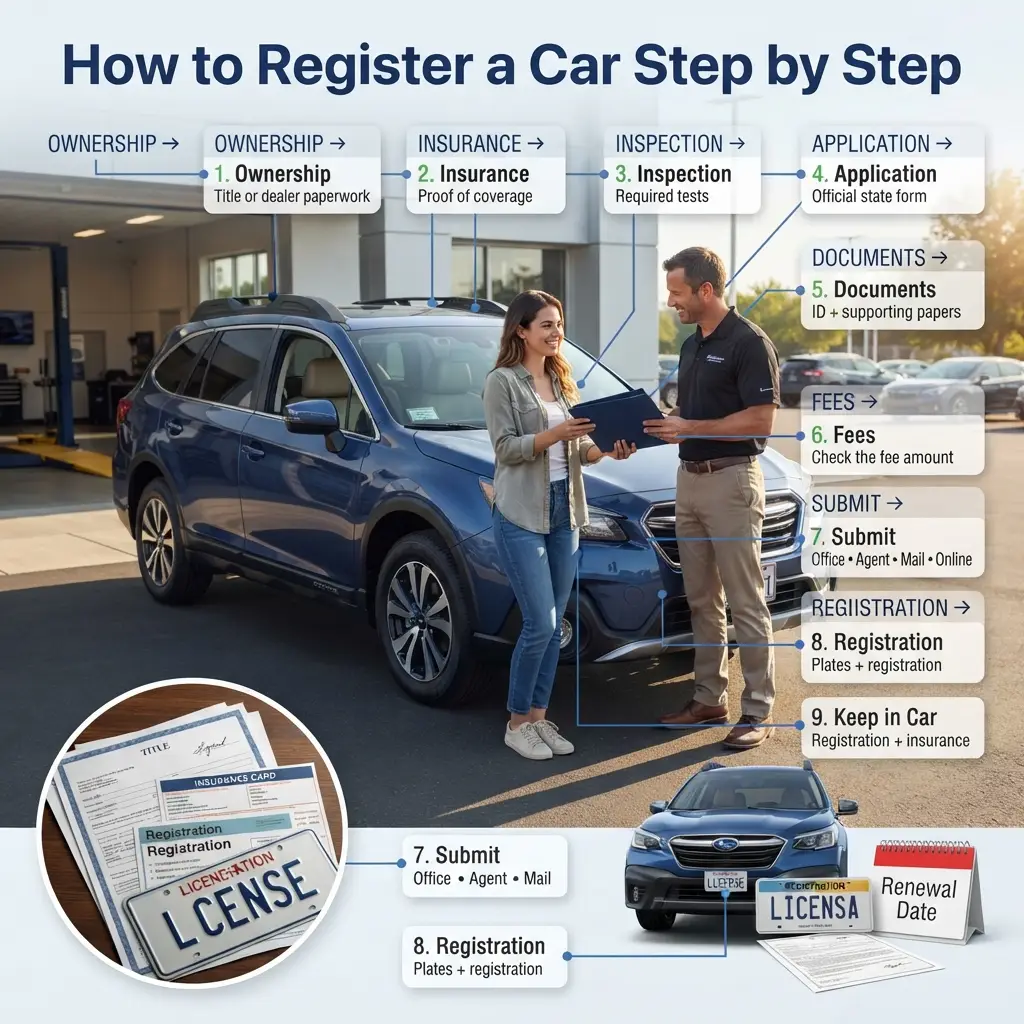
Follow these steps in order, and you will avoid most of the usual problems. Details change by state, so confirm each step on your agency’s website. Keep your documents in one folder as you go.
- Get proof of ownership. For a dealer purchase, the dealer usually provides the paperwork. For a private sale, you need the signed title from the seller. If you are moving, bring your out-of-state title or registration.
- Buy or confirm insurance. Most states require proof of insurance before registration. Some states, such as Florida, require coverage from a company licensed in that state.
- Complete any inspections. This may be a smog test, an emissions test, a safety inspection, or a VIN verification, depending on your state and county.
- Fill out the application. Use your state’s official form, such as Texas Form 130-U or Florida’s HSMV 82040, and have every owner sign where required.
- Gather identification and supporting papers. Bring your driver license or ID, a bill of sale if the state wants one, and odometer disclosure for vehicles where it applies.
- Calculate your fees. Use the agency’s fee calculator or estimator when one exists, so you arrive with the right payment method and amount.
- Submit the application. Do this at a DMV office, county tax office, authorized agent, or by mail or online where your state allows it.
- Receive your plates and registration. You may leave with plates or a temporary permit, and the permanent registration and stickers may arrive by mail.
- Put the registration in the car. Keep proof of registration and insurance in the vehicle, and note the renewal date.
If you follow these steps and keep copies of everything you submit, a visit rarely needs to be repeated. Take photos of every signed page before you hand anything over. A missing signature on the title is the most common reason an application is rejected.
Which Situation Fits You?
The right path depends on how you got the car. Pick the situation below that matches yours. Dealer, private, and out-of-state cases each come with their own deadlines.
Buying From a Dealer
Dealers often handle registration for you, which makes this the simplest case. California says many dealers are authorized to transfer titles and issue temporary registration for use until the permanent registration and stickers arrive in the mail. If the dealer does not offer that service, you must register the vehicle yourself at a DMV office.
Ask the dealer in writing who is responsible for submitting the paperwork and by what date. Keep your copy of the purchase contract and any temporary permit. If the permanent plates do not arrive, contact the dealer first and the agency second.
Buying From a Private Seller
A private sale puts more of the work on you. You need the title signed by the seller, a bill of sale in many cases, an odometer disclosure where required, and any inspection or smog certificate your state asks for. California gives buyers 10 days to transfer ownership after a private purchase and gives sellers 5 days to report the sale.
Check the title carefully before you hand over money. The name on the title must match the seller’s identification, and any lienholder must be released. If the title is lost, the seller usually needs to apply for a replacement before the sale can be completed.
Moving From Another State
New residents have a short window to register, and it can be as brief as 10 days. Florida says new residents must get Florida insurance and title and register within 10 days of establishing residency. Texas and Ohio each state 30 days from the time you move.
Bring your out-of-state title or registration, proof of insurance, and identification. Many states also ask for a VIN check on out-of-state vehicles. If a bank holds your title, ask the lender how to send it to your new state, because that step can take extra time.
Gifted, Inherited, or Family Transfers
When a car is a gift or an inheritance, the title still has to be transferred into your name. States often have special forms and different tax rules for these transfers, and some give reduced fees for family transfers. Check your state’s page for gifted or inherited vehicles before you go, and have any death certificate or court papers the state requests.
Documents You Usually Need to Register a Car
Document lists differ, but most states ask for a similar core set. Bring originals, not photocopies, unless your agency says otherwise. A quick call to the agency can confirm any item you are unsure about.
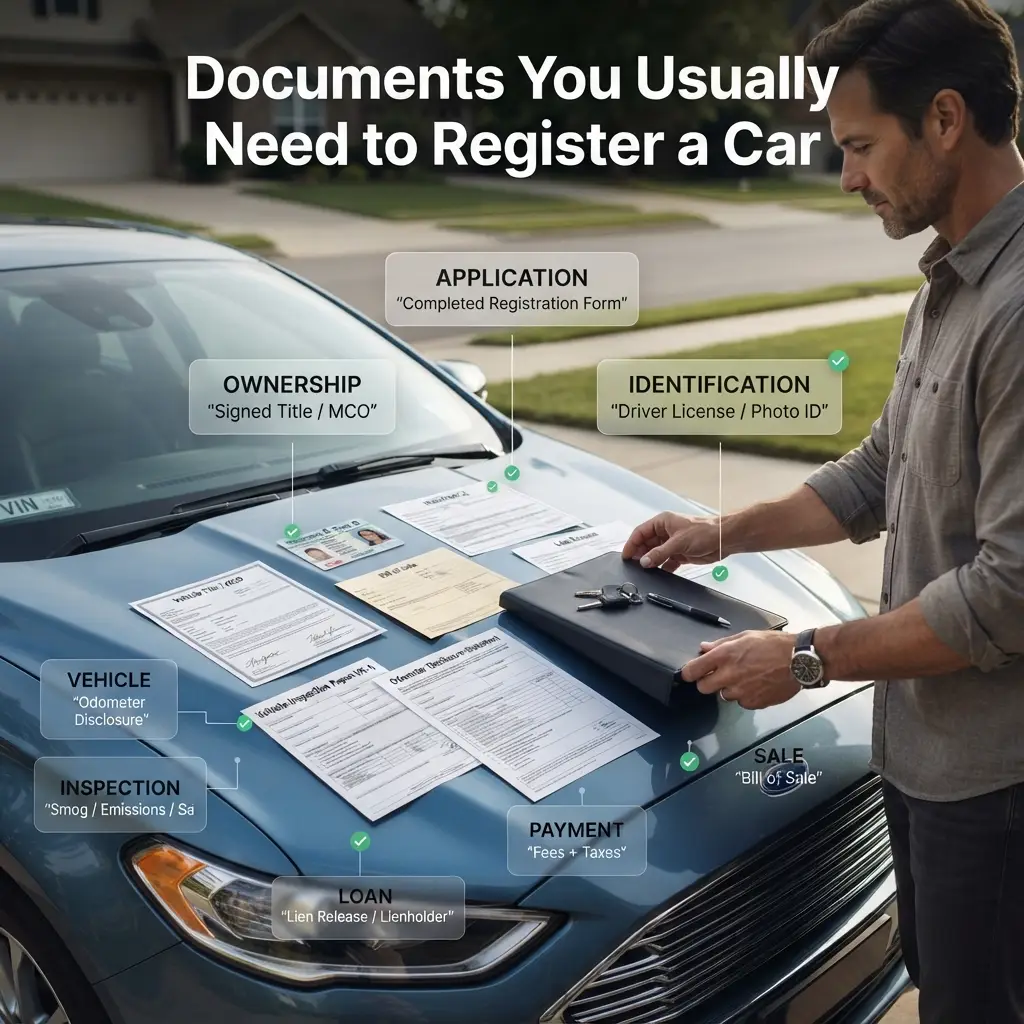
Pennsylvania’s registration page, for example, lists your ID, insurance information, sales tax payment, vehicle title, inspection documentation, and the registration application for first-time registration. For a private sale, it adds a title with all owners on the transfer line, plus an odometer disclosure statement and bill of sale. Use your own state’s checklist as the final word, since a single missing item can send you home.
How Much Does It Cost to Register a Car?
Registration cost depends on your state, the vehicle’s weight, age, or value, and local fees. There is no single national price, which is why a fee estimate before your visit helps. Most totals combine several parts:
The base registration fee
Title fee
Sales tax or use tax on the purchase
License plate or transfer fee
County, city, or service fees
Inspection or emissions fees where required
Late fees if you missed a deadline
Texas offers a clear example. TxDMV lists a $50.75 base registration fee plus a $1 TexasSure program fee, for a $51.75 state total, and notes that counties may add fees. It also lists a sales-tax-related charge of about $90, or the difference between your previous state’s tax and Texas tax, for vehicles brought from another state.
New York explains that first-time registration includes sales tax, plate and transfer fees, a title fee, vehicle use tax, and one or two years of registration fees. Fees vary by vehicle weight, class, and location, so the agency offers an online estimator. California points customers to its fee calculator, and its dealer page notes that transfer fees are due within 10 days of the sale, with a late penalty after 30 days.
Before you go, use your state’s calculator and ask what payment types the office accepts. Some offices do not take every card type or personal checks. Bring a backup payment method.
How Long Do You Have to Register a Car?
You usually have anywhere from 10 to 30 days after a purchase or a move, though the deadline varies by state and situation. Missing it can bring late fees, so check the rule before you drive off the lot or unpack. The table shows published deadlines from official state pages.
| State | Situation | Published timeframe |
|---|---|---|
| California | Private party buyer | 10 days to transfer ownership after purchase |
| California | Dealer sale | Transfer fees due within 10 days; late penalty after 30 days |
| Texas | New resident | 30 days from the time you move |
| Florida | New resident | Within 10 days of establishing residency |
| Ohio | New resident | Within 30 days of establishing residency |
| New York | Insurance ID card | Register within 180 days of the effective date on the card |
Pennsylvania’s registration page did not list a deadline in the material checked for this page, so check its official pages for timing. A short call to PennDOT can settle any doubt. Because deadlines change and can differ by county, confirm the number of days in your own state before you rely on this table.
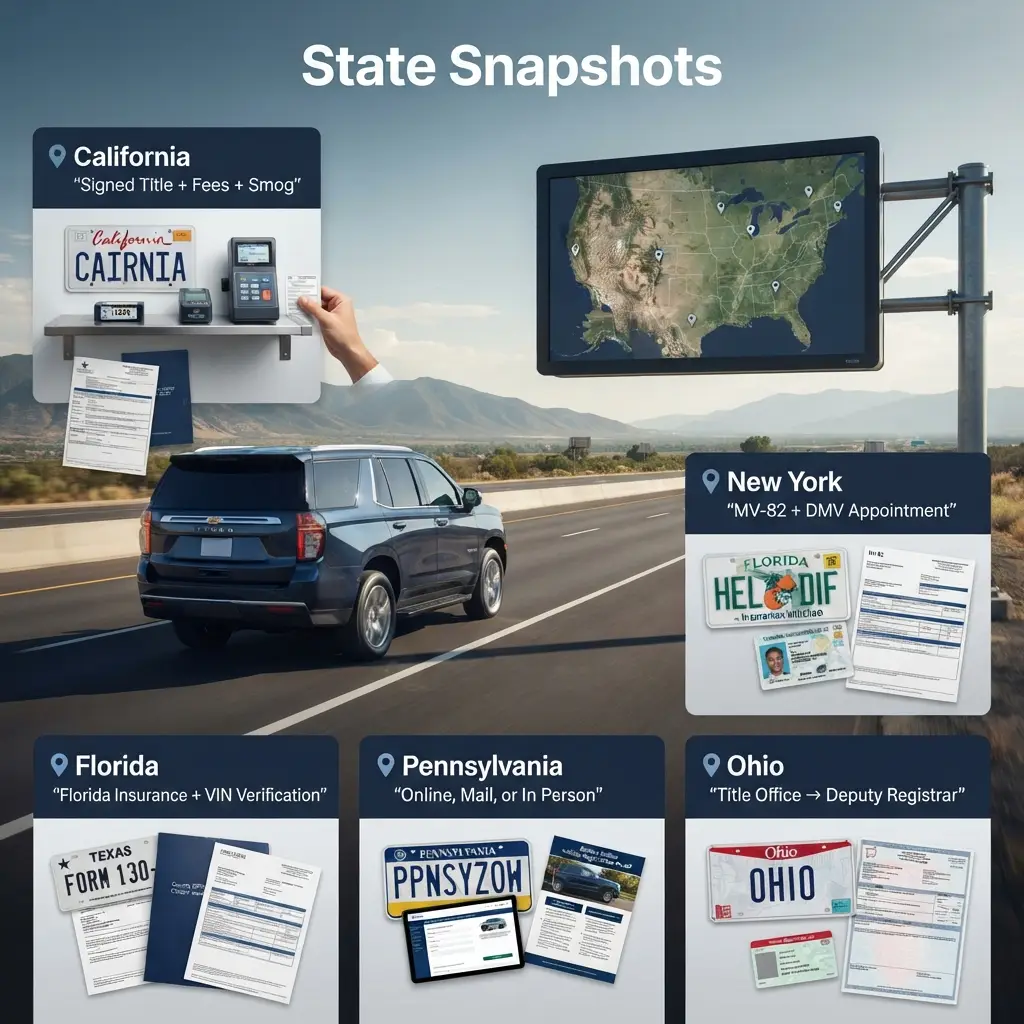
State Snapshots
These short summaries show how different the process can look in six large states. They are based on each agency’s own pages, so use them as examples and confirm current details before you go. Each snapshot starts with the part that trips up most applicants.
California
California lets you transfer a privately purchased vehicle by mail or at a DMV field office. You will need the signed title, applicable fees and use tax, and a smog certification for private party sales. Odometer mileage is required if the vehicle is less than 10 years old, and if the title is lost, you need the replacement application listed on the DMV’s page.
Texas
Texas sends you to your county tax assessor-collector office. New residents need an insurance card, proof of ownership from the previous state, and Form 130-U. Emissions inspections apply in a list of counties that includes Harris, Dallas, Tarrant, Travis, and several others, so check whether your county is on it.
Florida
Florida requires new residents to carry Florida insurance before titling and registering. Without a lien, you generally need proof of identity, proof of Florida insurance, the original out-of-state title, and application form HSMV 82040 signed by all owners. A VIN verification must be completed by a law enforcement officer, a military police officer, a licensed Florida dealer, or a county tax collector employee or Division of Motorist Services Compliance Examiner.
New York
New York uses the MV-82 form to register a vehicle, and registration happens at a DMV office. The agency directs applicants to make an appointment first. You must register within 180 days of the effective date on your insurance ID card, and after registering you get an inspection extension of 10 days from the registration date.
Pennsylvania
Pennsylvania accepts registrations online, by mail, or in person through PennDOT or on-line messenger locations. The state asks for ID, insurance information, a sales tax payment, the title, inspection documentation, and the application. Emissions and safety inspection rules vary by county, and PennDOT offers an emissions calculator to check your vehicle.
Ohio
Ohio asks new residents to transfer their title at a County Clerk of Courts Title Office, then register at a Deputy Registrar license agency. You need the Ohio title or a receipt, plus an Ohio driver license, ID card, or proof of Social Security number. If your county requires E-Check, bring the certificate with you.
Can I Register a Car Online?
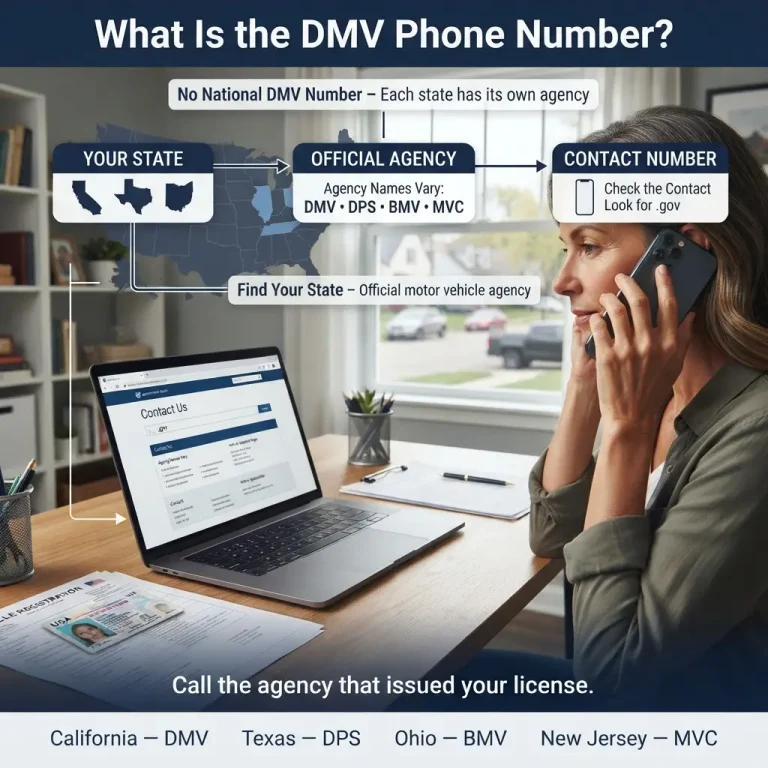
Sometimes, but first-time registration often needs an office visit or mail. Renewals are the most common online task in most states. For a first registration, many agencies require original documents such as the title to be reviewed or mailed in.
Your options vary. Pennsylvania lists online, mail, and in-person routes. California’s private party page mentions mail or a field office, and New York’s page directs applicants to a DMV office with an appointment. Check your agency’s page for the exact method before you plan the trip.
If your state offers online services for your situation, they can save a long wait. Use only the official .gov website, because lookalike sites may charge extra fees. Keep the confirmation page and your temporary registration, if one is provided.
Inspections, Smog Tests, and VIN Checks
Many states require a test or check before they will register your vehicle. Others require inspections only in certain counties. Knowing which applies to you prevents a second visit.
- Smog or emissions: California requires a smog certification for private party sales, and Texas requires emissions inspection in a list of counties. Ohio asks for an E-Check certificate in counties that require it.
- Safety inspection: Pennsylvania’s inspection rules vary by county. New York gives a 10-day inspection extension after registration.
- VIN verification: Florida requires a physical VIN inspection by an approved person for out-of-state vehicles.
Ask your agency where to get the right test and how long the result is valid. If a vehicle fails, keep the report, because repairs and a retest may be needed before the agency will complete the registration. Ask whether the result expires, since some are valid only for a limited time.
How Long Does It Take to Get Plates and Registration?
Timing depends on your state and on whether you leave with plates or a temporary permit. In many cases you can drive legally with temporary documents while permanent registration and stickers are mailed. California describes this for dealer purchases, where authorized dealers issue temporary registration until permanent items arrive in the mail.
Mailing times vary and are not guaranteed, so check your agency’s page for a typical range. Make sure your address on file is correct before you apply, because misdelivered plates are a common delay. If your documents do not arrive within the time your agency states, contact the office and give them your application date and receipt number.
How to Avoid Delays When You Register a Car
A little preparation avoids most second trips. Use these habits:

If you are buying from a dealer, ask which documents they will file and request a copy of each one. That record protects you if the paperwork is delayed. If you are moving, start the process the first week, since some states give only 10 days.
Common Mistakes When Registering a Car
These errors cause the most rejected applications and late fees:
Troubleshooting: Problems When You Register a Car
The seller will not sign the title. Do not complete the purchase until the title is signed in the right spot. A bill of sale alone may not be enough in your state.
The title is lost. The owner usually needs to apply for a replacement title before selling. California lists a replacement application for lost, stolen, or damaged titles on its private party page.
There is a lien on the car. Ask the seller to arrange the lien release or provide the lienholder’s instructions. Do not pay in full until you know how the title will be released.
You missed the deadline. Register as soon as possible and ask the agency what penalties apply. California notes a late penalty after 30 days on dealer-sale transfer fees, and other states set their own penalties.
Your insurance was not accepted. Some states require coverage from a company licensed in that state, as Florida does. Call your insurer or a local agent and ask for a policy that meets the rule.
The VIN does not match. Stop and have the seller or an inspector check the VIN on the vehicle and on the title. Do not proceed if the numbers differ, because the agency will not complete the registration.
You moved states with a loan on the car. Contact your lender and ask how to send the title to your new state. This step can take extra weeks, so start early.
Frequently Asked Questions
Final Word on Registering a Car
Registering a car is mostly a matter of knowing your deadline, gathering the right papers, and paying the correct fees. Start with your state’s official page, confirm the documents and any inspections, and check how many days you have. A signed title, valid insurance, and a completed application solve most problems before they begin.