How to Get a CDL: Requirements, Training, Tests, and Costs
Getting a commercial driver’s license, or CDL, can open the door to a steady driving career, but the process has more steps than a regular license. You need the right age, a medical certificate, a learner’s permit, federally required training, and a skills test in a real commercial vehicle.
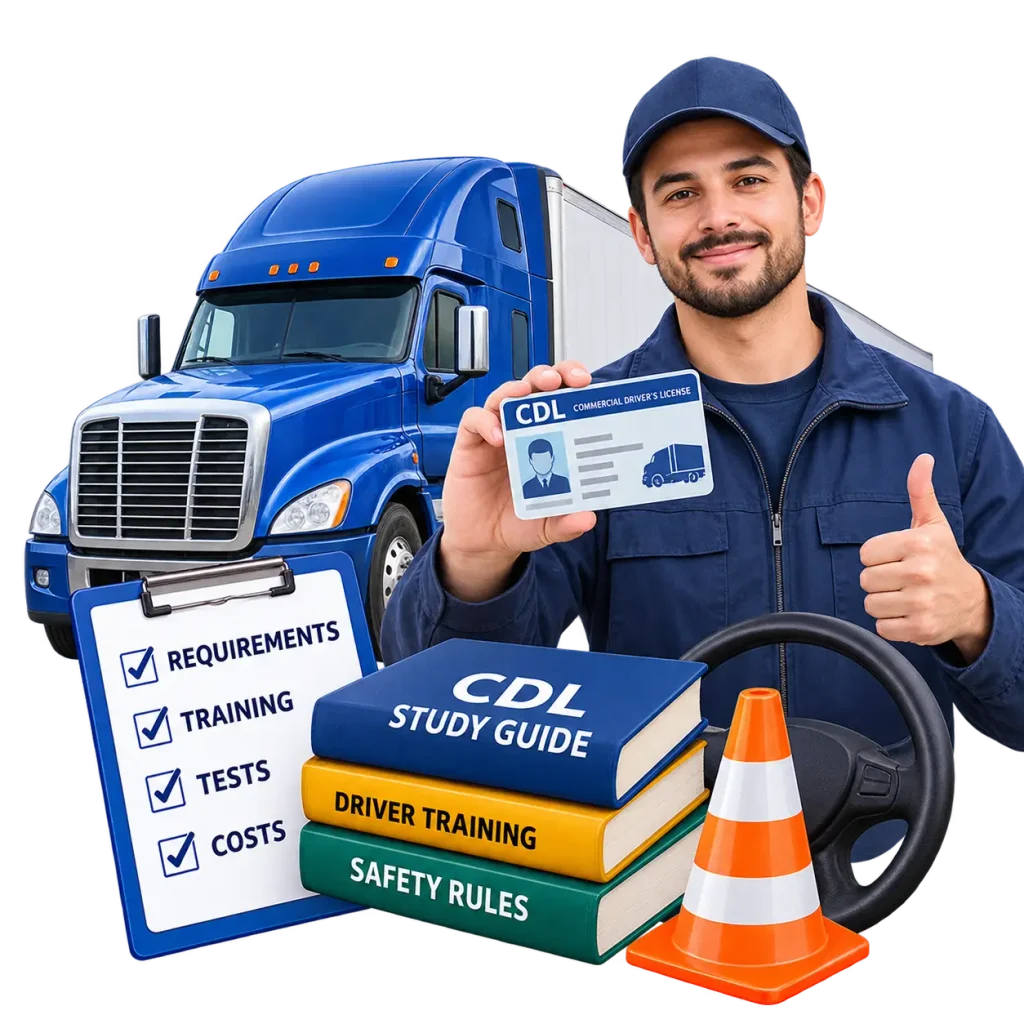
You will also find a troubleshooting section, a checklist, and answers to the questions people ask most. Rules differ by state and change over time, so confirm the details on your state’s official .gov website and in its CDL manual.
What Is a CDL?
A CDL is a commercial driver’s license that allows you to operate large, heavy, or specialized vehicles that a regular license does not cover. It is issued by your state, but it follows federal standards set by the Federal Motor Carrier Safety Administration, or FMCSA. A CDL is usually required for tractor-trailers, large buses, tankers, and vehicles that carry hazardous materials.
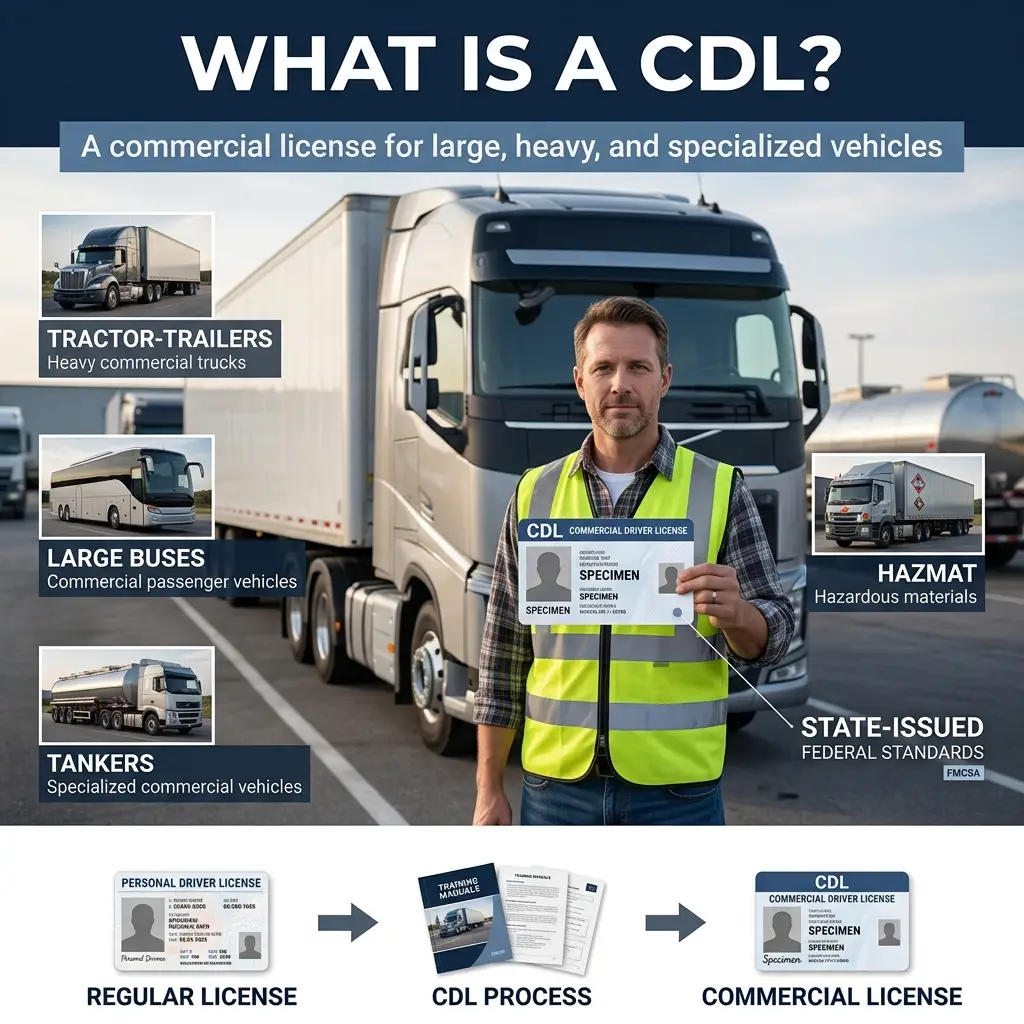
People search for this in many ways, including “how do I get a CDL,” “how to obtain a CDL,” “steps to get a CDL,” and “what does it take to get a CDL license.” They all describe the same process. It starts with a regular driver’s license and ends with a commercial license that matches the type of vehicle you plan to drive.
A CDL is not a replacement for your regular license. You must first hold a valid non-commercial license, and the CDL builds on it. If your regular license has problems, our page on how to check your driver’s license status can help you find out where you stand before you start.
CDL Classes and Endorsements
There are three CDL classes, and the class you need depends on the vehicle you will drive. The class is based on the weight of the vehicle and any trailer it pulls. Choosing the right class at the start saves time and money.
| Class | Typical vehicles | Common use |
|---|---|---|
| Class A | Combination vehicles, such as tractor-trailers | Long-haul and regional trucking |
| Class B | Single heavy vehicles, such as straight trucks and large buses | Delivery, dump trucks, city buses |
| Class C | Smaller vehicles that carry hazardous materials or many passengers | Small buses, specialized vehicles |
An endorsement adds permission to drive certain vehicles or carry certain loads. Common endorsements include hazardous materials, tank vehicles, passenger vehicles, school buses, and double or triple trailers. Each endorsement usually requires an extra knowledge test, and some require a skills test or a background check.
Restrictions can also appear on your license. For example, an air brake restriction may apply if you take your skills test in a vehicle without air brakes. Before you choose a training school or a test vehicle, ask what class and restrictions you will be eligible for.
Who Needs a CDL?
You need a CDL if you drive a vehicle that meets the federal or state definition of a commercial motor vehicle. The exact rules depend on weight, passenger count, and cargo type. Your state’s CDL manual lists the definitions.
You generally need a CDL to drive:
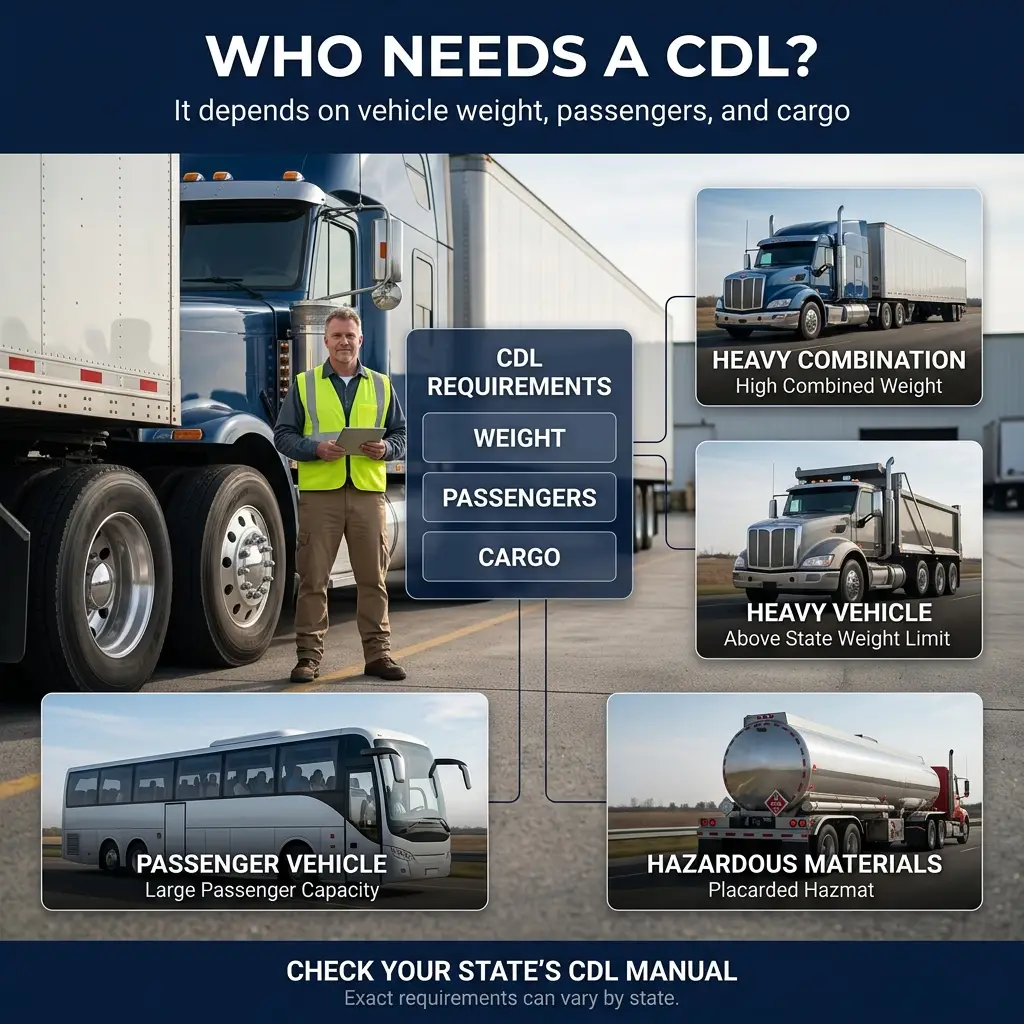
You do not need a CDL for a regular car, pickup truck, or small van. If you are not sure, check your state’s definition or ask the DMV before you buy or rent a vehicle. A short call can save you from driving a vehicle you are not licensed for.
Basic Requirements to Get a CDL
You must meet age, license, medical, and training requirements before you can finish the process. The federal rules set the minimums, and states may add their own.
- Age. You must be at least 18 to drive within your home state, and at least 21 to drive across state lines or to carry hazardous materials.
- A valid regular license. You need a non-commercial driver’s license in good standing.
- A DOT medical certificate. Most drivers need a medical examiner’s certificate from a DOT physical.
- Entry-level driver training. First-time Class A and Class B applicants must complete training from a registered provider.
- Passing tests. You must pass knowledge tests and a skills test.
- Identity and residency documents. The documents are similar to those for a regular license.
- English proficiency. Federal rules expect drivers to read, write, and speak English well enough to talk with the public, read signs, and complete records.
Some states add rules, such as holding a regular license for a set time or taking a state-approved course. Utah, for example, asks applicants to be at least 18 and to have held a regular license for a year. Read your state’s page carefully, since a missing requirement can send you home.
How to Get a CDL: Step by Step
The path usually has seven steps, and the order matters. Skipping a step or doing it out of order is a common cause of delays.
Choose your class and endorsements. Think about the vehicle and the job you want, and read your state’s CDL manual.
Pass a DOT physical. Visit a medical examiner listed on the FMCSA National Registry, and get your certificate.
Apply for a commercial learner’s permit. Submit your application, documents, and medical certificate, and pass the required knowledge tests.
Make notes about your permit’s expiration date. Many states issue the learner’s permit for 180 days, and some do not allow renewal. If your permit expires before you finish, you may need to start the permit process again.
For help scheduling a visit, our page on how to book a DMV appointment explains how to find a slot, and our page on finding a DMV near you helps you compare offices.
The DOT Medical Exam
Most CDL applicants need a medical examiner’s certificate showing they meet federal health standards. The exam must be done by a medical examiner listed on the FMCSA National Registry of Certified Medical Examiners. The certificate is often sent electronically to your state’s licensing agency, but check your state’s process.
The type of driving you plan to do affects the rules. Drivers who cross state lines and are not in an excepted category must meet the federal medical standards. Drivers who stay within one state usually follow their state’s standards. Some excepted categories do not need a federal medical certificate.
Plan ahead for this step. A certificate has an expiration date, and an expired certificate can put your CDL at risk. Keep your medical paperwork organized, and set a reminder to renew it before it runs out.
Your medical examiner will review your health history and perform a physical. If you have a medical condition, ask your own health care provider and the examiner how it may affect eligibility. This page does not give medical advice, and decisions about your health belong with licensed professionals.
Getting Your CLP and Passing the Knowledge Tests
A commercial learner’s permit, or CLP, lets you practice driving a commercial vehicle with a qualified CDL holder beside you. You get it after you submit your application, documents, and medical certificate, and pass the required knowledge tests at your state’s licensing agency. The permit is the first official step toward a CDL.
The knowledge tests are based on your state’s CDL manual. The general knowledge test is required for everyone. Other tests may include air brakes, combination vehicles, and endorsement subjects, depending on your class and goals.
Study the manual closely, since the tests are closed-book. CDL tests are given in English only in many states, and translation materials are not allowed. Our page on the DMV written test explains how knowledge tests work in general, including how to study and what to do if you fail.
A CLP is usually valid for about 180 days. During that time, you can practice with a qualified driver, and you must hold the permit for at least 14 days before the skills test. Keep the permit with you whenever you drive a commercial vehicle for practice.
Entry-Level Driver Training (ELDT)
Since February 7, 2022, first-time Class A and Class B applicants must complete entry-level driver training before the skills test. The training must come from a provider listed on the FMCSA Training Provider Registry. It also applies to people who want certain endorsements for the first time, such as passenger, school bus, or hazardous materials.
ELDT has two parts. The theory part covers topics such as basic operation, safe practices, and regulations. The behind-the-wheel part covers range and public road driving. Some theory training can be done online, but the driving portion must be completed with an approved provider.
Before you enroll, ask the school which license class and endorsements it prepares you for. Maryland’s licensing agency advises applicants to contact the training school before they begin, to find out what type of CDL they will be eligible to receive. That simple question prevents training you cannot use.
After you finish, the provider reports your completion to the registry. Your state checks the record before you can take the skills test. Ask your school how long reporting takes, and confirm that your name and license number are correct.
The CDL Skills Test
The skills test checks that you can inspect, control, and drive a commercial vehicle safely. It has three parts, and you must pass all of them. The test is given in a vehicle of the class you want, so you usually bring or arrange one.
| Part | What the examiner checks |
|---|---|
| Vehicle inspection | You walk around the vehicle and explain safety checks |
| Basic vehicle control | Backing, turning, and parking maneuvers in a set area |
| Road test | Driving on public roads, with turns, shifting, and traffic |
Some states offer the test through the licensing agency, and others allow approved third-party testers. Utah, for example, says skills tests can be taken at the Driver License Division or with a third-party tester. Ask whether your state uses private testers and how they schedule.
For more detail on scheduling and what to expect on test day in general, see our page on scheduling a DMV appointment for a road test. The vehicle rules are strict, so confirm your test vehicle’s requirements before you go. A vehicle that fails the inspection can end your test before it starts.
How Much Does It Cost to Get a CDL?
The total cost varies widely, and the training is usually the largest expense. Fees depend on your state, your class, your training school, and the endorsements you add. Rather than relying on a single number, plan for each part.
| Cost item | What to expect |
|---|---|
| DOT physical | Paid to the medical examiner, varies by location |
| CLP application and tests | State fees, vary by state |
| Entry-level driver training | Largest cost, varies by school and program |
| Skills test fee | State or third-party fee, varies |
| License fee | State fee for the CDL itself |
| Endorsement fees | Extra for each endorsement, in many states |
| Test vehicle rental | May apply if the school does not provide one |
Some schools include test fees and vehicle use in their price, while others charge separately. Ask for a written breakdown before you sign. Beware of schools that promise a guaranteed job or a license without proper training, since federal rules require real training.
Some employers pay for training or offer programs with a work commitment. Read the contract carefully. Check the length of the commitment and what happens if you leave early.
How Long Does It Take to Get a CDL?
It usually takes a few weeks to a few months, depending on your schedule and how quickly you can book tests. The minimum steps include a medical exam, knowledge tests, training, a 14-day permit holding period, and the skills test. Full-time programs can be done in weeks, while part-time schedules take longer.
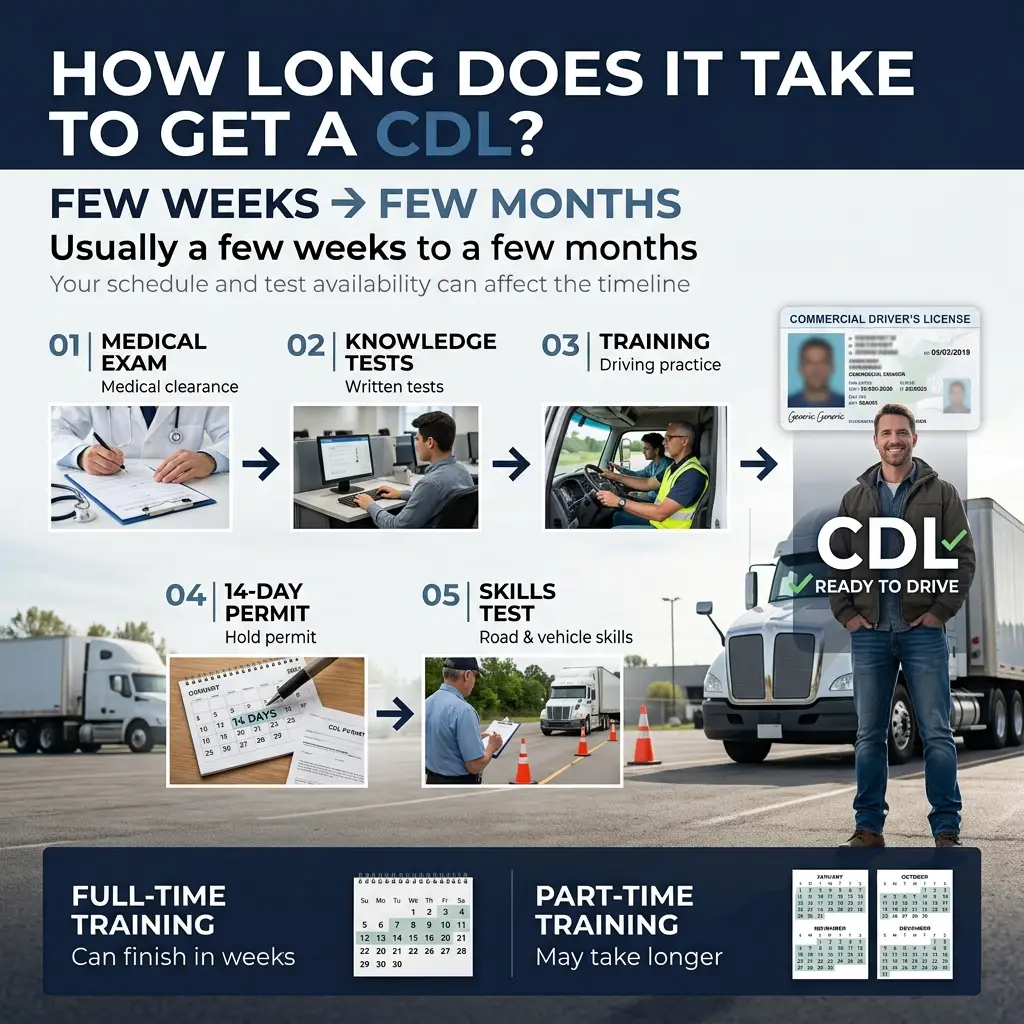
Several things can slow you down. Appointment waits at the DMV, school start dates, and test scheduling all play a part. If you fail a test, you may need to wait before you retake it, depending on your state.
Plan your timeline around your permit’s expiration. If it lasts 180 days and does not renew, you need to finish before it ends. Build in extra time for a retest.
Non-Domiciled and Non-Citizen Applicants
Rules for applicants who live in the United States but are not domiciled in a state have tightened, and issuance has been paused in some places. A non-domiciled CDL is a license for people who are domiciled in a foreign country and work in the United States with qualifying status. Federal rules for these licenses changed, and some states have paused issuing them.
Maryland’s licensing agency, for example, announced a pause on non-domiciled commercial learner’s permits and licenses effective September 29, 2025, and Utah announced a pause on non-domiciled CDLs in January 2026. Rules may have changed again since then. Check your state’s official page for the latest information before you apply or pay for training.
If you are a lawful permanent resident or a citizen, the standard process applies, and you will show proof of identity and lawful status. If you have another status, ask your state which documents it accepts and whether it is currently issuing licenses for your situation. Do not pay for a school until you confirm you are eligible.
Disqualifications and the Drug and Alcohol Clearinghouse
Certain violations can disqualify you from holding a CDL, and employers check your record. Serious traffic offenses, driving under the influence, leaving the scene of an accident, and use of a vehicle in a felony can lead to disqualification, with longer periods for repeat offenses. A conviction in your regular vehicle can also affect your CDL.
Federal rules also require drug and alcohol testing for many commercial drivers, and employers report violations to a national database called the FMCSA Drug and Alcohol Clearinghouse. A violation can prevent you from driving commercially until you complete a return-to-duty process. Prospective employers must check this database.
Check your own record before you invest in training. Our page on how to check your driver’s license status explains how to see whether your license is valid, and if you have been required to carry special insurance, our page on SR-22 insurance explains how that works. A clean record makes the process smoother.
Paying for Training and Choosing a School
Choose a school that is listed on the FMCSA Training Provider Registry, and ask the right questions before you pay. Not all schools are equal. A good school explains costs clearly, prepares you for the tests, and has a track record.
Questions to ask:
Is the school listed on the FMCSA Training Provider Registry?
What class and endorsements does the program prepare me for?
What is the total cost, including test fees and vehicle use?
How much behind-the-wheel time do I get?
Do students use a school vehicle for the skills test?
What is the pass rate and the typical timeline?
Are there job placement services, and are claims in writing?
What is the refund policy?

Community colleges, private truck driving schools, and employer programs are common options. Compare at least three, and visit in person if you can. Avoid any program that pressures you to pay quickly or promises a license without the required training.
Keeping Your CDL
A CDL needs attention after you earn it. You must keep your medical certificate current, renew your license on time, and follow federal and state rules. A lapse in any of these can suspend your commercial privileges.
Track these dates:
Medical certificate expiration
CDL expiration and renewal date
Endorsement renewals, such as hazardous materials checks
Drug and alcohol testing requirements, if you work for a carrier
Your state’s self-certification filing, if required
Our page on driver’s license renewal explains the general renewal process, and CDL renewals have extra steps. If you also need a REAL ID, see our page on REAL ID requirements. Update your address promptly, since notices can affect your status, and our page on how to change the address on your driver’s license explains how.
Common Mistakes When Getting a CDL
Most delays come from preventable errors.
Choosing the wrong class. If you train for the wrong class, you may need extra training or tests.
Skipping ELDT or using an unregistered school. The skills test requires training from a registered provider.
Letting the medical certificate lapse. An expired certificate can block your permit or license.
Waiting too long after getting the permit. Many permits expire after about 180 days.
Not studying the manual. The knowledge tests are closed-book and based on your state’s CDL manual.
Bringing an unsafe or non-compliant test vehicle. The test can end before it starts.
Paying a school before checking eligibility. Rules for certain applicants have changed, so confirm first.
Believing job guarantees. No school can guarantee a job, and promises in writing should be read carefully.
Using unofficial sites for booking. Private sites may charge extra or collect your information. Start from your state’s .gov page.
Troubleshooting CDL Problems
Most problems have a clear fix.
You failed a knowledge test. Review the manual and take practice tests. Check your state’s waiting period and retest fee, then try again.
You failed the skills test. Ask the examiner what went wrong, practice that part, and check the waiting period. Some states limit how many attempts you can make within a set time.
Your permit is about to expire. Ask your state whether you can renew or must start over. Schedule your test early if you can.
Your training was not recorded. Ask your school to confirm it submitted your completion to the registry. Provide your name and license number, and ask for a confirmation.
Your medical certificate was not received. Ask your examiner to resend it, or submit it by the method your state allows. Keep a copy.
You cannot find a test slot. Check other locations, ask about third-party testers, and look for cancellations. Book as soon as you meet the requirements.
Your test vehicle was rejected. Ask exactly what failed, fix it, and reschedule. Use a vehicle that meets your state’s requirements.
Your state says it is not issuing your type of CDL. Ask whether the pause is temporary, and check federal and state updates. Do not pay for training until your eligibility is confirmed.
You have a violation that affects your record. Check your driving record and ask your state about disqualification periods. Consider speaking with a licensed attorney if the situation is complicated.
CDL Checklist and Tips
Use this list as you work through the process.
- ☐ Read my state’s CDL manual
- ☐ Chose my class and endorsements
- ☐ Confirmed I meet age and license requirements
- ☐ Passed a DOT physical with a listed medical examiner
- ☐ Applied for my CLP and passed the knowledge tests
- ☐ Chose a school on the FMCSA Training Provider Registry
- ☐ Completed ELDT and confirmed it was recorded
- ☐ Held my CLP for at least 14 days
- ☐ Scheduled my skills test and arranged a compliant vehicle
- ☐ Kept my permit and medical certificate dates on my calendar
A few tips help in practice. Study a little each day instead of cramming. Practice the vehicle inspection out loud until you can do it from memory. Keep every receipt and certificate in one folder.
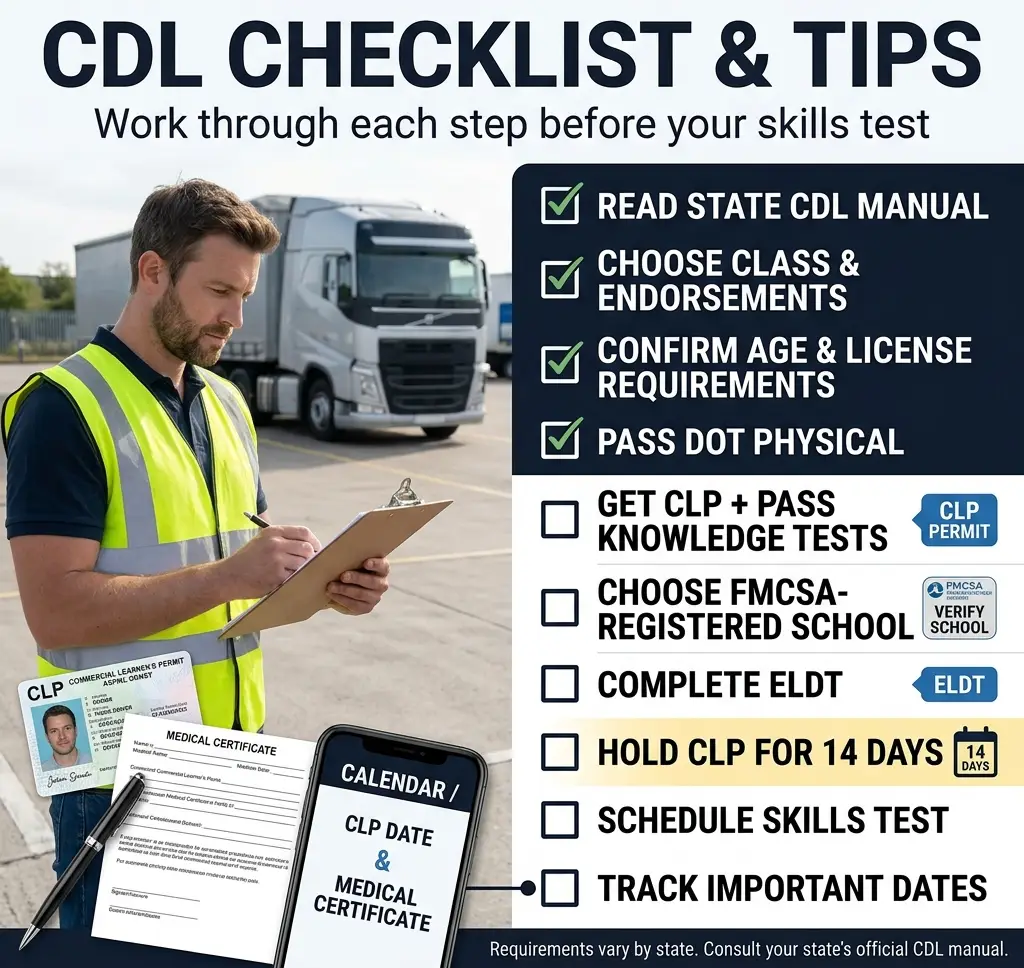
Ask your school and your DMV for the latest information, since rules change. If you are changing careers, talk to drivers in your area about the type of work, pay, and schedule before you commit.
CDL Terms Explained
| Term | Meaning |
|---|---|
| CDL | Commercial driver’s license |
| CLP | Commercial learner’s permit |
| ELDT | Entry-level driver training required for first-time applicants |
| FMCSA | Federal Motor Carrier Safety Administration |
| Training Provider Registry | The federal list of approved training providers |
| Medical examiner’s certificate | Proof that you passed a DOT physical |
| Endorsement | An added permission, such as hazardous materials or passenger |
| Restriction | A limit on your license, such as no air brake vehicles |
| Interstate | Driving across state lines |
| Intrastate | Driving within one state |
| Non-domiciled CDL | A CDL for people domiciled in a foreign country with qualifying status |
| Drug and Alcohol Clearinghouse | A federal database of drug and alcohol violations |
Frequently Asked Questions
Conclusion
Getting a CDL is a clear process once you see the order: choose your class, pass a DOT physical, get your learner’s permit, finish entry-level driver training, hold the permit for at least 14 days, and pass the skills test. Check your state’s CDL manual and official site at each stage, since rules and fees differ and sometimes change.
Most delays come from the wrong class, an unregistered training school, an expired medical certificate, or an unsafe test vehicle. Use the checklist on this page, confirm your eligibility before you pay for training, and keep your dates on a calendar. With careful planning, you can move from permit to license smoothly.