DMV Fee Calculator: Estimate Registration, Title & License Fees
A DMV fee calculator is an online tool on your state’s official motor vehicle website that estimates what you will pay to register a car, renew a registration, transfer a title, or renew a license. You enter details such as your license plate.

Most people search for a calculator because the total at the DMV was higher than they expected. This page explains how these tools work, what goes into the final number, and where to find the official calculator in six large states. It also shows how to estimate your fees by hand when no calculator exists, how to avoid surprise charges, and what to do if your estimate does not match the bill.
What Is a DMV Fee Calculator?
A DMV fee calculator is an official online estimator that totals the charges you will owe for a vehicle or license transaction. It uses the same fee tables the agency applies at the counter. Because it relies on what you type in, the estimate is only as accurate as your inputs.
California’s DMV, for example, offers calculators for new vehicle registration, renewal registration, change of ownership, and a separate tool that shows the vehicle license fee for tax purposes. New York’s registration fee estimator covers passenger and commercial vehicles. Other states publish fee charts or fee schedules instead of an interactive tool.
Third-party sites also use the name “DMV fee calculator.” Some are helpful, but others may show old numbers or push you toward paid services. Check the date on any estimate you find. Use the .gov calculator whenever your state has one, and treat any other estimate as a rough idea only.
What Goes Into Your DMV Fees?
Your total is usually a stack of several separate charges, not one fee. Knowing the parts helps you read a calculator result and spot what drives the price. The main building blocks are listed below.
Registration fee: The base charge for the right to operate the vehicle on public roads
Title fee: A charge to issue or transfer the certificate of title
License plate fee: A charge for new or replacement plates
Sales or use tax: A tax on the purchase price, or on vehicles brought in from another state
Weight or value-based fees: Charges tied to vehicle weight, vehicle value, or fuel type
County, city, or local fees: Add-ons set by local governments
Processing or service fees: Charges from deputy registrars, tax collectors, or agents
Late fees: Penalties for missing a deadline
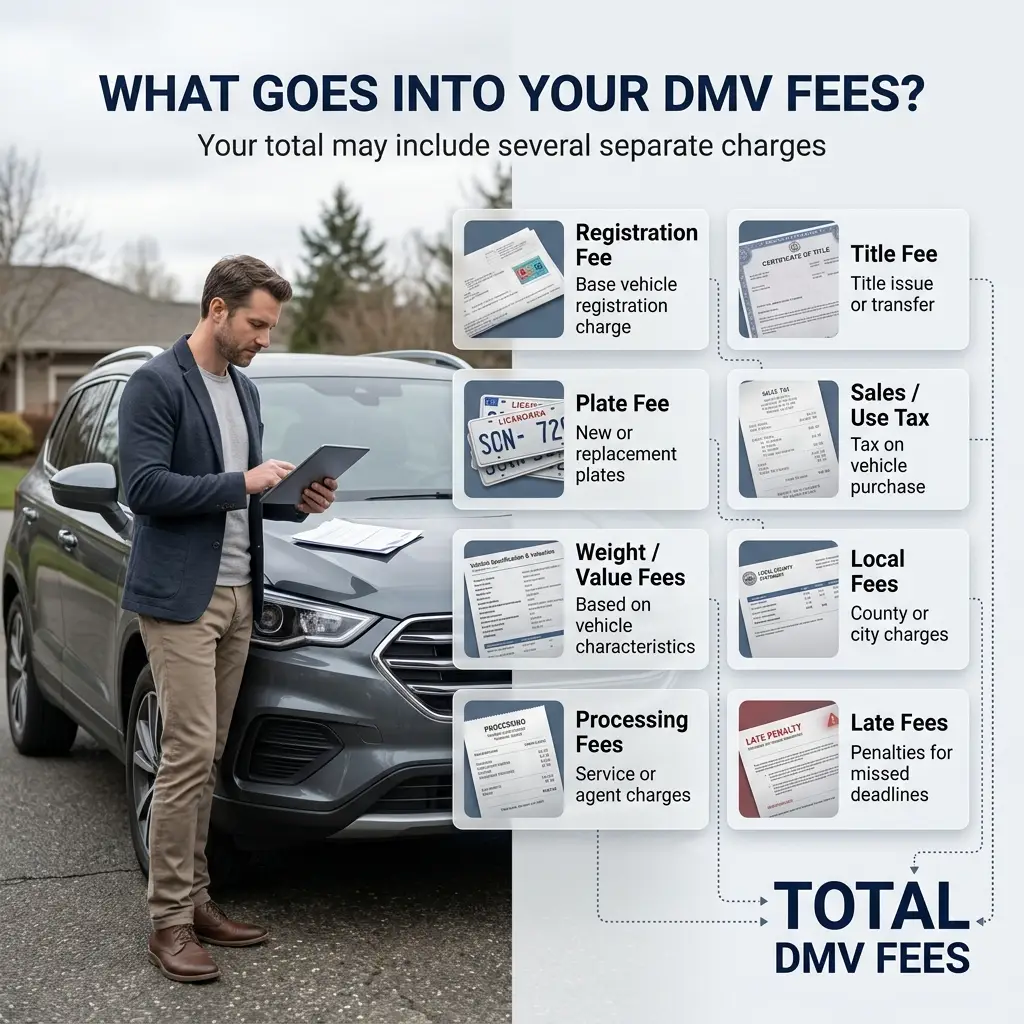
Which of these apply depends on your situation. A renewal usually has no title fee or sales tax, while a purchase from a dealer includes most of them. A move from another state can add use tax or an initial registration charge.
How to Use a DMV Fee Calculator Step by Step
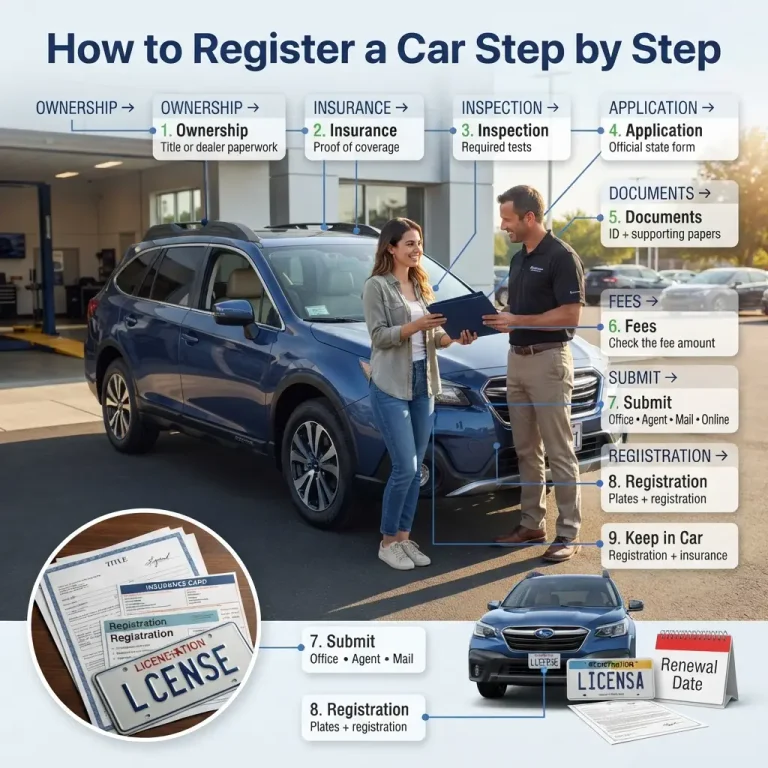
Most calculators work in a similar way, and a few minutes of preparation gives a better estimate. Gather your paperwork before you open the page. Follow these steps. Use this before you renew vehicle registration online.
- Find your state’s official calculator. Search for your state’s motor vehicle agency and look for “fees” or “estimate” on a .gov site.
- Pick the right transaction. Choose new registration, renewal, transfer, or license fees, since each uses different rules.
- Gather your vehicle details. Have your plate number, the last digits of your VIN, vehicle weight, and model year ready.
- Enter the purchase price or value. Use the exact price on your bill of sale or title, since some states base fees on it.
- Add your location. Enter your county or ZIP code so local fees are included.
- Select your registration period. Choose one year or two years where the state offers both.
- Review the breakdown. Read each line, not just the total, so you can see what is included.
- Save or print the result. Bring it with you and compare it with the bill at the counter.
Check what the tool leaves out. New York says its online estimates do not include sales tax, and California says its tool can only determine fees for basic transactions. Those exclusions are where surprises tend to come from.
DMV Fee Calculators by State
The list below shows what six large states publish. Each state names its tool or fee chart differently, so use the official page for your own state. The inputs listed are the ones the agencies describe.
| State | Calculator or fee source | What you typically enter |
|---|---|---|
| California | Vehicle Registration and Licensing Fee Calculators on the DMV site | Plate number, last five VIN characters, purchase price, county and ZIP for renewals |
| New York | Registration fee estimator on the DMV site | Weight, vehicle type, county, fuel type, cylinders, registration period, plate type |
| Texas | Annual registration fee chart from TxDMV | Vehicle weight class and county for local fees |
| Florida | Fees page and fee schedule from FLHSMV | Vehicle weight and transaction type |
| Pennsylvania | Payments and Fees page and Bureau of Motor Vehicles fee schedule (MV-70S) | Vehicle class and transaction type |
| Ohio | Documents and Fees page from the BMV | Registration type and county for taxes |
California’s tool carries a clear warning. If the purchase price you enter differs from what ends up on the title, the registration fees may change when the vehicle is registered. That makes the number on your bill of sale the most important input.
Some states do not offer a full interactive calculator, so you add up the published fees yourself. The next sections show what those fees look like in several states, so you can do the math. Each one also names the extras that tend to get missed.
California: What Makes Up the Total
California registration fees typically combine several parts. The DMV lists a registration fee of $76 for original and renewal registration, which includes a $3 Alternative Fuel and Technology Fee. It also lists a California Highway Patrol fee of $34 for standard vehicles, a county or district fee that varies by county, and a Transportation Improvement Fee that ranges from $33 to $231 depending on vehicle value.
The Vehicle License Fee is 0.65% of the vehicle’s purchase price or value. On a $20,000 vehicle, that comes to $130 for the first year, which is simple arithmetic from the published rate. It’s also useful when you register a car for the first time. The VLF decreases over the first 11 renewal years or until the vehicle is transferred, whichever comes first.
Late payment adds penalties that grow with time. The DMV says penalties can reach 160% of the vehicle license fee due for that year when payment is more than two years late. Renew on time to avoid this part of the bill entirely.
Texas: Base Fee Plus Local Charges
Texas publishes an annual registration fee chart, and the 2026 chart is effective January 1, 2026 through December 31, 2026. The base fee for a passenger vehicle or light truck weighing up to 6,000 pounds is $50.75. Local county fees vary from $0 to $21.50, and the total on the renewal notice includes the local fees that apply to you.
For new residents, TxDMV lists a $1 TexasSure program fee, which brings the state total to $51.75, and counties may add more. It also lists a sales-tax-related charge of about $90, or the difference between your previous state’s tax and Texas tax, for vehicles brought from another state. Electric vehicles have an added annual fee, listed at $200 at renewal.
The Texas chart does not show every possible fee, so use it for the base number and add anything that applies to your case. Your county tax assessor-collector’s office can confirm the local portion. Ask for the total in writing if you are paying in person.
Florida: Weight, Plates, and Title Fees
Florida bases its registration fee on vehicle weight. The FLHSMV fee page lists $14.50 for automobiles up to 2,499 pounds, $22.50 for 2,500 to 3,499 pounds, and $32.50 for 3,500 pounds or more. Other fees apply on top of those amounts.
The same page lists an initial registration fee of $225, a license plate fee of $28 for original or replacement plates, and title fees of $85.25 for an original used vehicle and $77.25 for an original new vehicle. A $2.50 service and handling fee applies if you request a paper title instead of an electronic one. The page also says other statutory fees apply, so the list is not a full total.
Florida’s county tax collector offices handle many of these transactions and may charge their own service fees. Ask the office for a written total before you pay. Compare it with the official fee page if any line looks unfamiliar.
New York: Registration, Plates, Title, and Use Tax
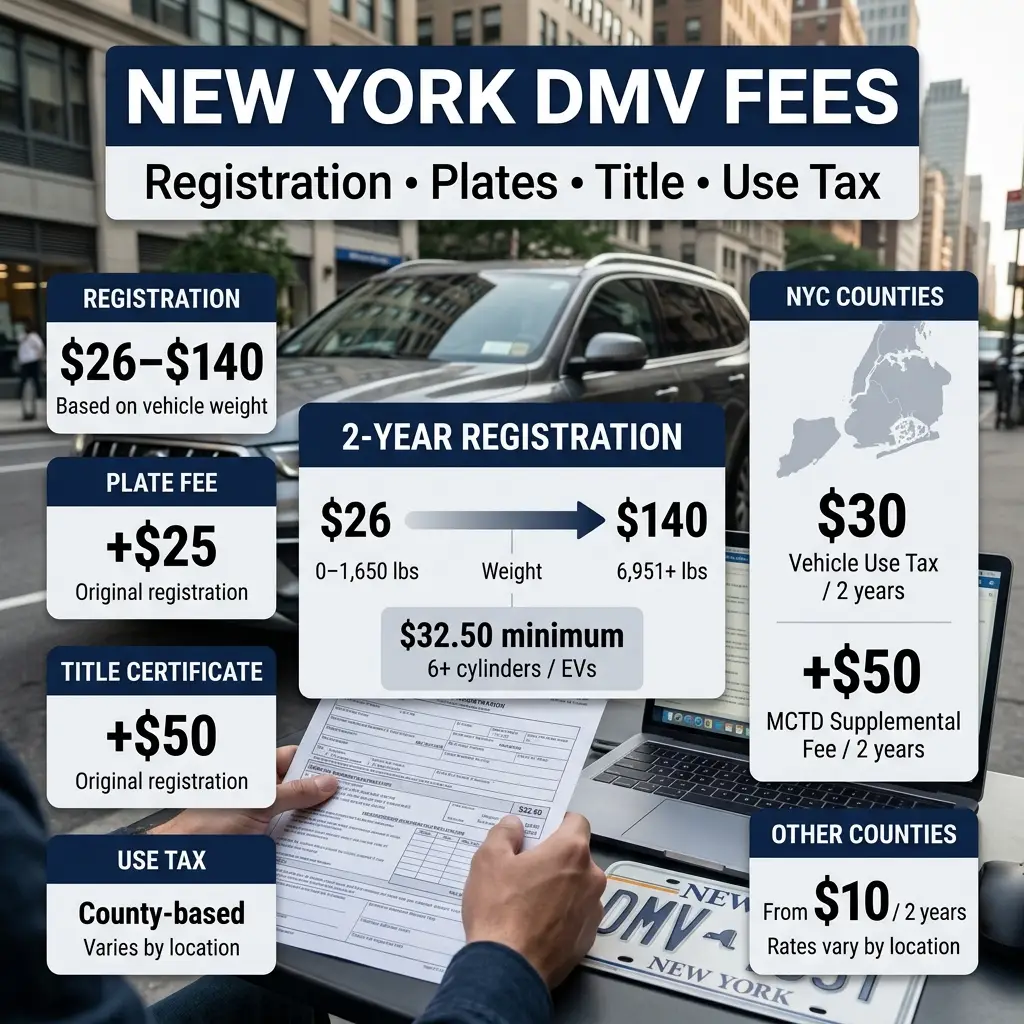
New York uses a registration fee table based on vehicle weight. For a two-year registration, the published fees range from $26 for vehicles of 0 to 1,650 pounds up to $140 for vehicles over 6,951 pounds. There is a minimum two-year fee of $32.50 for vehicles with six or more cylinders and for electric vehicles. Check this before your driver’s license renewal as well.
An original registration adds a $25 plate fee and a $50 title certificate fee. County use tax is also added. In New York City counties, the vehicle use tax is $30 for two years, plus a $50 supplemental MCTD fee for two years. Other counties have lower or higher rates, such as $10 for two years for lighter vehicles in many counties.
The state’s online estimator handles these inputs for you, including county and fuel type. Remember that it does not include sales tax, which you may have already paid at purchase. Bring proof of that payment to the office.
Pennsylvania: Fixed Fees You Can Add Up
Pennsylvania’s Payments and Fees page lists a passenger vehicle registration fee of $48 and an original title fee of $72. A standard registration plate is included with the initial registration fee, while a personalized registration plate is listed at $103. The Bureau of Motor Vehicles schedule of fees, form MV-70S, lists fees for other vehicle classes.
Because the fees are fixed, you can add them up quickly. A passenger vehicle with an original title adds to $120 from the two listed figures, before sales tax and any other charges that apply. Treat that as a floor rather than a total.
The page also covers how you can pay. Driver License Centers accept payment cards, checks, or money orders, and online payment accepts Visa, MasterCard, American Express, and Discover. Returned checks carry a $62 minimum penalty plus a $51 transaction fee, so double-check your check before you mail it.
Ohio: Registration, Title, and Permissive Tax
Ohio lists a passenger vehicle registration fee of $36 and a statewide title fee of $18, which is $23 in some counties. Plates cost $15 for one replacement plate or $16.25 for two. A deputy registrar processing fee of $8 applies for a one-year standard registration.
Ohio also assesses a permissive tax in $5 increments, up to a maximum of $30 per vehicle. The state notes that the tax may be prorated by 50 percent if you register for seven months or less. Adding the listed registration fee, title fee, deputy fee, and the maximum permissive tax gives $92, which shows how local charges can lift the total well above the base fee. Your own county’s tax level decides the real number.
How to Estimate DMV Fees by Hand
If your state has no calculator, you can still build a reliable estimate with a simple method. Use the official fee page and work through each line. Keep a running total as you go.
DMV Fees by Hand
- List every fee that applies to your transaction, such as registration, title, and plates.
- Add sales or use tax if you bought the vehicle or moved it from another state.
- Add county or local fees for your address.
- Add processing or service fees if you use a deputy registrar or tax collector office.
- Add late fees only if you have missed a deadline.
- Round up slightly to cover small differences.
Write down where you found each number, since fees change at set times each year. Texas, for instance, issues a new chart each year with an effective period. If you call the agency, ask whether your total includes every add-on.
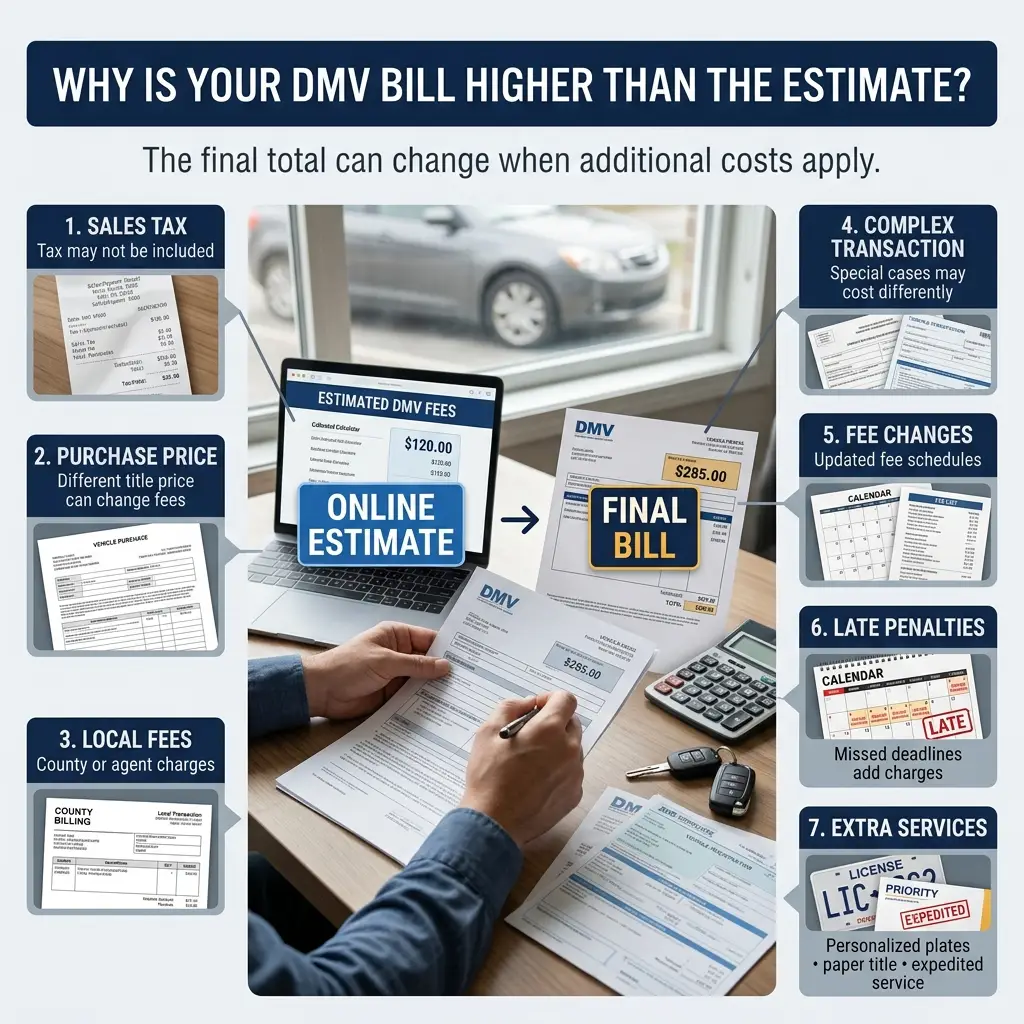
Why Your DMV Bill May Be Higher Than the Estimate
The estimate and the bill can differ for a few predictable reasons. Most come from information that was left out or entered incorrectly. The list below covers the usual causes.
If the numbers still do not match, ask the clerk for an itemized receipt. Compare it with the official fee page line by line. Errors are rare, but asking costs nothing.
Can You Calculate License Fees Too?
Yes, though the tools are less common than registration calculators. Some states list driver license fees on a fee page, while a few offer an estimator. California includes licensing fees in its fee listings, and New York offers an Enhanced license or ID renewal fee calculator.
License fees depend on the card type, your age, and the length of the renewal period. Add any extra charges for a REAL ID upgrade or a longer term. Check the official fee page for your card type before you visit.
Ways to Lower Your DMV Costs
You cannot change the official fees, but you can avoid unnecessary charges. A few habits make a real difference over time. None of them require special paperwork. If you’re applying for personalized license plates, this covers those fees too.
Some states publish exemptions or reduced fees, such as California’s exemptions for certain disabled veterans and non-resident military personnel. Search your agency’s site for “exemptions” or “reduced fees.” Do not rely on third-party sites for eligibility rules. Keep any proof the agency asks for.
Common Mistakes When Estimating DMV Fees
These mistakes lead to the most surprise bills:
Using an unofficial calculator. Old numbers and hidden fees are common.
Guessing the purchase price. Use the figure on your bill of sale.
Forgetting taxes. Sales or use tax can be the largest part of the total.
Skipping local fees. County and agent fees vary by location.
Ignoring weight or vehicle class. The registration fee often depends on them.
Not checking the effective date. Fee charts change each year.
Bringing the wrong payment method. Some offices do not accept cash or certain cards.
Waiting until after the deadline. Late fees add up quickly.
Troubleshooting: DMV Fee Calculator Problems
The calculator will not accept your plate number. Check that you entered the plate exactly as shown, without spaces or symbols. California’s tool accepts up to eight alphanumeric characters.
The estimate looks too low. Look for what the tool excludes, such as sales tax. Add local fees and any deputy or agent fees.
The estimate looks too high. Check the vehicle details and the registration period you selected. A two-year choice costs more upfront than a one-year choice.
There is no calculator for your state. Use the official fee chart or schedule and add the lines yourself. Call the agency to confirm the total.
The tool says it cannot calculate your case. Complex cases such as fleet registration or planned non-operation need staff help. Contact the agency or visit an office.
The fees changed since you checked. Fee schedules update, often at the start of a year. Check the official page again right before you pay.
Frequently Asked Questions
Final Word on DMV Fee Calculators
A DMV fee calculator gives you a useful estimate when you use your state’s official tool and enter accurate details. Know what it leaves out, such as sales tax or local fees, and keep your bill of sale handy. Where no calculator exists, adding up the published fees line by line works well.
Bring a payment method your office accepts and a printed copy of your estimate. Renew on time to avoid late fees, and ask for an itemized receipt if the total looks off. A few minutes of checking before your visit can prevent an unpleasant surprise at the counter.