Handicap Parking Permit: Who Qualifies, How to Apply
A handicap parking permit makes everyday errands possible for people whose disability or health condition makes walking long distances hard. Getting one is usually simple, but the paperwork confuses many applicants.
You will also find a troubleshooting section, a checklist, and answers to the questions people ask most. A note before you start: this page gives general information, not medical or legal advice, and your state’s rules and your health care provider’s guidance always come first.
What Is a Handicap Parking Permit?
A handicap parking permit is a state-issued placard or license plate that lets a person with a qualifying disability use designated accessible parking spaces. The permit shows that the holder has a mobility-related impairment and may park in spaces marked with the international symbol of access. It is issued by your state’s motor vehicle agency, often after a medical professional certifies your condition.
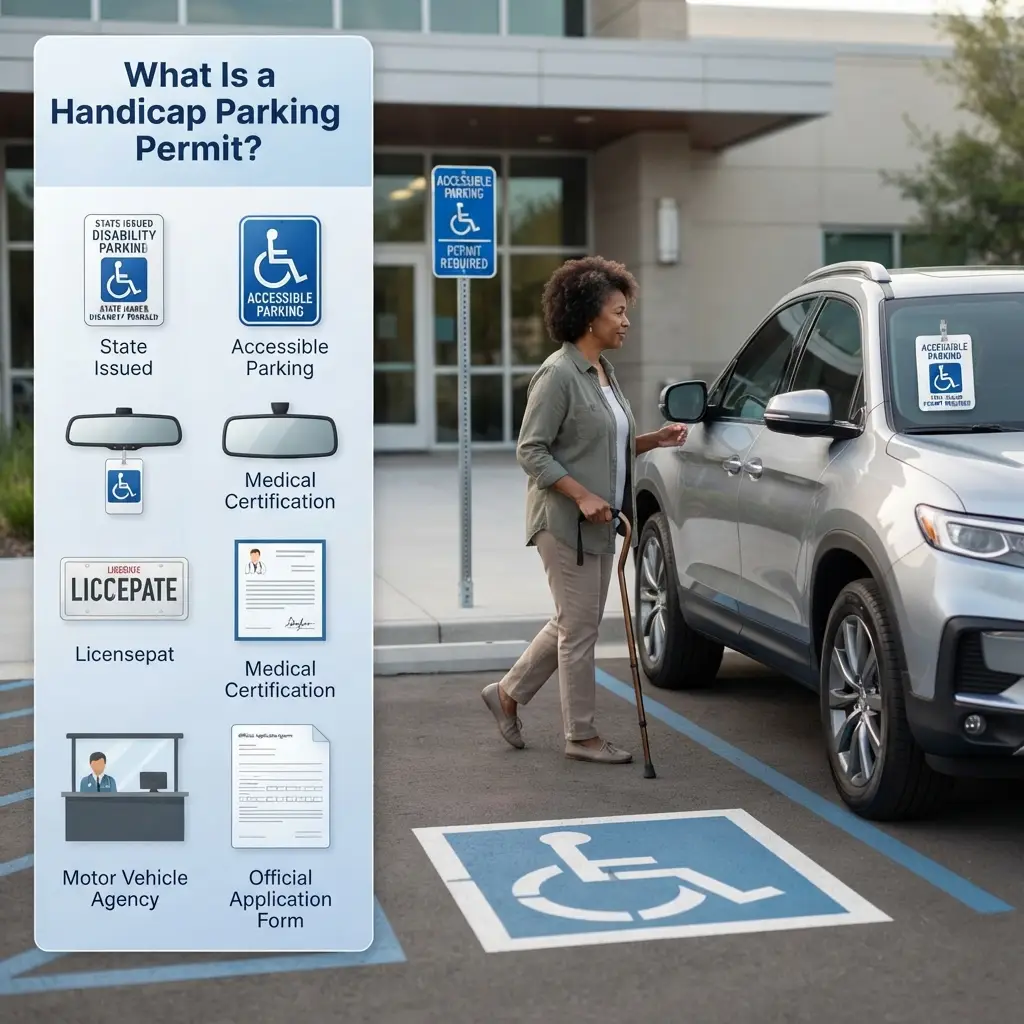
You will see many names for the same thing. People search for “handicap parking pass,” “handicapped parking permit,” “disabled parking permit,” and “disability parking placard.” Many states now prefer terms like “disability parking placard” or “disabled person placard,” but the application process is similar.
The permit belongs to the person, not the car. In many states the holder does not have to own or drive the vehicle, but the person with the disability must be traveling in it when the permit is used. That rule is one of the most important to remember, and it is covered in more detail below.
Types of Disability Parking Permits
Most states offer several types, and the right one depends on how long your condition is expected to last. The names differ, but the main options are common across the country.
| Type | Typical length | Best for |
|---|---|---|
| Temporary placard | Up to about six months | Short-term conditions, such as recovery from surgery or an injury |
| Permanent placard | Several years, with renewal | Long-term or permanent conditions |
| Disability license plates | Tied to your vehicle registration | People who want a plate instead of a hang tag |
| Disabled veteran plates | Tied to registration | Eligible veterans, where offered |
| Travel placard | Varies by state | Frequent travelers, in states that offer it |
| Organization placard | Varies | Agencies that transport people with disabilities |
A temporary placard is often a different color, so enforcement officers can tell it apart. Some states allow a temporary placard to be renewed, while others require a new application with a fresh medical certification. A permanent placard may carry an expiration date even though the condition is long-term, and renewal rules differ by state.
If you are not sure which type to request, ask the DMV or your health care provider. Choosing the wrong type is one of the most common reasons for a delay.
Who Qualifies for a Handicap Parking Permit?
People whose disability or condition substantially limits their ability to walk generally qualify, but each state sets its own criteria. The medical professional who certifies your application decides whether your condition meets your state’s definition. The DMV does not decide whether you have a medical condition; it relies on the signed certification.
Common qualifying categories in many states include:

These examples are only a starting point. Your state may use different wording, add categories, or exclude some. Read your state’s definition on its official page before you apply, and ask your provider to review it with you.
You usually do not need to prove your condition in more detail than the form requires. Staff at the DMV do not typically review medical records. Keep the application and any medical details private, and share only what the form asks for.
Who Can Certify Your Application?
A licensed medical professional must sign the certification section of the form. Which professionals count depends on your state. Many allow physicians, and some also allow physician assistants, nurse practitioners, podiatrists, chiropractors, or optometrists.
For example, Florida lists a licensed physician, osteopath, podiatrist, chiropractor, optometrist, advanced registered nurse practitioner, or physician assistant as eligible certifiers. Virginia’s form also includes physicians, physician assistants, nurse practitioners, chiropractors, and podiatrists, though the exact rules depend on the type of condition. Check your own state’s form for its list.
If you see a provider outside your state, such as while traveling or moving, ask whether your state accepts out-of-state certification. Some states do, with proof of the provider’s license. Plan ahead if your provider is not in your state.
Make sure the certifying professional fills in every box, signs, and adds a license number if the form asks. A missing signature or date is a common reason an application is returned. Ask the provider to read the form before you leave the office.
How to Get a Handicap Parking Permit: Step by Step
The process usually takes a few weeks at most, and often much less. The steps below work in most states, with small differences in forms and names.
- Find your state’s official DMV website. Search for your state plus “disability parking placard” and open the result that ends in .gov.
- Read the eligibility rules. Check the definition of disability and the types of placards offered.
- Download or pick up the application form. The form may be called a disability parking application, a placard application, or a certification form.
- Complete your section. Enter your name, address, date of birth, and driver’s license or ID number if asked.
- Ask your provider to complete the medical certification. Make sure the provider signs and dates it, and marks whether the condition is temporary or permanent.
- Gather any required documents. This may include proof of identity or a copy of your license.
- Submit your application. Use the method your state allows, such as online, by mail, or in person.
- Pay any fee. Many states charge nothing for permanent placards, but fees for temporary ones vary.
- Receive your placard. It arrives by mail or is handed to you at the office.
- Read the rules that come with it. Keep the paperwork and learn how and when to display it.
If you have an urgent need, ask whether your state offers same-day issuance. Some offices give temporary placards on the spot with a completed form, while others mail them.
Where Can You Apply?
You can usually apply through your state’s DMV, and some states also use local offices. Methods include online applications, mail, and in-person visits. Some states route certain applications through other agencies, such as county tax collectors.
| Method | Best for | Watch out for |
|---|---|---|
| Online | Renewals and some new applications | Not available in every state, upload rules vary |
| Applicants who prefer paper | Slower, use a trackable service | |
| In person | Same-day help, complex cases | May need an appointment |
| Local office or tax collector | States that split duties | Not every office handles placards |
If you want an in-person visit, our page on how to book a DMV appointment explains how to reserve a slot, and our page on finding a DMV near you helps you compare offices. If you are also renewing your driver’s license, ask whether you can handle both at the same time, since our page on driver’s license renewal explains the process.
Visitors to a state may need a temporary placard in person, even if their home placard is valid elsewhere. Check the rules in the state you plan to visit before you travel.
Documents and Forms You May Need
The medical certification is the key document, and your state may ask for a little more. The exact list depends on where you live. These items come up often.
| Item | Why you need it |
|---|---|
| Completed application form | The official request for the placard or plates |
| Medical certification | Signed by an authorized professional |
| Proof of identity | Driver’s license, state ID, or another accepted document |
| Vehicle registration | Required for disability license plates |
| Veteran documentation | For disabled veteran plates, where offered |
| Payment method | For any fee |
If you are applying for license plates instead of a placard, you will usually need vehicle registration details. If you are renewing, some states do not require a new medical certification for a permanent condition, while others do. California’s form, for example, notes that a doctor’s certification may not be needed if you were previously issued a permanent placard or disabled plates and your record is still on file.
Keep copies of everything you submit. If the application is lost or delayed, copies let you resubmit quickly. Store your placard number and expiration date in a safe place too.
How Much Does a Handicap Parking Permit Cost?
Many states issue permanent placards for free, while temporary placards and replacements may carry a small fee. Fees differ, so check your state’s official page. A few examples show the range.
Florida issues a four-year permanent placard at no charge, and a temporary placard costs $15 for up to six months, with the next temporary placard in a 12-month period free. California lists no fee for a permanent placard or disabled person plates and a small fee for a temporary placard. Virginia’s form lists replacement fees, such as $5 for a replacement placard with an ID card.
| Cost item | What to expect |
|---|---|
| Permanent placard | Often free |
| Temporary placard | Free to a small fee, often under $20 |
| Disability license plates | Often free or reduced, plus normal registration fees |
| Replacement placard | Small fee in many states |
| Application by mail | Postage only |
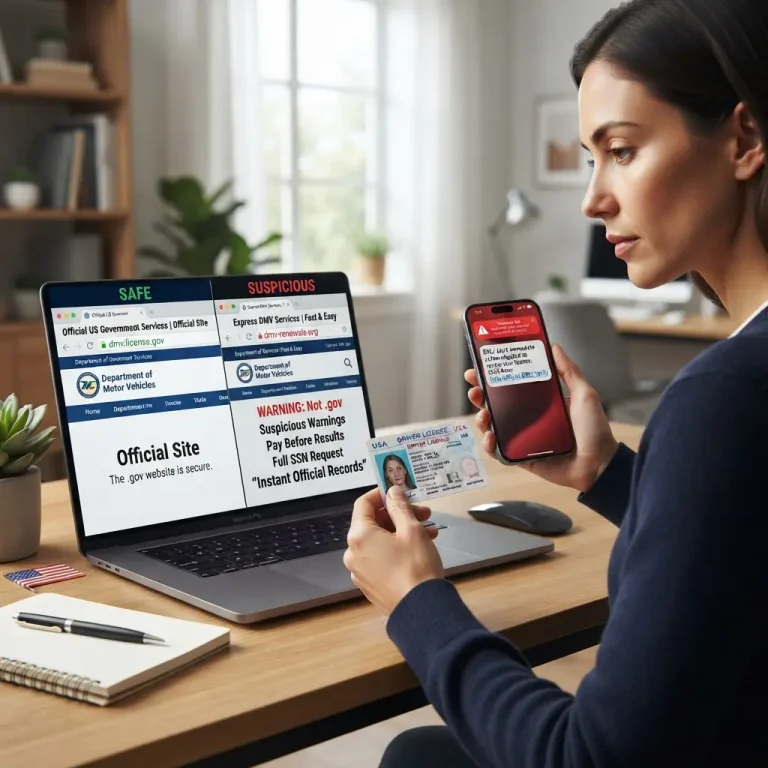
Be wary of any website that charges you to apply for a placard. The official application is typically free or low cost, and private sites that add “processing fees” are not run by the government. Always begin from your state’s .gov page.
How Long Does It Take to Get a Permit?
It can take anywhere from same-day issuance to a few weeks. Applications handled in person may be completed on the spot if your paperwork is correct. Mail and online applications often take one to several weeks, depending on the state and how many requests the DMV has.
Delays usually come from incomplete forms. A missing signature, a missing date, or an unclear provider license number can send the form back. If you apply by mail, allow time for postage in both directions.
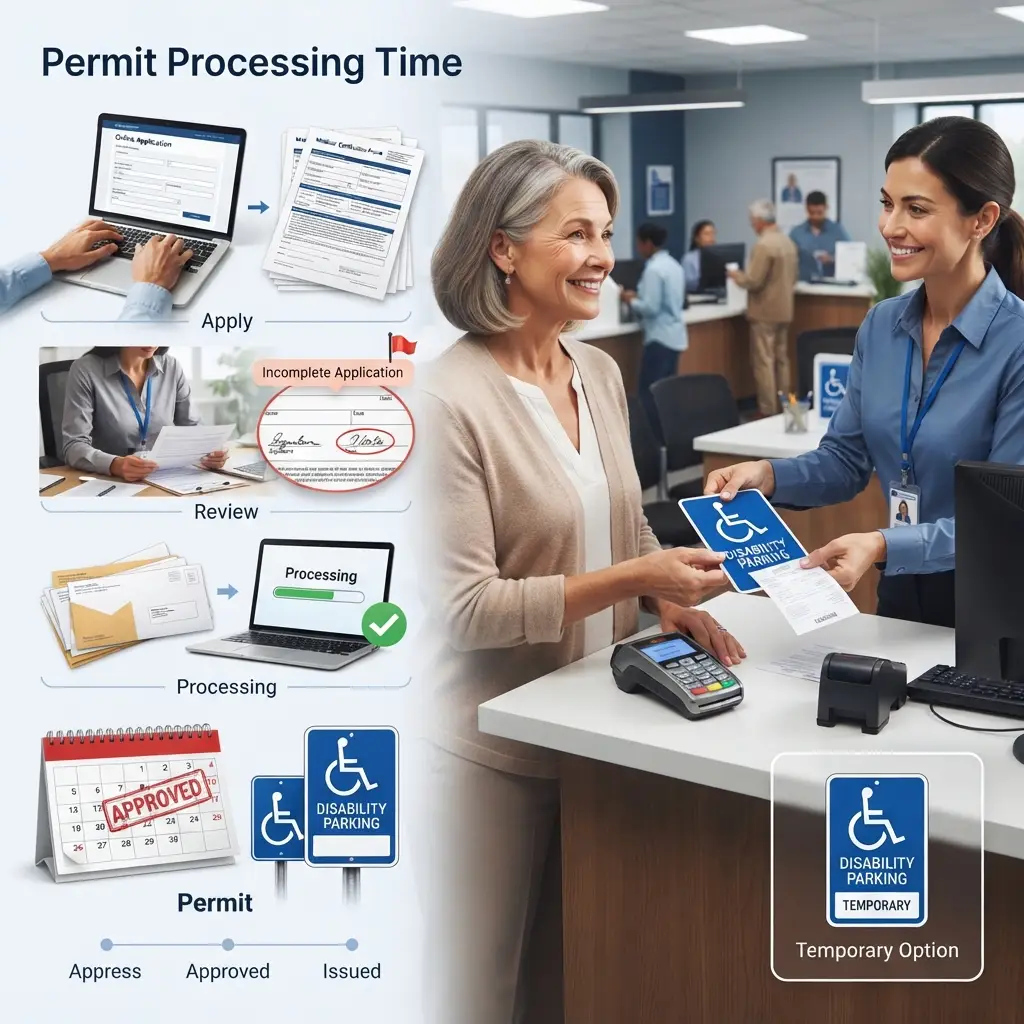
If you need parking access right away because of surgery or a sudden injury, ask your state about expedited or temporary options. Some offices issue a temporary placard on the same day.
Temporary vs. Permanent Permits and Renewals
Temporary placards usually last up to six months, and permanent placards last several years before renewal. Florida’s permanent placard lasts four years and Virginia’s lasts five years, while Illinois forms describe six months for a temporary placard and four years for a permanent one. Your state’s term may be different.
A permanent placard does not mean the placard never expires. It means the condition is expected to last, so no new medical proof may be needed at each renewal, depending on the state. Some states mail renewal notices, while others expect you to renew on your own.
To renew, follow the steps on your state’s DMV page, which may allow online renewal, mail, or an office visit. Check your placard’s expiration date and mark it on your calendar. Renew a few weeks early so you never have a gap.
If your temporary condition lasts longer than expected, ask your state whether you can renew the temporary placard or must apply for a permanent one. Your provider can update the certification if needed.
What If Your Placard Is Lost, Stolen, or Damaged?
You can request a replacement through your state’s DMV, often for a small fee. Report a stolen placard to the police if your state requires it, and keep any report number. Then complete the replacement form, which usually asks for your placard number, if you know it, and your identity details.
Most states void the old placard when they issue a new one, so do not use both. If you find the lost placard later, destroy it or return it to the DMV as instructed. Using an old, canceled placard can lead to fines.
Do not leave your placard in a parked car where it is visible when you are away. Theft of placards is a known problem, and storing it out of sight protects you.
How to Use Your Permit Correctly
Basic rules for use:
- Display the placard from your rearview mirror, or as your state directs
- Remove it from the mirror when driving, since it can block your view
- Park only in spaces marked for accessible parking, and never in striped access aisles
- Follow time limits and meter rules, which differ by state and city
- Carry your ID, since an officer may ask to see it
- Keep the placard in good condition and visible
You may use the placard only when the person with the disability is in the vehicle, either driving or riding as a passenger. The permit belongs to that person. California’s form states the disabled person does not need to own or drive the vehicle to use the placard, but they must be present in it.
Meter and time-limit exemptions vary. Some states let placard holders park for free at meters or for longer than the posted limit, while others do not. Check your state and the city where you park, because local rules can differ.
Never lend your placard to family, friends, or caregivers who are not with you. Even if it feels harmless, misuse can lead to penalties for both you and the borrower.
Traveling and Using Your Permit in Another State
Most states honor out-of-state disability placards for visitors, but the rules vary. Florida, for example, states that it has an agreement with every state that allows out-of-state permits to be used there, but a person with a Florida driver’s license or registration cannot use an out-of-state permit. Other states have their own rules.
Before you travel, check the DMV website of the state you will visit. Look for pages for visitors or out-of-state permits. Some states ask for a temporary placard if your home permit does not display the international symbol of access.
If you are moving to a new state, you generally need to apply for that state’s placard once you become a resident. Ask both states how to transfer your information, and when your old placard stops being valid. If you hold plates, you will also need to re-register your vehicle.
For international trips, the rules are different. Some countries recognize permits from other countries and some do not. Check the destination country’s rules, and carry your permit and ID.
Misuse and Penalties
Misusing a disability placard can bring fines, loss of the permit, and criminal penalties. Disability placards are issued by state governments, and misuse is generally treated as a misdemeanor. Unauthorized use often carries fines of several hundred dollars, and some states allow up to a year in jail.
Common examples of misuse include:
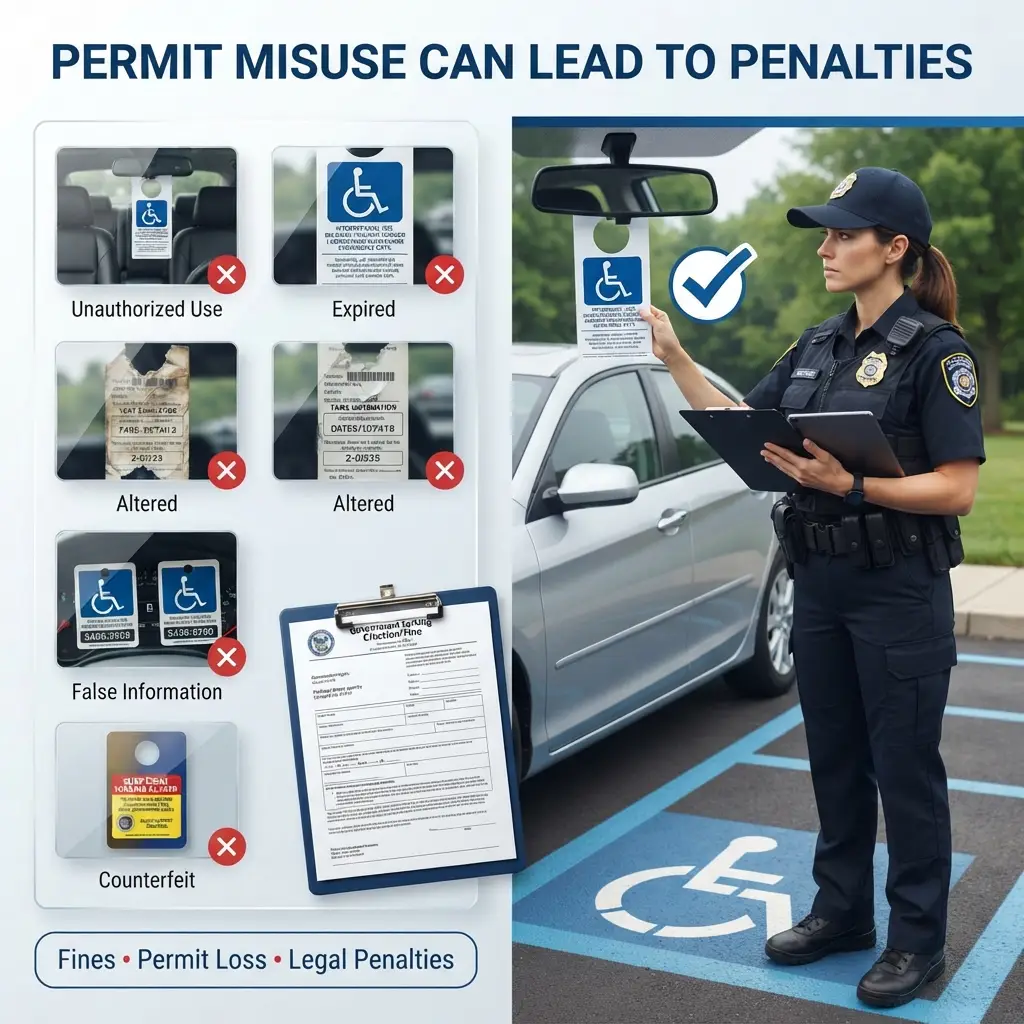
Illinois forms warn that misuse or a false application can lead to revocation of the placard. In many places, officers or parking enforcement can confiscate a misused placard on the spot. If you inherit a placard from a family member who has died, return it to the DMV rather than keep using it.
Special Situations
Some situations change how you apply or use the permit.
Temporary injuries or surgery. Ask your provider about a temporary placard, and apply as soon as you know your recovery period. Keep the expiration date in mind.
Veterans. Some states offer disabled veteran license plates or special placards. Bring your discharge or disability documents if required.
Children with disabilities. A parent or guardian can usually apply on the child’s behalf with a provider’s certification. The child must be in the vehicle when the placard is used.
Caregivers and organizations. Organizations that transport people with disabilities can often apply for an organization placard. A caregiver cannot use a client’s placard without the client present.
New residents. If you moved from another state, apply for a new placard in your new state, and check how to turn in the old one.
People with changing conditions. If your condition improves, you may no longer qualify. Follow your state’s rules on returning a placard that you no longer need.
Common Mistakes When Applying for a Handicap Parking Permit
Most delays and denials come from preventable errors.
Using the wrong form. States may have separate forms for placards, plates, temporary, and permanent permits. Check which one applies.
Leaving out a signature or date. A missing signature from you or your provider can stop the application.
Choosing the wrong type. Temporary and permanent permits have different rules and certifications.
Waiting until the placard expires. Renew a few weeks early to avoid a gap.
Letting others use the placard. Even a short loan is misuse.
Leaving the placard in the car. This invites theft and can lead to problems if it is stolen.
Using unofficial websites. Private sites may charge extra or collect your information. Start from your state’s .gov page.
Not reading local parking rules. Meter and time-limit rules vary by city, so check where you park.
Troubleshooting Permit Problems
Most problems have a simple fix.
Your application was returned. Read the notice or call the DMV to learn what was missing. Most often it is a signature, a date, or a provider license number. Fix it and resubmit.
Your provider is not on your state’s list. Ask the DMV which professionals can certify. If needed, ask your provider to refer you to someone eligible, or to a provider licensed in your state.
You were denied. Ask for the reason in writing. Many states allow you to appeal or reapply with additional information from your provider. Keep copies of everything.
You never received your placard. Check your application status or call the DMV with your name and application date. Confirm that your mailing address is correct.
Your placard expired. Renew as soon as possible, and do not use the expired placard. Ask whether you need a new medical certification.
You moved to another state. Contact the DMV in both states. Apply for a new placard in your new state and ask how to return the old one.
Your placard was stolen. Report it as your state directs, and request a replacement. Keep any report number.
You received a ticket while using your placard. Check the citation, since local rules and meter exemptions differ. Contact the issuing agency with your placard number and proof of eligibility.
Handicap Parking Permit Checklist and Tips
Use this list when you prepare your application.
A few tips help in practice. Ask your provider to complete the form while you are at the visit, since it saves a second trip. If you use public parking often, learn the local meter rules. If you travel, check the destination’s rules before you go.
If you are helping a family member apply, gather the paperwork together and make sure the applicant signs their section. Keep a calm, patient approach if the DMV requests more information.
Handicap Parking Permit Terms Explained
| Term | Meaning |
|---|---|
| Disability parking placard | A hang tag that allows use of accessible parking spaces |
| Disability license plates | A special plate that serves the same purpose |
| Medical certification | A signed statement from an authorized professional |
| Temporary placard | A short-term permit, often up to six months |
| Permanent placard | A long-term permit that is renewed periodically |
| International symbol of access | The wheelchair symbol that marks accessible parking |
| Access aisle | The striped area next to a space, which must stay clear |
| Meter exemption | A rule that lets placard holders park without paying, where allowed |
| Misuse | Using a placard when the holder is absent or in a prohibited way |
| Travel placard | A special permit for frequent travelers, in states that offer it |
Frequently Asked Questions
Conclusion
Getting a handicap parking permit comes down to a few clear steps: confirm your state’s rules, have an authorized professional complete the medical certification, and submit the official application with any required documents. Choose the right type, whether temporary or permanent, and keep track of your expiration date so you can renew on time.
Most problems come from missing signatures, the wrong form, and misuse of the placard. Use the checklist on this page, keep your placard out of sight when you park, and follow your state’s rules for display and travel. A little preparation keeps your permit valid and your parking access reliable.