DMV Appointment for Road Test: How to Schedule, What to Bring
Booking a DMV appointment for a road test is often harder than taking the test itself. Slots can be weeks away, one missing document can cancel your visit, and an unsafe test car can end the appointment before you even start the engine.
You will also find fee and cancellation rules, a list of common automatic-fail mistakes, a troubleshooting section, and answers to the questions people ask most. Rules differ by state, so use this as a map and confirm the details on your own state’s official .gov website.
What Is a DMV Road Test?
A road test is the behind-the-wheel exam where a DMV examiner checks that you can drive safely and follow traffic laws. You take it in a real vehicle, usually the one you bring, on public streets near the testing site. The examiner scores you on skills such as observation, speed control, lane changes, turns, and parking.
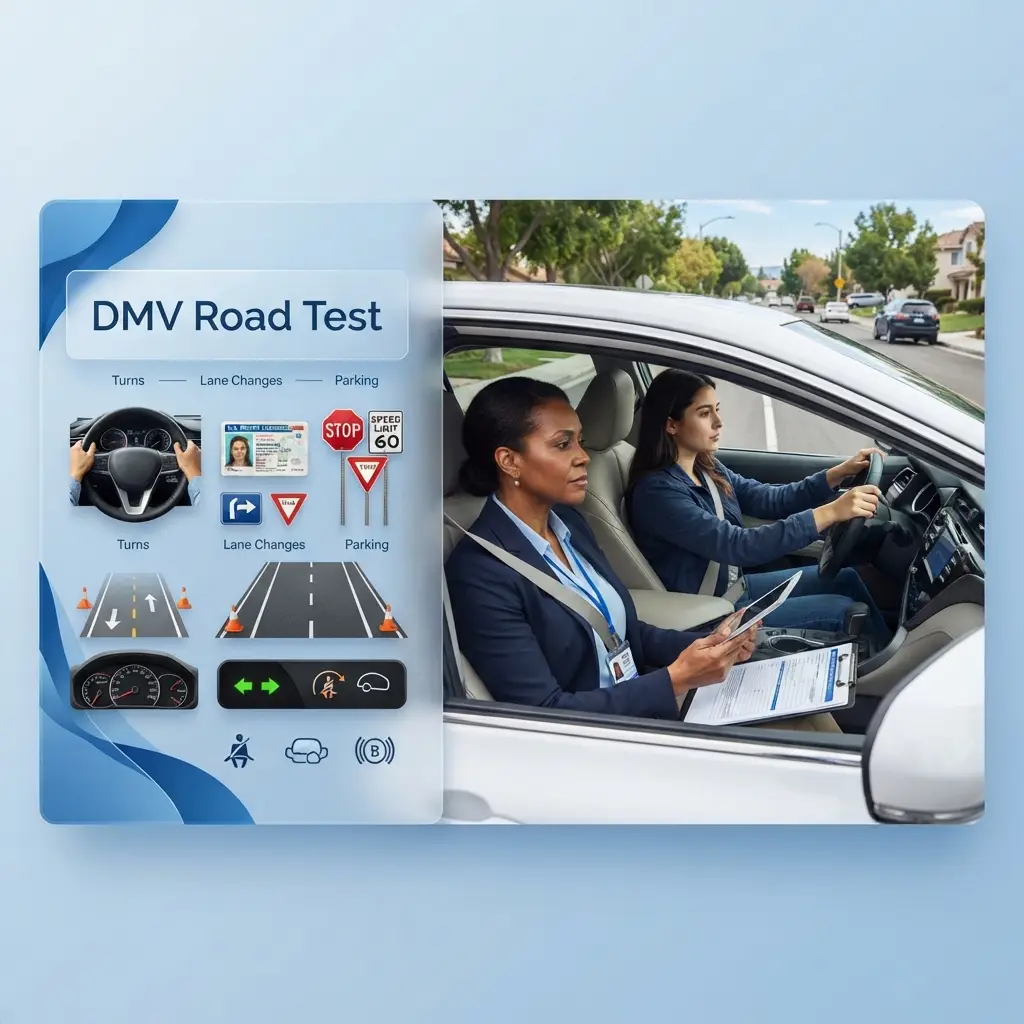
People search for this in many ways, including “road test appointment DMV,” “DMV driving test booking,” “schedule a road test,” and “drivers license road test appointment.” They all describe the same step. Some states call it a skills test or a driving test, and some offer it through the DMV while others use approved third-party testers.
The road test usually comes after you have held a learner’s permit, finished any required practice hours, and passed the written knowledge test. Passing it earns you a driver’s license or the next stage of a graduated license. Failing it means a wait and sometimes a fee before you can try again.
What You Need Before You Can Book
Most states require you to meet eligibility rules before the online system lets you schedule. The requirements vary, but the same items come up often. Check your state’s page before you try to book, since the scheduler may reject your request. Before this, make sure you’ve passed the DMV written test.
Some states allow a single test with a recently expired permit, but you may not be allowed to drive on it. Others may refuse your appointment if the permit is expired. If your permit is close to expiring, renew or extend it before you schedule.
If you are not sure you qualify, call your DMV or read the “road test” page on its website. Booking a slot you cannot use can cost a fee or a long wait. A few minutes of checking can save weeks.
How to Schedule a DMV Road Test Appointment Step by Step
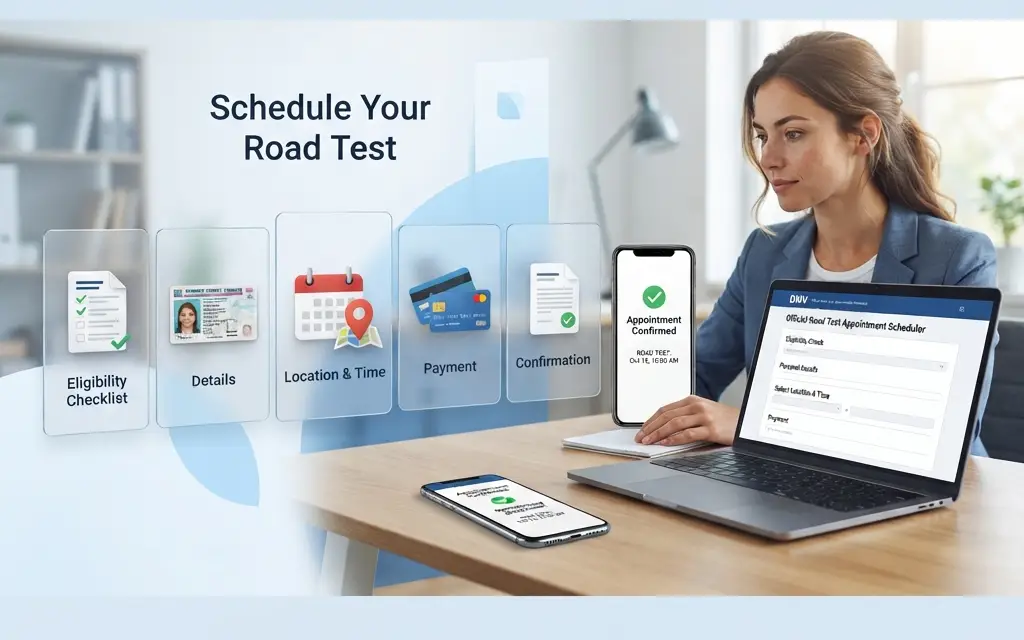
The fastest way to book is through your state’s official DMV scheduling system. The steps below work in most states, with small differences in names and layout.
- Find your state’s official site. Search for your state plus “DMV road test” and open the result that ends in .gov. Avoid ads and sites that charge a “booking fee.”
- Read the eligibility page. Confirm that you have the right permit, practice hours, and documents.
- Open the road test scheduler. It may be labeled “Schedule a Road Test,” “Book a Driving Test,” or sit inside a MyDMV account.
- Enter your details. You usually give your permit or license number, date of birth, name, and phone number.
- Choose the test type. Select the correct class, such as a passenger car, motorcycle, or commercial vehicle.
- Pick a location and time. Compare several testing sites, since some locations have openings sooner.
- Pay the fee if the system asks. Some states charge when you book, others on the test day.
- Save your confirmation. Print or screenshot the confirmation page and email, since many offices require it at check-in.
If you already hold an appointment and need a different time, use the same system to reschedule. Some systems keep your old slot until you confirm the new one, which prevents losing both.
Booking by Phone, in Person, or Through a Third-Party Tester
Most states favor online booking, but you may have other options. Phone and in-person booking help if the website fails or you do not qualify for self-scheduling. Be aware that phone agents often cannot open extra slots beyond what the system shows.
| Method | Best for | Watch out for |
|---|---|---|
| Online scheduler | Fast, 24-hour booking | Eligibility rules, limited slots |
| Phone | Help with account or eligibility issues | Long hold times, no extra slots |
| In person | Complex cases, paperwork problems | Time at the office |
| Third-party tester | Faster slots in states that allow it | Extra fees, must be approved |
Some states and districts allow approved private testing businesses to give the road test. These providers can have shorter waits, but they charge their own fees and must be listed on your state’s official site. Never use a tester who is not listed by the DMV, since a test from an unapproved provider may not count.
If you need help finding an office or checking hours, our page on finding a DMV near you explains how to compare locations. For general booking tips that also apply to other services, see our page on how to book a DMV appointment.
How Far Ahead Should You Book, and How Can You Find an Earlier Slot?
Book as soon as you are eligible, because road test slots often fill weeks in advance. In some states, the system lets you reserve a slot a couple of months ahead. One state’s scheduler, for example, lets drivers book roughly eight to eleven weeks out at most centers.
Busy cities and the weeks around school breaks are the hardest. Rural testing sites may have shorter waits, which is worth knowing if you can travel. Check several locations rather than just the closest one. This is also a required step when learning how to get a CDL.
To find an earlier slot:
Do not book slots you do not plan to keep. Many systems limit how many appointments you can hold, and a no-show can come with a fee or a restriction.
Road Test Fees, Rescheduling, and Cancellation Rules
Fees vary by state, and the cost of missing your appointment can be higher than the test fee. Some states charge one fee that covers the license, while others charge a separate road test fee and a retest fee. Examples from official state pages show a range, with retest fees such as $40 in one state and no-show fees such as $15 or $25 in others.
| Cost or rule | What to expect |
|---|---|
| Road test fee | Set by your state, sometimes included in the license fee |
| Retest fee | Often a smaller fee for each additional attempt |
| No-show or late-cancel fee | Often $15 to $25 or more |
| Reschedule deadline | Often 24 hours to 3 business days before the test |
| Third-party tester fee | Set by the provider |
The cancellation deadline matters. Some states let you reschedule without losing a prepaid fee if you do it at least three days ahead. Others ask for 24 hours or 48 hours notice, and charge a fee if you miss it. Check the rule for your state and put the deadline on your calendar.
If you arrive late, many offices will cancel the test and ask you to reschedule. Some states may also charge a no-show fee. Plan to arrive 15 to 20 minutes early so a parking problem does not ruin your slot.
What to Bring to Your Road Test
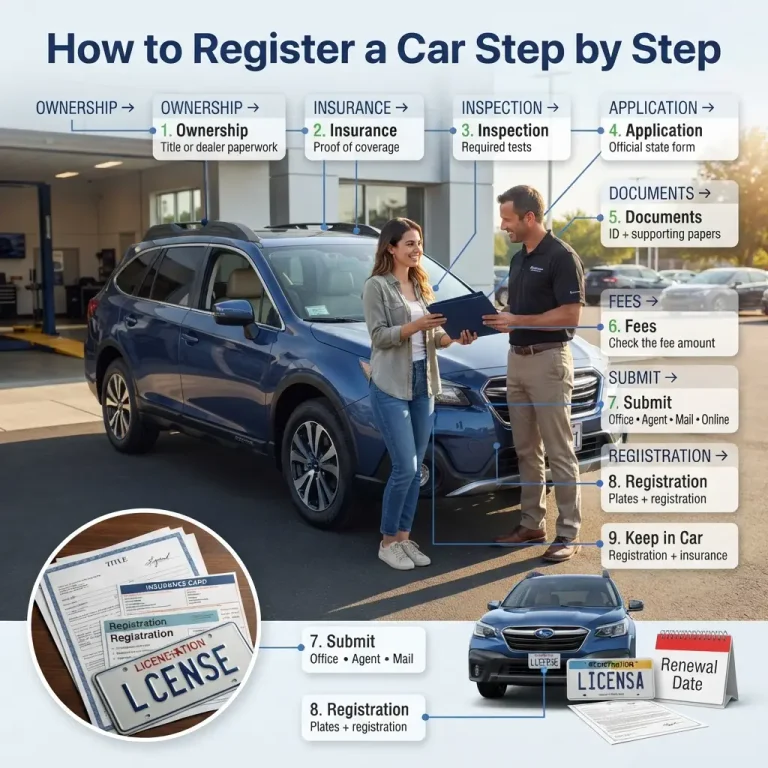
Bring your permit, your confirmation, and the right vehicle papers. Many tests are canceled before they begin because a document is missing. Use this list and check it against your state’s page. Check the current DMV wait times before scheduling.
| Item | Why you need it |
|---|---|
| Learner’s permit | Proves eligibility to test |
| Appointment confirmation | Often required at check-in |
| Vehicle registration | Shows the test car is legally registered |
| Proof of insurance (paper or electronic) | Must match the vehicle you drive |
| Photo ID | To confirm who you are |
| Parent or guardian, if you are a minor | Some states require them to sign or attend |
| Completed forms or practice hour logs | Required in some states |
| Payment method | If fees are due on the day |
If you lost your permit, apply for a duplicate before the test day. In some states, showing up without a permit means you lose the appointment and must pay again. Keep your documents in one folder so nothing is left in the car or at home.
If the car is borrowed or rented, check your state’s rules on insurance and registration. Some states require the owner’s name to match the paperwork, and some do not allow certain rental vehicles. Ask the DMV before you plan to use anything other than your own car.
Vehicle Requirements for a Road Test
The examiner inspects the car first, and an unsafe vehicle ends the test. In many states, the examiner checks the condition of the vehicle before you drive. If the vehicle is found unsafe, the test is not conducted, and you must reschedule.
Common vehicle checks include:
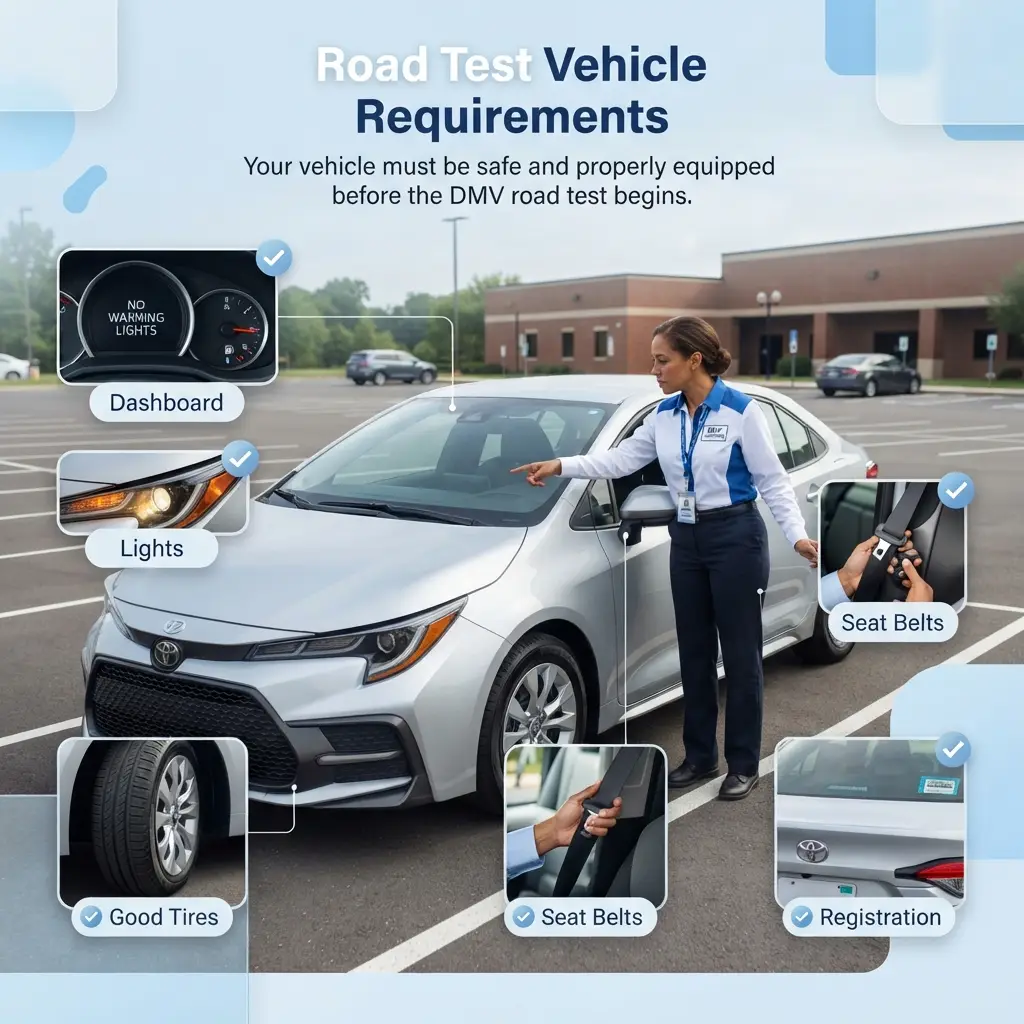
Test the lights and signals with a helper the day before. A burned-out bulb is a common reason for a canceled test. If you rely on a loaner or a friend’s car, drive it a few times first so you know how the brakes and mirrors feel.
Some states have rules about backup cameras, large vehicles, or cars with dashboard obstructions. Check your DMV’s vehicle requirements page, and ask if you are not sure whether your car qualifies.
Who Can Drive You to the Test?
A licensed adult usually must accompany you if you drive to the test site on a permit. Driving alone with a learner’s permit is not allowed in most places, and some states penalize it. In one jurisdiction, for example, a permit holder who drives to the road test without a licensed driver may be barred from testing for six months.
Plan your ride the night before. Ask a licensed adult who meets your state’s age and experience rules to sit next to you on the way. If you are nervous, the practice drive to the site can help you warm up.
In many states, the person who accompanies you does not go on the test with you. The examiner rides alone with you, and your helper waits at the office. Ask your DMV about its rule so you do not lose your slot.
What Happens During the Road Test?
The test usually lasts 15 to 30 minutes, and the examiner scores your driving as you go. You start with a vehicle check, then drive a short route that includes common situations. The examiner gives directions and keeps notes without much conversation. Find the most convenient office using our DMV near me tool.
Typical items include:
Pre-drive checks, such as signals, brake lights, and horn
Starting, backing, and stopping smoothly
Observing speed limits and traffic signs
Stopping at stop signs and signals, and yielding correctly
Turning, lane changes, and merging with proper mirror and head checks
Keeping a safe following distance
Parking, such as parallel parking or backing into a space
Three-point turns or similar maneuvers in some states
Handling intersections, crosswalks, and school zones
Stay calm and follow directions. If you make a small mistake, do not panic, since one error does not always mean failure. Drive as you would with a parent in the passenger seat, and give clear signals and checks.
Automatic Fail Reasons
Some mistakes end the test right away. The exact list varies by state, but these are commonly treated as automatic fails.
Causing a crash or a near collision
Disobeying a traffic sign or signal, such as running a stop sign or red light
Driving unsafely, speeding, or driving too slowly for conditions
Failing to yield to pedestrians or other vehicles
Hitting the curb hard during a maneuver
Driving on the wrong side of the road or in the wrong lane
Examiner intervention, such as grabbing the wheel or braking
Refusing to follow instructions
Using a phone or other distractions
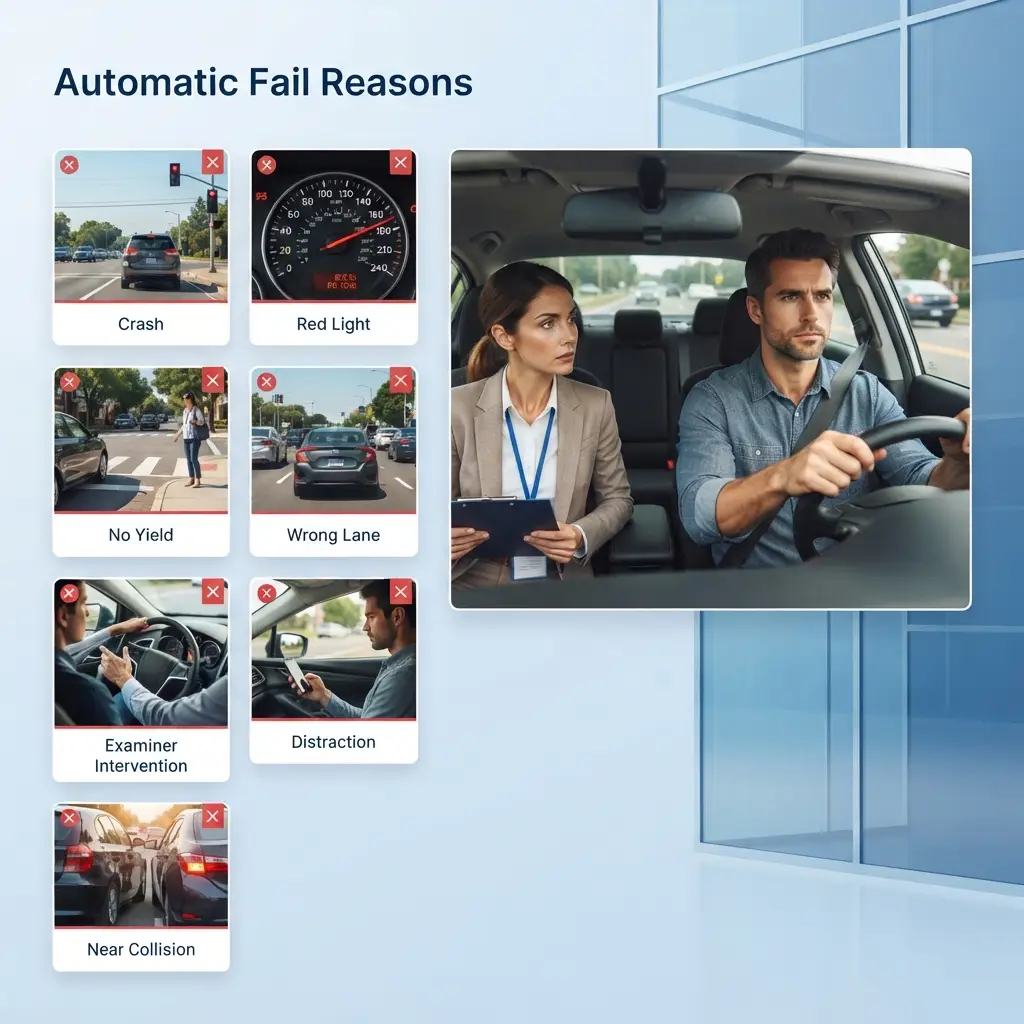
Know your state’s scoring system. Some states use a points system, and you pass if you stay under a set number of errors. Others use critical errors, where one serious mistake means failure.
If You Pass, If You Fail
If you pass, you get your license or the next stage of it; if you fail, you rebook and try again. After passing, you usually get a temporary license or paper permit, and the card arrives by mail in a few weeks. Keep your paperwork until the permanent card shows up.
If you fail, ask the examiner for the scoring sheet and read what went wrong. Many states set a waiting period before the next attempt, and some require you to rebook within a short window. In one state, for example, drivers must go online to reschedule within 72 hours after a failed test, and a retest fee applies.
Repeated failures can trigger limits. One jurisdiction does not allow a seventh attempt until a year after the first failed test if a driver fails six times within twelve months. Practice more between attempts, and consider a professional lesson.
Special Cases: Teens, Adults, Out-of-State Drivers, Motorcycles, and CDL
The process changes slightly depending on your situation.
Teen drivers. Most states use graduated licensing, which can require a minimum permit period, supervised practice hours, and parent certification. Check your state’s rules for restrictions that apply after you pass.
Adult first-time drivers. Many states waive some teen requirements, but you still need a permit, a written test, and a road test. Some states do not require a long permit holding period for adults.
New residents with an out-of-state license. Many states waive the road test if you hold a valid license from another state, but not all do. Ask before you book, since an unneeded test is a waste of time.
Motorcycle licenses. A motorcycle test may be offered at a separate site or as part of a course. Some states let you skip the DMV test if you pass an approved safety course.
CDL skills tests. A commercial license has a skills test with a vehicle inspection and a driving portion. It often requires a commercial learner’s permit, a medical certificate, and a longer appointment.
Drivers with disabilities. Many offices offer adapted vehicles or accommodations. Ask when you book, since arrangements may need advance notice.
Common Mistakes When Booking and Taking the Road Test
Most failed or canceled tests come from preventable errors.
Waiting too long to book. Slots can be weeks away, so start as soon as you qualify.
Letting the permit expire. An expired permit can cancel your appointment or block you from driving to the test.
Bringing the wrong vehicle. A car with a broken light, expired registration, or warning lights may be rejected.
Forgetting documents. Missing registration, insurance, or your confirmation can cost you the slot.
Arriving late. A late arrival can mean a canceled test and a fee.
Skipping practice in the test car. Unfamiliar mirrors and brakes can make you nervous.
Missing the reschedule deadline. Canceling too late can cost you a fee.
Using an unofficial site. Private sites may charge extra or collect your information. Always start from your state’s .gov page.
Troubleshooting Road Test Appointment Problems
Most problems have a simple fix.
No appointments are available. Check other testing locations, look for cancellations at different times, and ask whether third-party testers are allowed. Phone agents often cannot open more slots, so do not count on a call to fix it.
The system will not let you book. Check your permit status, your practice hour record, and any required waiting period. Some systems calculate your earliest date automatically. If the rules seem to be met, call the DMV to ask for help.
Your permit expires before your slot. Renew or extend the permit first. Some states allow one test on a recently expired permit, but you may not be allowed to drive until it is renewed.
You need to reschedule. Use the same online system and do it before the deadline. Check whether your old slot stays until the new one is confirmed.
You did not receive a confirmation. Check your spam folder and look up your appointment on the DMV site with your name and permit number. Call the DMV if you cannot find it.
You were turned away at the office. Ask exactly what was missing and write it down. Fix the problem and rebook. Some offices offer a short grace period for minor issues, but many do not.
You failed and cannot rebook. Check the waiting period and any online deadline. Some systems show the earliest date when you log in. If it fails to show, call the DMV and keep your scoring sheet.
Your car was rejected. Ask which item failed. Fix it, such as a bulb or sticker, and rebook. Consider borrowing a different car that meets the rules.
Road Test Checklist and Tips
Use this list the night before your test.
A few tips help in practice. Do a short practice drive on the same roads near the test site, if allowed. Sleep well, eat a light meal, and avoid heavy caffeine. During the test, check your mirrors, signal early, and say nothing unless the examiner speaks to you.
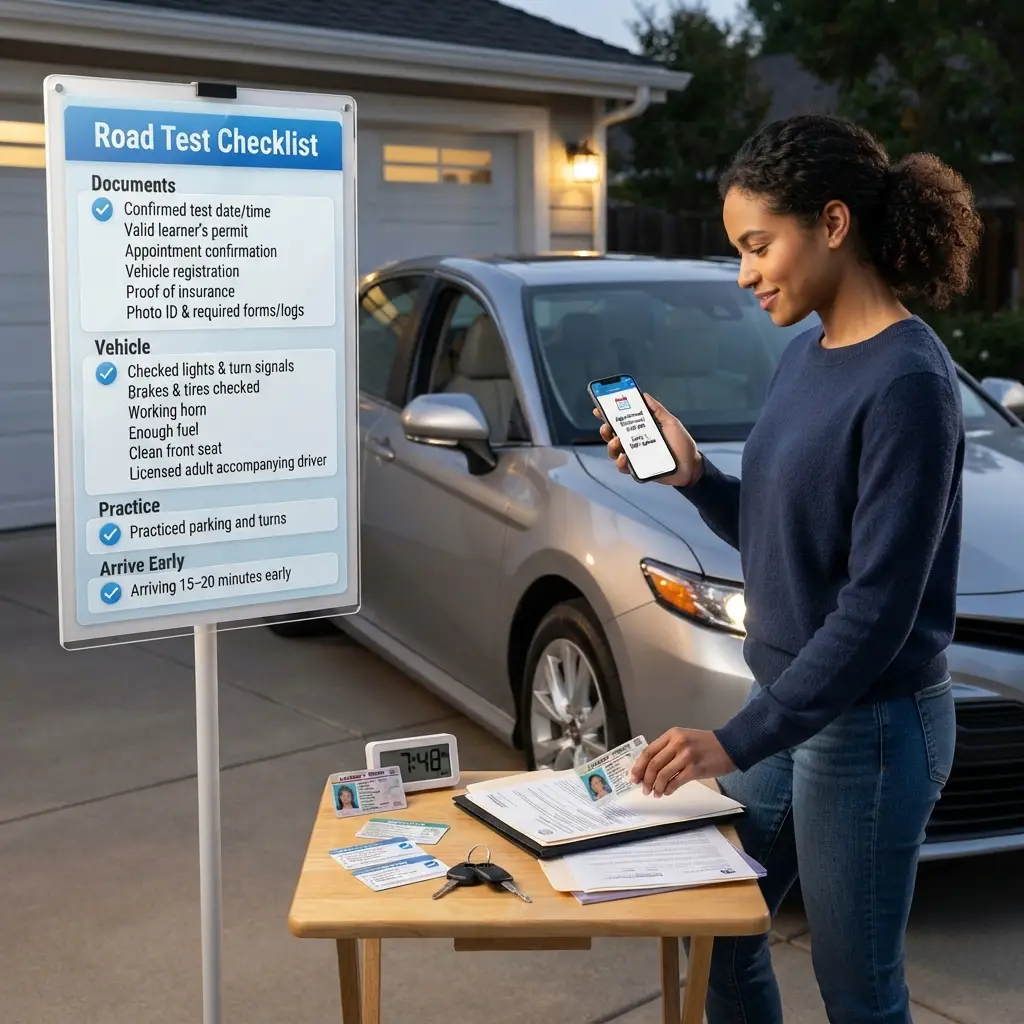
If you are very nervous, take a few slow breaths before you start. Remember that examiners expect a little nerves. Safe, steady driving matters more than perfect parking.
Road Test Terms Explained
| Term | Meaning |
|---|---|
| Road test or skills test | The behind-the-wheel exam with a DMV examiner |
| Learner’s permit | A permit that allows supervised driving |
| Graduated licensing | A staged system with limits for new, usually young, drivers |
| Examiner | The DMV staff member who scores your driving |
| Critical error | A serious mistake that can end the test |
| No-show fee | A charge for missing your appointment without notice |
| Third-party tester | An approved private business that gives the test |
| Retest fee | A charge for taking the test again |
| Supervising driver | A licensed adult who rides with a permit holder |
| Temporary license | A paper document valid until your card arrives |
Frequently Asked Questions
Conclusion
A DMV appointment for a road test takes planning, but the steps are simple once you know them. Check your eligibility, book through your state’s official scheduler, and look at several locations for an earlier slot. Bring your permit, confirmation, and vehicle papers, and make sure your car passes the safety check.
Most problems come from late booking, expired permits, missing documents, and unsafe test cars. Use the checklist on this page, practice in the vehicle you will use, and arrive early. With a little preparation, the appointment is much smoother, and you can focus on driving well.