What Is REAL ID? Requirements, How to Get One & Who Needs It
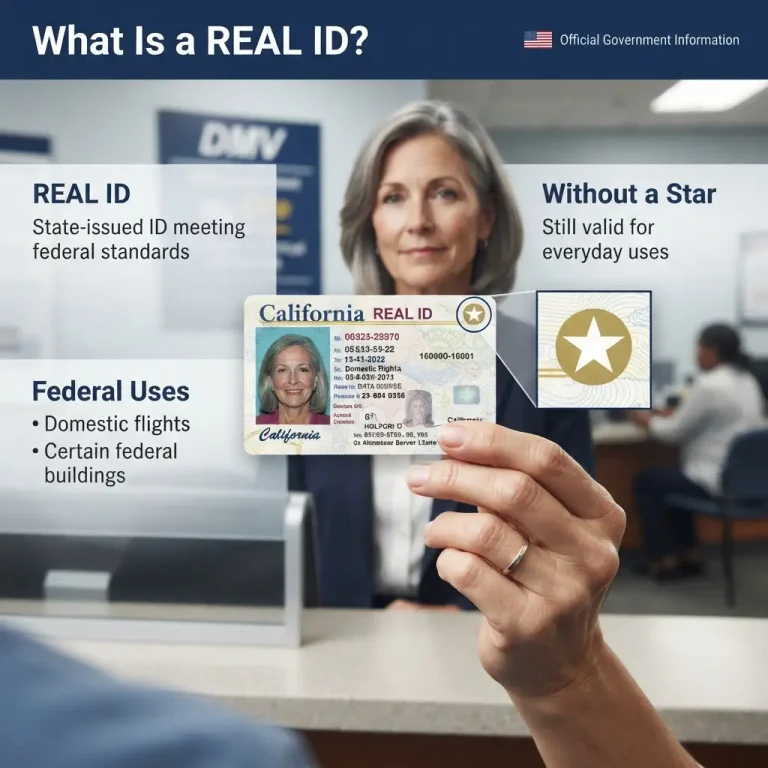
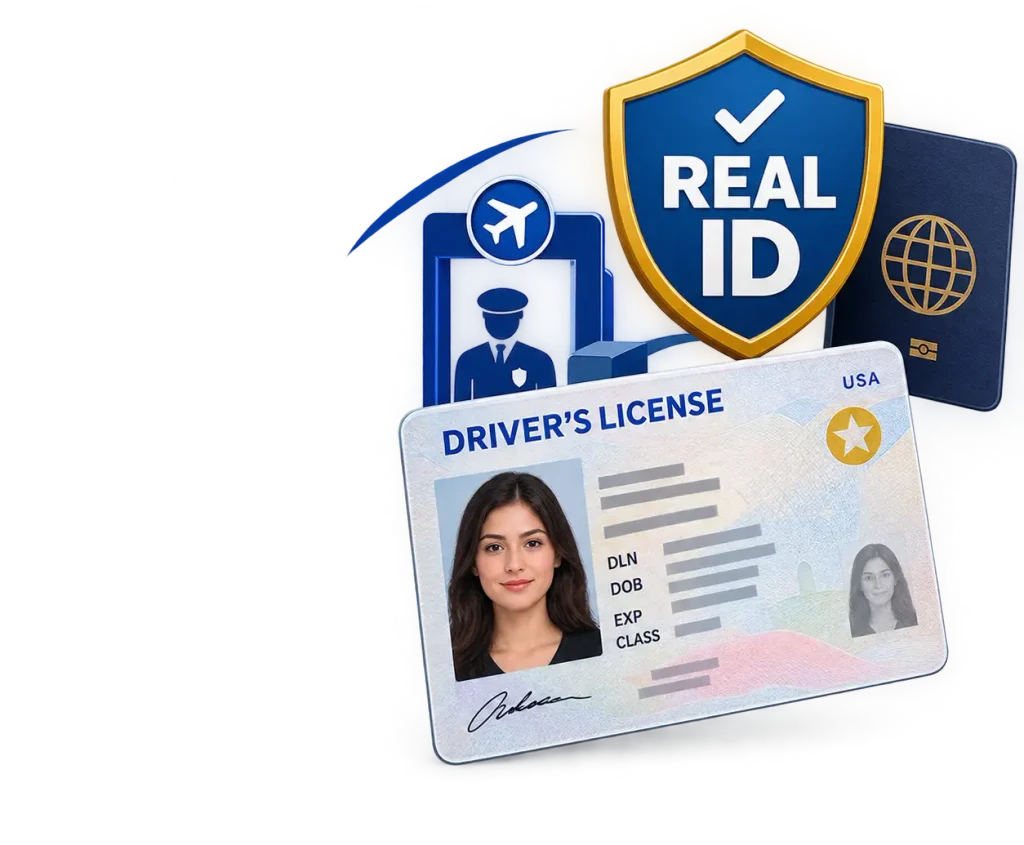
A REAL ID is a driver’s license or state ID card that meets federal security standards, which makes it a federally accepted form of identification. You need one, or another accepted ID such as a passport, to board a domestic flight within the United States and to enter secure federal facilities such as military bases.
Most of the confusion comes from timing, paperwork, and the difference between a REAL ID, a standard license, and an enhanced license. This page explains what a REAL ID is, how to tell whether yours is one, what documents you need, and how six states handle the application. It also covers what happens at the airport without one, what it costs, how long it takes, and the mistakes that send people home from the counter.
What Is a REAL ID?
A REAL ID is a state-issued driver’s license or identification card that meets the federal standards for identity checks. California describes it as a driver’s license or identification card that is also a federally accepted form of identification. Florida describes the program as a nationwide effort to improve the security of state-issued licenses and ID cards and to reduce identity fraud.
The card looks like your regular license, with one visible difference: a marking that shows it is compliant. The state verifies your identity documents in person before issuing it, which is why the first application takes more effort than a normal renewal. After that first approval, renewals are often simpler.
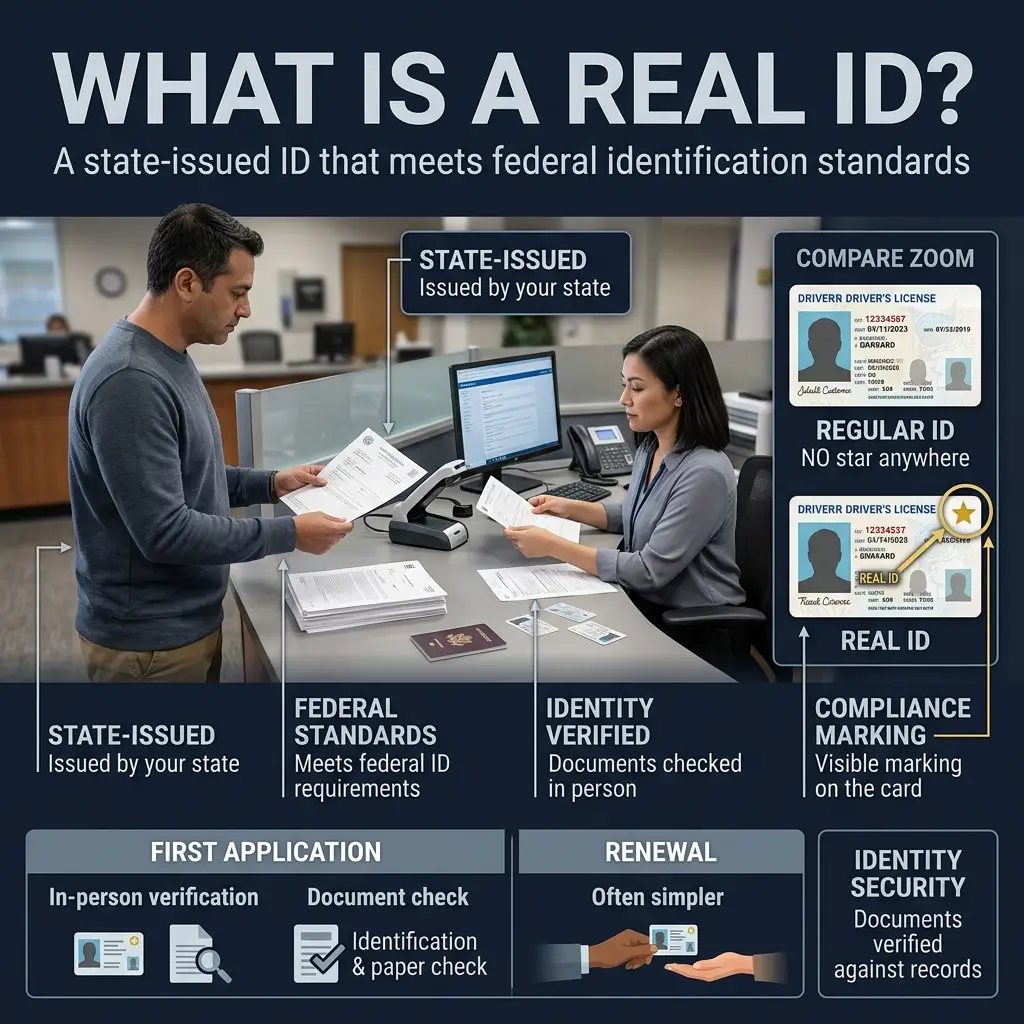
A REAL ID is not a separate document that you carry in addition to your license. Your license or state ID becomes the REAL ID. You do not need two cards, and some states warn that you can hold only one at a time.
Is a REAL ID Mandatory?
No. California states plainly that a REAL ID driver’s license or identification card is optional. You only need one if you want to use your state license or ID for domestic air travel or to enter secure federal facilities, and you can use a passport instead for flights.
The federal enforcement date was May 7, 2025. TSA says that beginning on that date, every air traveler 18 years of age and older needs a REAL ID-compliant driver’s license, a state-issued enhanced driver’s license, or another acceptable form of ID to fly within the United States. TSA also says people who cannot verify their identity will not be permitted to enter the security checkpoint.
If you never fly and never visit a secure federal building, a standard license may be all you need. Many people still choose a REAL ID for convenience, since it keeps one card useful for every purpose. Think about your travel habits before you decide.
What Do You Need a REAL ID For?
You need a REAL ID, or an accepted alternative, for two main things. The first is boarding a domestic flight within the United States. The second is entering secure federal facilities, such as military bases and federal courthouses.
California lists what a REAL ID is not needed for, which clears up common worries. You do not need one to:
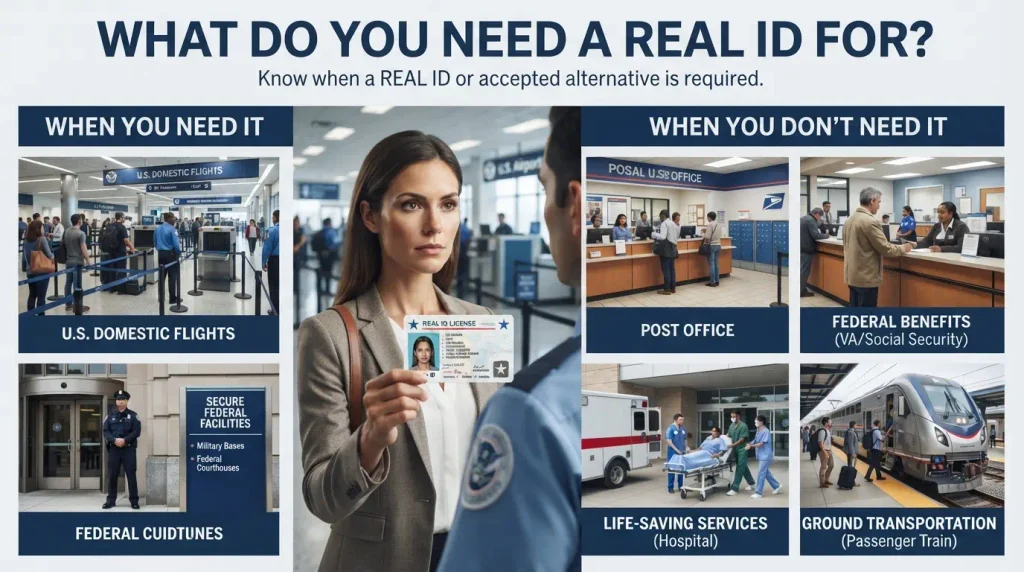
A REAL ID does not replace a passport for international travel. Border crossings are a separate matter. New York’s enhanced license, for example, is the type that can be used for land and sea border crossings, while its REAL ID cannot.
How Can You Tell If Your License Is a REAL ID?
Look for the star marking on the front of the card. Each state uses a slightly different design, so check your own state’s description. If your card has no marking, it is probably a standard license.
The published descriptions show the variety:
| State | How a REAL ID is marked |
|---|---|
| California | A golden bear and star in the top right corner |
| Florida | A star in the upper right corner of the card |
| New York | A black circle with a white star centered within the circle |
| Pennsylvania | A gold star in the top right corner |
| Ohio | A star in the upper part of the card |
New York’s enhanced license shows a U.S. flag instead of the star, and it also works for domestic flights and federal buildings. A standard New York license has no distinguishing mark. If you are unsure about your card, your state’s motor vehicle site shows sample images.
Do not assume that a recently renewed license is a REAL ID. A renewal does not automatically upgrade your card. Check the front of the card before you book a flight.
REAL ID vs. Standard License vs. Enhanced License
The three card types differ in what they allow. New York’s DMV page gives a clear comparison, and the same idea applies in other states that offer enhanced licenses. The table below uses New York’s published information.
| Feature | Standard | REAL ID | Enhanced |
|---|---|---|---|
| Domestic air travel | No | Yes | Yes |
| Federal buildings | No | Yes | Yes |
| Border crossing | No | No | Yes, by land or sea only |
| Extra fee | None | None | $30 additional |
Only a few states offer enhanced licenses, so your state may have just two options. In those states, the choice is simple: standard for driving only, or REAL ID for driving plus flights. A passport covers the same flight need regardless of the card you hold.
If you travel often by air, a REAL ID is usually the practical choice. If you already carry a valid passport and rarely visit federal buildings, a standard license can be enough. Either way, keep your ID current.
What Happens at the Airport Without a REAL ID?
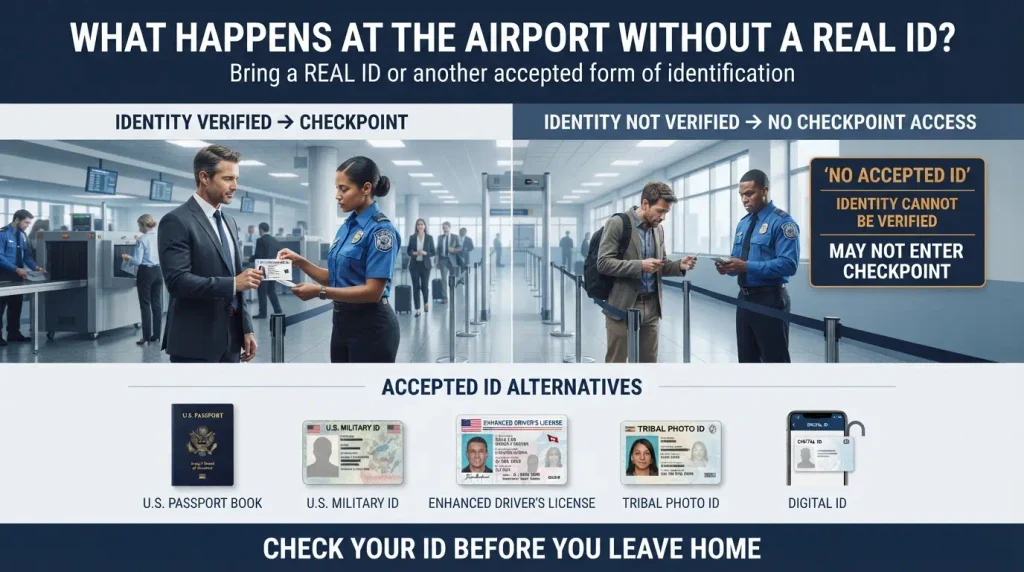
Without a REAL ID or another accepted ID, you may not be allowed through the TSA checkpoint. TSA says travelers who cannot verify their identity will not be permitted to enter the checkpoint or fly. That is why the choice of ID matters before you leave home.
TSA lists several accepted alternatives to a REAL ID-compliant license:
A valid passport
A U.S. military ID
A state-issued enhanced driver’s license
A federally recognized tribal-issued photo ID
Digital IDs at select TSA PreCheck checkpoints
TSA also announced a paid option for travelers who arrive without a REAL ID. A TSA press release from January 2026 describes a $45 fee option that began on February 1, 2026, known as TSA ConfirmID. Check tsa.gov for how it works, how long it lasts, and what it covers. Treat it as a backup, not a plan, since it adds cost and time.
What Documents Do You Need to Get a REAL ID?
You generally need proof of identity, proof of your Social Security number, and two proofs of where you live. If your name has changed, you also need documents that connect each name. Bring originals or certified copies, not photocopies, unless your state says otherwise.
The published checklists are close to each other. California asks for one proof of identity that includes your full name and date of birth, such as a U.S. passport, a certified birth certificate, or a Permanent Resident Card. It also asks for two different printed documents showing your California mailing address, with both documents showing your first and last name. Florida asks for one primary identity document, your Social Security card or proof of the number, and two documents showing your principal residence.
Pennsylvania lists the same three groups. Its identity example is a U.S. birth certificate with a raised seal or a valid passport, its Social Security proof can be a card or a pay stub with the full number, and its residency proof is two documents with your Pennsylvania address, such as utility bills or lease agreements. Bring originals for each group.
Ohio and New York have their own wording. Ohio asks for proof of full legal name, date of birth, Social Security number, Ohio residency, and legal presence, with two documents from different sources for the address. New York asks for two proofs of residency and proof of your full legal name, with documents current within one year and no P.O. Box addresses.
Common residency documents include utility or cell phone bills, bank or credit card statements, insurance documents, rental agreements, and government mail. Choose documents that show your name and address exactly as they appear on your application. A mismatch is the most common reason for a rejected visit.
Name Changes and REAL ID
If your current legal name differs from the name on your identity document, bring proof of each change. California lists marriage certificates, adoption papers, and court dissolution documents as examples, and asks for documents covering each legal name change. Bring the full chain of documents if your name changed more than once.
Update your Social Security record before you apply if your name changed. Many agencies check the new name against that record, and a mismatch can stop the application. Allow a few days for that update to show up before your visit.
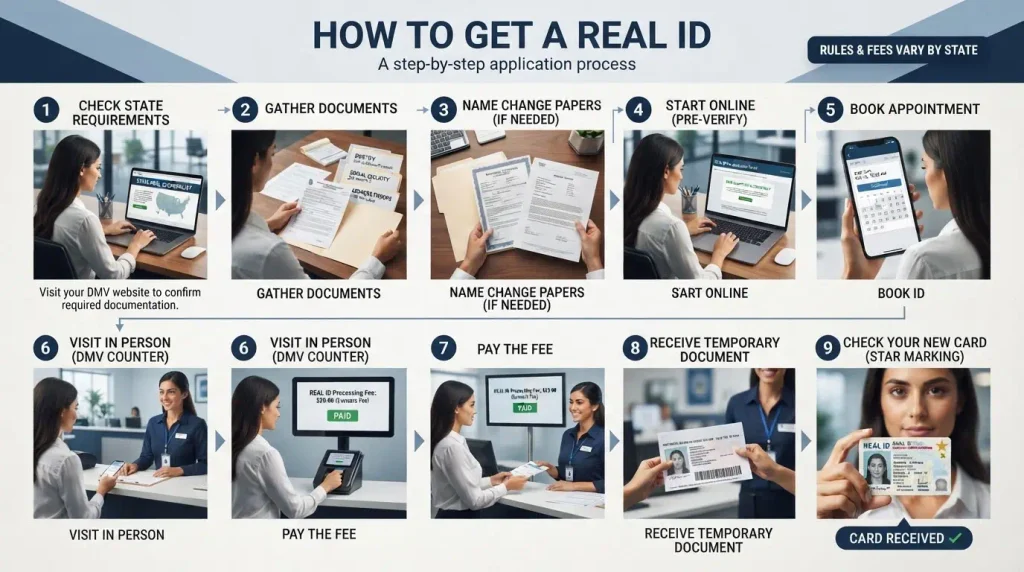
How to Get a REAL ID Step by Step
The process has the same basic shape in every state. Follow this order. Details such as fees and online steps change by state.
- Check your state’s REAL ID page. Look at the document list and any pre-screening tool the agency offers.
- Gather your documents. Collect one proof of identity, proof of your Social Security number, and two proofs of address.
- Add name change papers if needed. Bring certified copies for each change.
- Start online if your state allows it. Some states let you begin the application or pre-verify before the visit.
- Book an appointment if possible. Florida recommends scheduling ahead, and New York directs applicants to its office pages.
- Visit the office in person. Most states require a first-time visit so staff can verify your originals.
- Pay the fee. Fees differ by state, and some states charge nothing extra.
- Receive your temporary document. Keep it until the permanent card arrives by mail.
- Check the new card. Confirm that the star marking is on the front and that your name is correct.
Plan the visit for a weekday morning when you can. Bring a folder with originals and a backup copy of each item. If a document is missing, ask the clerk what you can bring on a return visit.
How Six States Handle REAL ID
State rules differ in fees, delivery times, and online options. The table summarizes what each agency publishes for the states checked for this page. Where a cell says the fee was not specified, check the agency’s fee page.
| State | In-person visit | Fee information | Delivery information |
|---|---|---|---|
| California | Application includes a visit to a DMV office | Fee not specified on the pages checked | New card by mail |
| Florida | Required for first-time REAL ID | Fee not specified on the page checked | Check the office for timing |
| New York | Required to upgrade to REAL ID | No additional fee for a REAL ID | About two weeks after a temporary document |
| Pennsylvania | Most applicants go in person; some can pre-verify online | One-time $30 REAL ID fee, plus the usual license fee | Same day at REAL ID Centers, or mail within 15 days from Driver License Centers |
| Ohio | Required at a deputy registrar location | Compliant and standard cards cost the same | Interim document at once, card by mail within 10 business days |
| Texas | Check the Texas DPS pages and its document check app | Check the DPS fee page | Check the DPS office |
Pennsylvania’s example shows how fees can stack. The state lists a $30 one-time REAL ID fee, and it notes that a non-commercial driver’s license renewal at $39.50 would bring the total to $69.50. New York and Ohio charge nothing extra for the REAL ID itself, though standard license fees still apply.
Texas details are best confirmed on the official DPS pages, so the Texas row points you there. Texas offers a document check app on its DPS site, and using it before you go is a good habit. Verify every detail on the agency’s own page.
Can You Get a REAL ID Online?
Usually not completely. States want to see your original documents at least once, so a first-time REAL ID typically needs an office visit. Some states let you start or pre-verify online to save time.
Pennsylvania says most applicants must go in person, although people who received their first Pennsylvania license, permit, or photo ID after September 2003 may be able to pre-verify online. Florida says customers must visit an office to become REAL ID compliant for the first time, and that customers who are not compliant cannot renew or replace credentials through the online portal. Ohio says you must visit a deputy registrar location and there is no option for remote application.
Once you hold a REAL ID, later renewals can often be done online. New York notes that standard renewals do not require an office visit for REAL ID holders. Check your state’s renewal rules before you assume either way.
How Long Does It Take to Get a REAL ID?
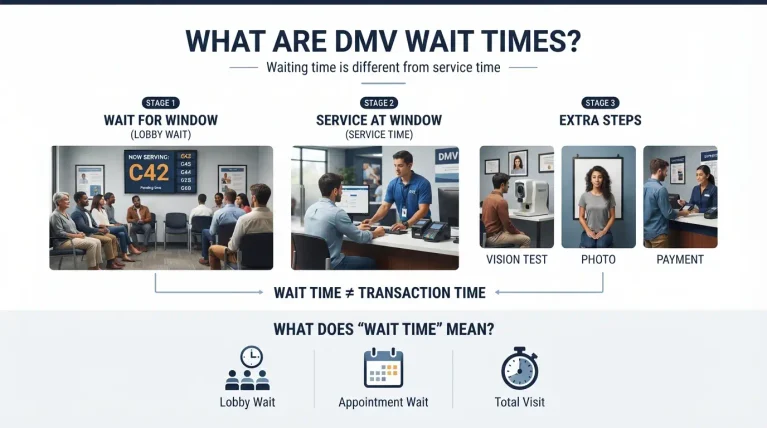
The office visit can be short, and the card usually arrives by mail in about one to two weeks, depending on the state. You normally receive a temporary document that day. Waiting times at the office are the unpredictable part.
New York says the permanent document comes about two weeks after you apply. Ohio says you receive an interim document immediately and the card by mail within 10 business days. Pennsylvania offers same-day issuance at REAL ID Centers, or mail delivery within 15 days from Driver License Centers.

If you have a flight booked, do not wait. Apply well before your travel date, since appointments can fill and mail can be delayed. Carry your passport as a backup until the new card is in your hands.
What If Your Name or Address Does Not Match?
Mismatches are the most common reason a REAL ID application stalls. The name on your birth certificate, Social Security record, and current license must line up, or you must provide the documents that explain the difference. Address proof must also show the address you want on the card.
If your name differs between documents, bring the marriage certificate, court order, or other record that connects them. If your Social Security record shows an old name, update it first. If your address documents show different spellings, bring extra proof that ties them together.
Ask the agency before you travel to the office. A short call can confirm which documents it will accept in your situation. Write down the answer and the date.
Common Mistakes When Applying for a REAL ID
These mistakes cause most second visits:
Troubleshooting: REAL ID Problems and Fixes
Your documents were rejected. Ask exactly which item failed and why, then write it down. Fix the problem and return, ideally with an appointment.
You cannot find your birth certificate. Order a certified copy from the vital records office in your birth state. This can take weeks, so start early, and consider a valid passport as your identity document instead.
Your card has no star. It is a standard license. Apply for a REAL ID at your state agency, or use a passport for flights.
Your new card has not arrived. Check your state’s status tool and confirm your mailing address. Keep your temporary document, and carry a passport if you are flying.
You have a flight soon and no REAL ID. Bring a passport or another TSA-accepted ID. Check TSA’s website for its current options, including the $45 fee option announced for 2026.
Your name changed after you applied. Update your Social Security record and then ask the agency about a replacement card with the new name. Bring your name change documents.
Frequently Asked Questions
Final Word on REAL ID
A REAL ID is a federally accepted license or state ID that you need for domestic flights and secure federal buildings, unless you carry a passport or another accepted ID. It is optional, but it makes everyday travel simpler. Look for the star on your card, and check your state’s page if you are unsure.
Gather your identity, Social Security, and address documents before you visit, and bring name change papers if they apply. Apply well before a trip, keep your temporary document, and carry a passport as a backup. A little preparation can keep you from being turned away at the counter or the checkpoint.