Briefly and concisely explain what you do for your audience
Use this space to add a medium length description. Be brief and give enough information to earn a click. Few errands have a worse reputation than a trip to the DMV, and most of that reputation comes from the wait. The good news is that wait times are not random.
This page explains what DMV wait times really mean, how to check current wait times near you, which days and hours tend to be busier, and how to skip the line entirely when your task allows it. You will also find a troubleshooting section, a checklist, and answers to the questions people ask most. Since each state runs its own system, always confirm the details on your state’s official .gov website.
What Are DMV Wait Times?
DMV wait time is the amount of time between arriving at an office, or checking in for an appointment, and being called to a service window. It is different from the time the transaction itself takes. A visit has three parts: the wait for a window, the service at the window, and any extra steps such as a vision test, photo, or payment.
People use the phrase in several ways. Some mean the lobby wait on the day, some mean how long it takes to get an appointment slot, and some mean the total time they spend at the office. Searches such as “DMV wait times near me,” “current wait times at the DMV,” and “DMV office wait times” usually mean the lobby wait right now.
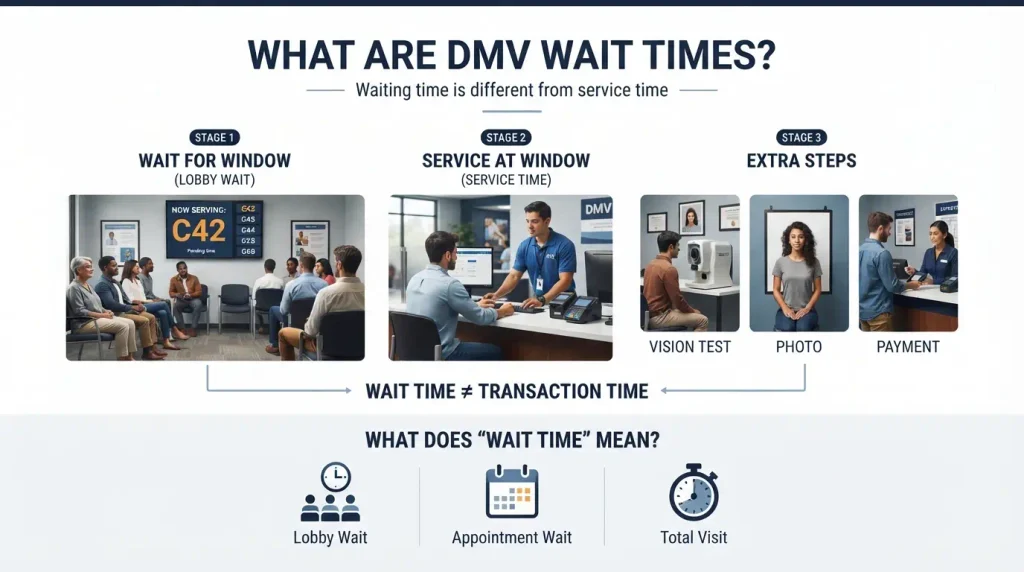
Knowing which one you mean helps you pick the right fix. A long lobby wait is solved by timing, office choice, and appointments. A long wait for a slot is solved by checking other offices, looking for cancellations, or using an online service.
How Long Is the Wait at the DMV?
There is no single national number, because wait times depend on the state, the office, the day, and the service. A quick registration sticker pickup can take minutes, while a first-time license or REAL ID can take much longer. Be careful with any website that gives one average wait for the whole country.
A few things shape the answer:
For a realistic picture, check live wait data when your state offers it, and use patterns as a backup. If your state does not publish wait times, call the office or look for other signs, such as the number of appointments still open.
How to Check Current DMV Wait Times
The most reliable way to check is your state’s official DMV website or app. Many states now publish live or near-live wait data, and a few let you join a line from your phone.
Oregon, for example, posts wait times online for field offices that have automated wait-time systems, and the numbers update through the business day. Virginia launched a tool called dmvNOW that shows how many customers are waiting at each office, the longest current wait, and wait estimates by service type, updated every five minutes. Other states use their own tools, so look for similar features.
Here is a simple way to find yours:
- Open your state’s official DMV website. Search for your state plus “DMV” and choose the result that ends in .gov.
- Go to the locations page. It may be called “Find an Office” or “Locations.”
- Enter your ZIP code. The list of nearby offices appears.
- Look for wait time information. Some states show it in the office list, while others put it on each office page.
- Compare two or three offices. Choose the one that offers your service with the shortest wait.
- Check again before you leave. Numbers change fast, especially in the morning and after lunch.
- Use the state app or text alerts if available. Some tools notify you when your turn is close.
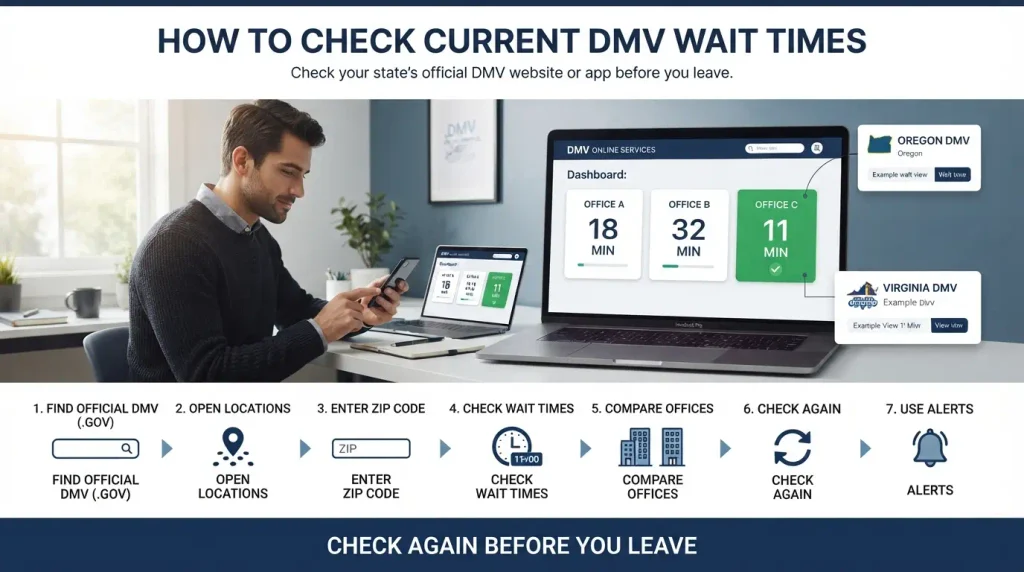
Some tools start showing numbers a short time after the office opens, since they need customers to take tickets first. If you see no data early in the morning, check again later. Third-party apps and map listings may use old or guessed numbers, so trust the official tool when you can.
What Makes DMV Lines Longer?
Lines grow when many people arrive at once and there are not enough staff or windows. Understanding the causes helps you avoid the worst moments.
Peak arrival times. Many offices fill right after opening, around lunch, and after work hours. Mondays, Fridays, and the days after holidays are often busy.
End-of-month and deadlines. Registrations and licenses that expire at the end of the month send extra visitors in the last days.
Seasonal rushes. Summer travel, the start of school, and the end of the year can raise demand. REAL ID deadlines and rule changes can also cause surges.
Complex services. First-time licenses, REAL ID visits, title work, and tests take longer per customer.
Staffing and system problems. Short staffing, computer outages, and training days can slow every line.
Missing documents. A customer who cannot complete a transaction can take extra time, and may need to return.
Walk-in volume. Offices that serve many walk-ins on top of appointments can have unpredictable lines.
Some of these factors are outside your control, but several are not. You can choose a calmer day, bring complete paperwork, and pick an office with less demand.
Best and Worst Times to Go to the DMV
Mid-week and mid-month visits are usually calmer than Mondays, Fridays, and the first and last days of the month. Advice on the best hour of the day varies. Some sources recommend late morning or early afternoon, some recommend right at opening, and some suggest late afternoon, since offices generally serve everyone who is in line at closing time.
Because the advice conflicts, treat it as a starting point and check your own office’s live data. Patterns also change from office to office. A large city branch may be busy all day, while a small rural office may be quiet except at lunch.
| Time | Typical pattern | Notes |
|---|---|---|
| Right at opening | Line may already be forming | Good if you arrive early with appointment or documents ready |
| Mid-morning | Often busy | Many people arrive after the first rush |
| Lunch hours | Often busy | Fewer staff windows at some offices |
| Mid-afternoon | Varies by office | Some offices thin out, others do not |
| Late afternoon | Varies | Offices must serve customers in line at closing |
| Monday and Friday | Often busiest | Weekend and weekday backlogs |
| Tuesday to Thursday | Often calmer | Good for non-urgent tasks |
| First and last days of the month | Often busy | Expirations and deadlines |
| Day after a holiday | Often busy | Pent-up demand |
If you can, use your office’s live wait tool for a week to see its pattern. A small amount of tracking gives you better advice than any general list. For more about Saturday and weekend options, see our page on DMV hours on Saturday.
Appointment or Walk-In: Which Has the Shorter Wait?
An appointment usually means a shorter and more predictable wait, though it is not always zero. A booked slot reserves your place, and many offices serve appointments before walk-ins. Even so, you may still wait if the office is running behind.
Walk-ins can work for simple tasks at quiet offices, but they are a gamble at busy ones. Some offices stop taking walk-ins early in the day or limit them to certain services. If you must walk in, arrive early and bring every document.
The trade-off is the wait for the appointment itself. Slots can be weeks away in busy areas. Our page on how to book a DMV appointment explains how to find an earlier time, and if you need a REAL ID, our page on the REAL ID appointment explains how to choose the right service.
Choosing the Right Office
The closest office is not always the fastest. A branch a short drive farther away may have a much shorter line. Use your state’s tool to compare wait times, and think about total time, including travel and parking.
Consider these points when you choose:
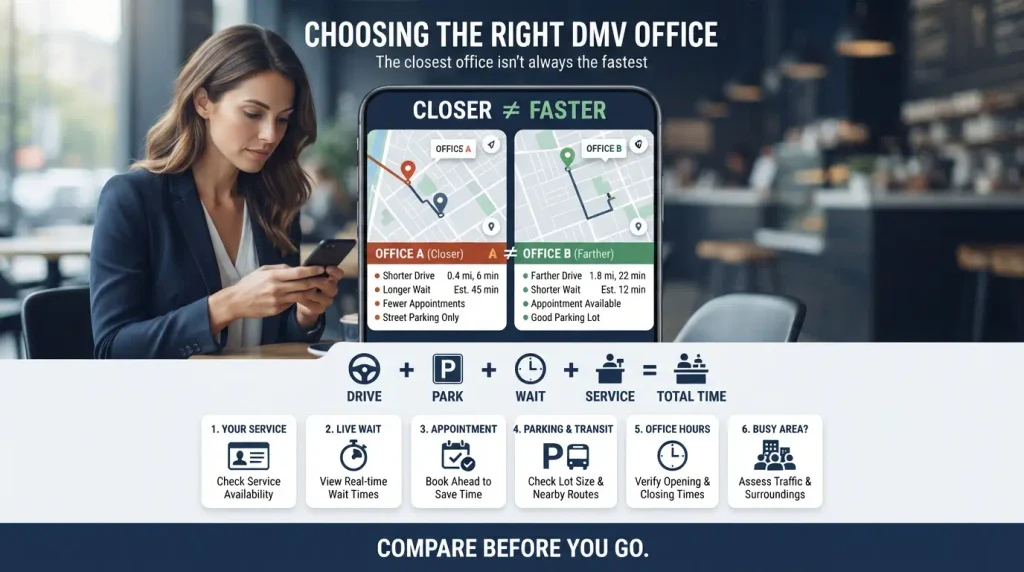
Smaller offices in towns and suburbs often have shorter lines than big city centers. Our page on finding a DMV near you explains how to compare locations and check hours. Always confirm that your chosen office handles your service before you drive.
Ways to Skip the Wait Entirely
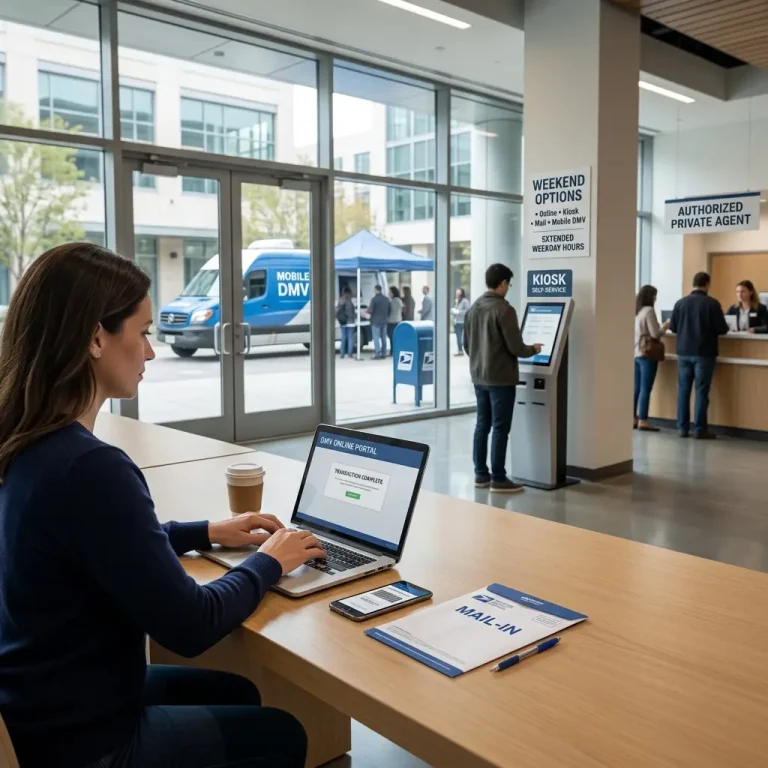
Many DMV tasks can be done without visiting an office, which removes the wait. If your task is simple, online and self-service options are the fastest choice.
| Option | Good for | Notes |
|---|---|---|
| Online | Renewals, address changes, duplicates, registration | Eligibility rules apply |
| Kiosk | Registration renewal, printing documents | Not available everywhere |
| Some renewals and registrations | Slower, use a trackable service | |
| Authorized private agent | Certain vehicle services | Usually extra fees |
| Extended or weekend hours | Working people | Limited offices and services |
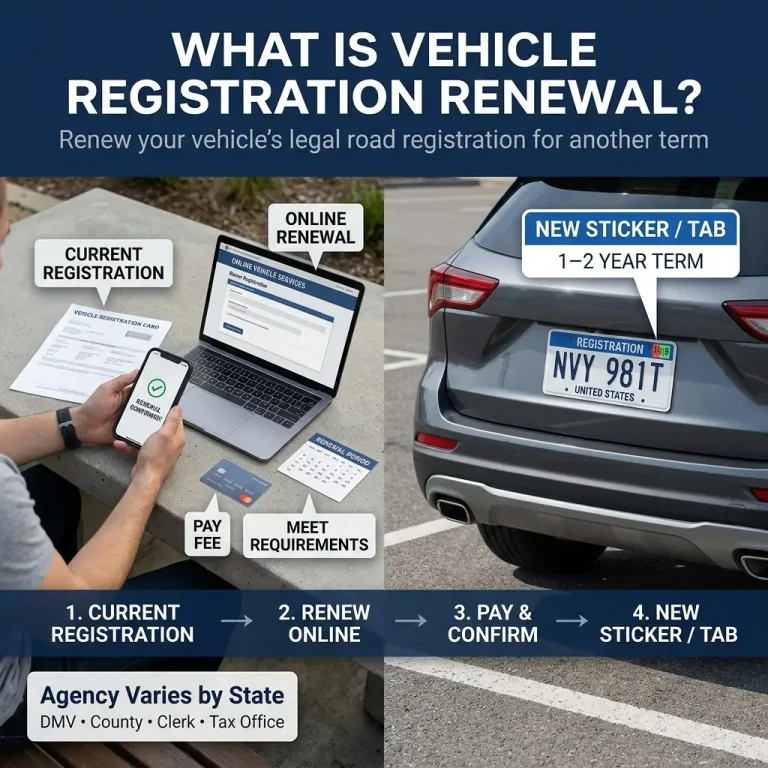
Our pages on driver’s license renewal, renewing vehicle registration online, and changing the address on your driver’s license explain which tasks you can do from home. If you must visit an office, a pre-application or document upload tool, where offered, can shorten your time at the window.
Use caution with private services. Make sure they are listed on your state’s official site, and compare their fees with the DMV’s price. A convenience fee may be reasonable, but large add-ons are a warning sign.
Virtual Queues and Text Alerts
Some states let you join a line from your phone and wait elsewhere. These tools are sometimes called virtual queues, digital tickets, or “save your spot.” You enter your details, pick a service, and receive a message when your turn is near.
Not every office offers this, and the rules differ. Some require you to be nearby when you join, while others let you join before you arrive. Check your state’s website or app for the exact steps.
If your state has no virtual queue, check whether it has alerts for appointment openings or short lines. Some sites let you sign up for texts or emails when a slot appears. Avoid paid third-party alert services that ask for sensitive details, and use the free official tools first.
Avoid a Second Trip
The longest wait of all is the one you have to repeat. Many people are turned away because of a missing document or the wrong service. A few minutes of preparation protects your time.
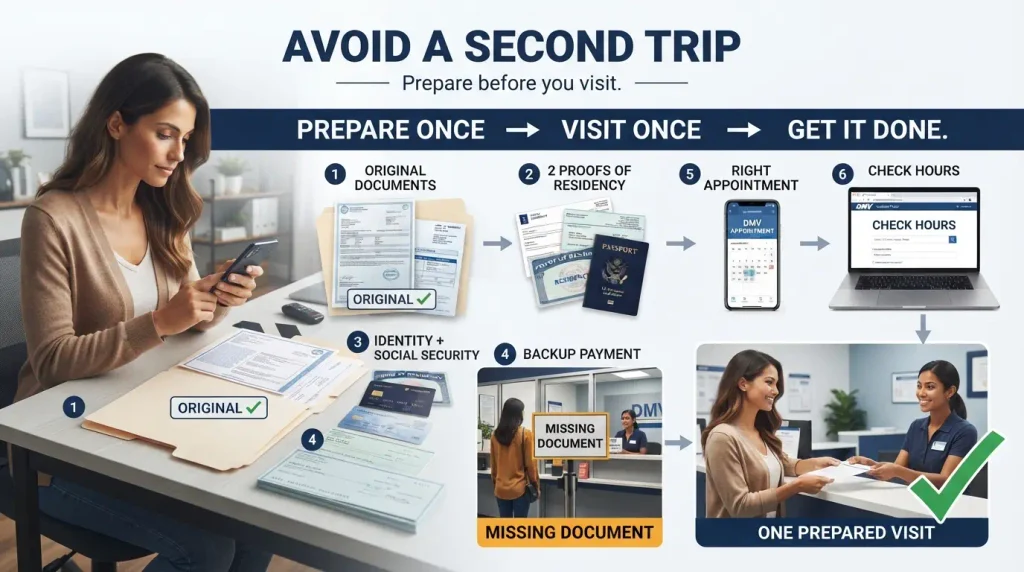
For REAL ID, driver’s license, and test visits, our pages on REAL ID requirements, the DMV written test, and the DMV appointment for a road test list what to bring and what to expect. A complete folder can turn a long visit into a short one.
Making the Wait Easier
If you still have to wait, a little planning makes it more bearable. Offices can be crowded, and waiting areas are not always comfortable.
- Bring a charged phone and a charger, in case of a long wait
- Bring a book, headphones, or work to do
- Bring water and a snack, if allowed
- Dress for the weather, since lines may form outside
- Keep your documents in a folder within reach
- Ask staff whether there are separate lines for appointments, quick services, or special needs
- Stay near the lobby so you do not miss your number
If you have a disability, are older, or are traveling with a young child, ask about priority service or accessible options. Mention your needs when you check in. Many offices can help, but they may not know unless you ask.
What to Do If the Line Is Too Long
You do not have to stay. If the wait looks much longer than you expected, you have options.
- Ask staff for an estimate. Some offices can tell you how long the wait is for your service.
- Check whether another office is closer to empty. Use the state’s wait tool on your phone.
- Check whether your task can be done online or at a kiosk. Many people discover this while waiting.
- Ask about an appointment for another day. Some offices let you book on the spot.
- Return at a calmer time. If your task is not urgent, leaving may save time.
- Stay if it is close to your turn. If you are near the front, leaving may cost more time than it saves.
If you are on a deadline, such as an expiring license, ask whether a temporary extension or alternative is possible. Do not let a long line push you into missing a deadline.
Common Mistakes About DMV Wait Times
Most long waits come from avoidable choices.
Trusting old or third-party numbers. Map apps and random websites can show outdated or guessed wait times. Use the official tool.
Going on the busiest days. Mondays, Fridays, and month-end are often the hardest.
Walking in for complex tasks. First-time licenses and REAL ID visits take longer and are better with appointments.
Choosing only the closest office. A slightly farther office can save time.
Showing up without all documents. A missing paper can mean a second wait.
Ignoring online options. Many tasks do not need a visit.
Arriving too late. Some offices stop taking customers before closing.
Using unofficial sites. Private sites may charge extra or show wrong information.
Troubleshooting DMV Wait Time Problems
Most problems have a simple fix.
Your state does not post wait times. Call the office, check appointment availability, and look at several offices. Visit during mid-week mornings if you can.
The wait tool shows no data. Some tools start a short time after opening, or only cover certain offices. Check again later, or use the office page for other information.
The posted wait was wrong. Numbers are estimates. Ask staff for an update, and consider that a surge may have arrived.
No appointments are available. Check other offices, look for cancellations, and ask about walk-in hours. See whether your task can be done online.
You were turned away. Ask exactly what was missing and write it down. Fix the problem and rebook.
The office closed early or was closed unexpectedly. Check the website for alerts, and call before you travel next time. Weather and outages can change hours.
You waited and the system went down. Ask staff whether you can stay in place or return later. Keep any ticket or receipt.
A private service charged high fees. Compare with the DMV’s price, ask for a breakdown, and consider reporting the business to your state’s consumer agency.
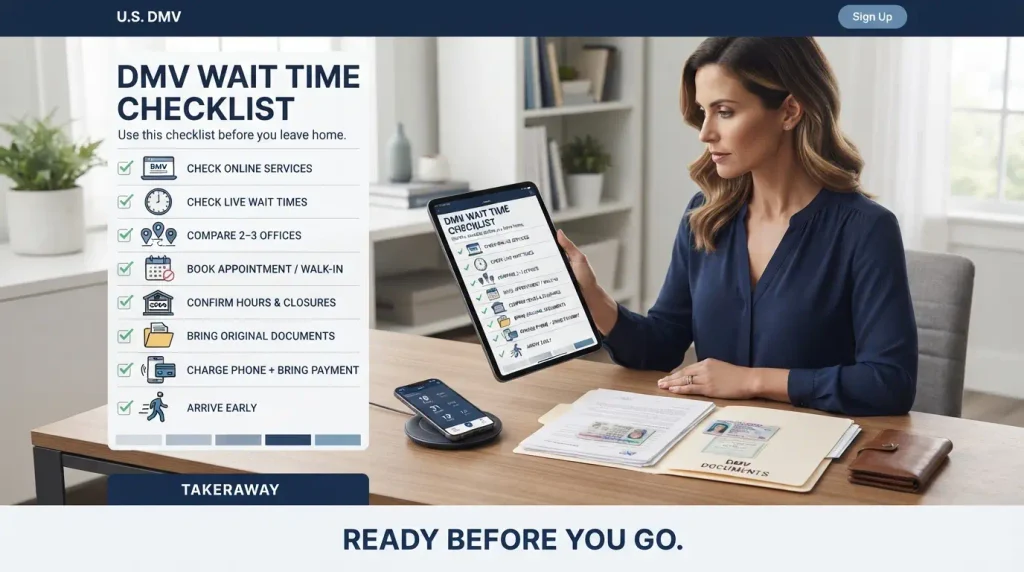
DMV Wait Time Checklist
Use this list before you leave home.
- ☐ Checked whether my task can be done online
- ☐ Looked at my state’s live wait times or app
- ☐ Compared two or three offices
- ☐ Booked an appointment, or checked the walk-in policy
- ☐ Confirmed hours and holiday closures
- ☐ Gathered original documents and a backup payment method
- ☐ Charged my phone and packed something to do
- ☐ Planned to arrive early
DMV Wait Time Terms Explained
| Term | Meaning |
|---|---|
| Wait time | Time from arrival or check-in until your number is called |
| Service time | Time spent at the window with staff |
| Lobby wait | The wait on the day in the office |
| Appointment wait | The wait to get a booked slot |
| Walk-in | A visit without a booked time |
| Virtual queue | A way to join a line from your phone |
| Wait-time tracker | An official tool that shows current wait estimates |
| Peak hours | The busiest times of day or week |
| Off-peak | Calmer times, often mid-week and mid-month |
| Kiosk | A self-service machine for simple tasks |
Frequently Asked Questions
Conclusion
DMV wait times depend on many things, but you can control more of them than you might expect. Check your state’s official tool for live numbers, compare nearby offices, and choose a calmer day when you can. Book an appointment for complex tasks, and use online or self-service options for simple ones.
Most long visits come from busy days, missing documents, and unreliable wait numbers. Use the checklist on this page, bring everything you need in one folder, and plan for the possibility of a short wait. A little preparation turns a dreaded errand into a quick one.