How to Change Address on Driver’s License: Online
Moving is stressful enough without worrying about whether your driver’s license still shows the right address. A wrong address can cause missed notices, trouble at the polls, and fines if an officer finds out you have not updated it.
This page explains who must update, how soon, which method to pick, what documents to have ready, and what to do when something goes wrong. Start with the quick answers if you are short on time, then use the checklist at the end before you submit anything.
What Does Changing Your Address on a Driver’s License Mean?
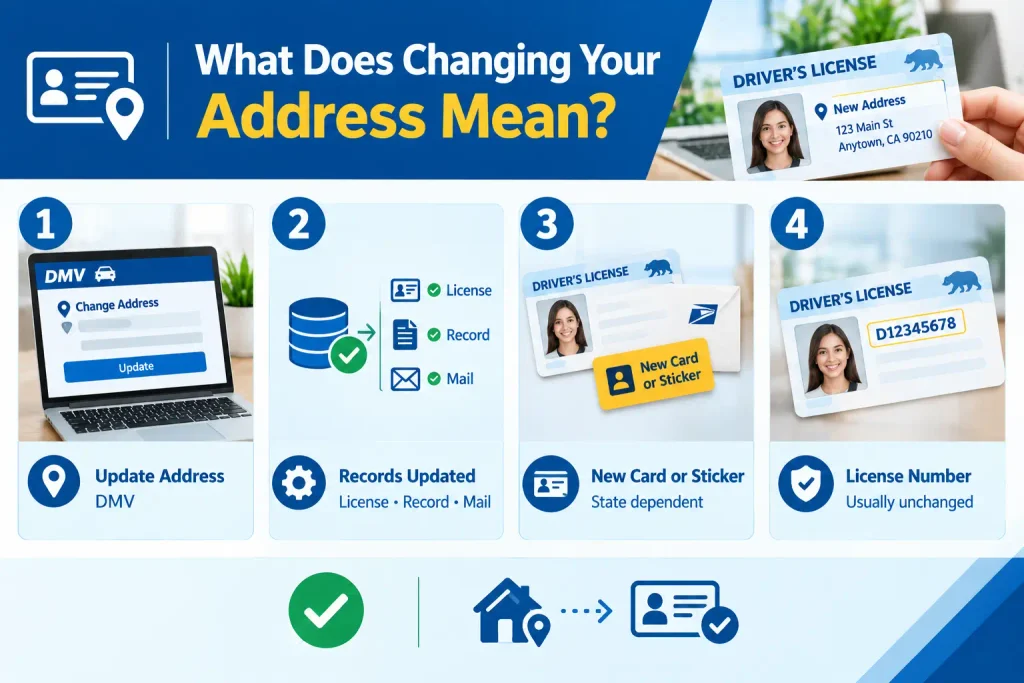
Changing your address means telling your state’s motor vehicle agency where you live now, so your license, your record, and your mail all match. The agency updates its database and, depending on the state, issues a new card, a corrected card, or a sticker. Your license number normally stays the same when you move inside the same state.
People search for this with many phrases, including “change of address for driver’s license,” “update my address on my driver’s license,” or “change driver’s license address.” They all mean the same process. Some states call the agency the DMV, while others use names such as the Secretary of State, DPS, MVD, or BMV, so look for your own state’s name.
The address on your license matters for more than mail. It affects registered voter records in many states, jury summons, tax and insurance letters, and how police and agencies confirm where you live. An outdated address can also cause problems with REAL ID applications, since your documents must match your record.
How Soon Do You Have to Change Your Address?
Most states give you about 30 days, but the range is wide. The most common deadline across states is 30 days, though a handful allow up to 60 days or set no fixed limit. The District of Columbia, for example, asks residents to report a move within five days. Some states, such as New York and Louisiana, have deadlines closer to 10 days.
Because the rules are so different, treat any number you read online as a rough guide only. Your state’s official DMV page lists the exact deadline for your situation. If you are close to the limit, update right away, since late reporting can bring a fine or extra fees in some states.
A good habit is to start the update as soon as you have proof of your new address, such as a signed lease or your first utility bill. Waiting for the move to settle down often means missing the deadline.
Moving Within Your State vs. Moving to Another State
If you stay in the same state, you update your address; if you move to a new state, you apply for a new license. These are two different processes with different costs and documents. Mixing them up is one of the most common sources of confusion.
| Situation | What you do | Typical effort |
|---|---|---|
| Same state, new address | Report a change of address | Online, mail, or short visit |
| Different state | Apply for a license in the new state | Full application, often in person |
| Same state, name also changed | Update name with Social Security first, then DMV | Extra documents needed |
| Temporary move (student, military) | Check your state’s rules | May keep home-state license |
For a move to another state, new-state deadlines commonly range from 30 to 90 days after you establish residency. You will usually surrender your old license, pass a vision test, show proof of identity and residency, and pay the new-license fee, which is often higher than a simple address change. You may also need to pass a knowledge test, depending on the state.
If you hold a commercial driver’s license (CDL), federal rules add a requirement. When you move to a new state, you must apply for a CDL transfer within 30 days of establishing residency there. Address changes within the same state follow the standard process, but missing the deadline can carry more risk for professional drivers.
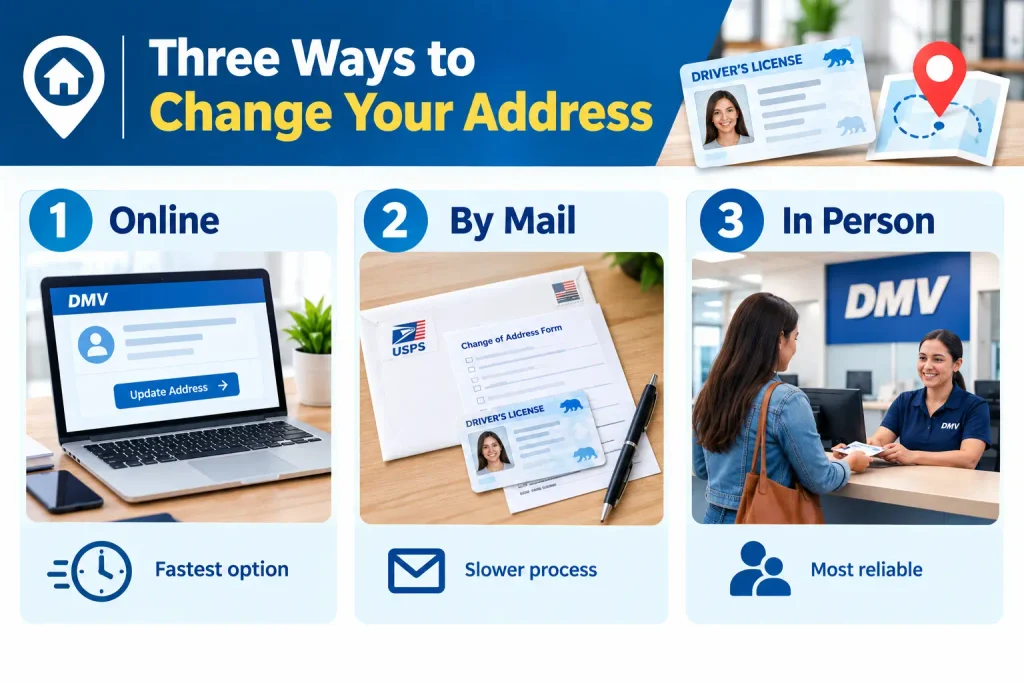
Three Ways to Change Your Address
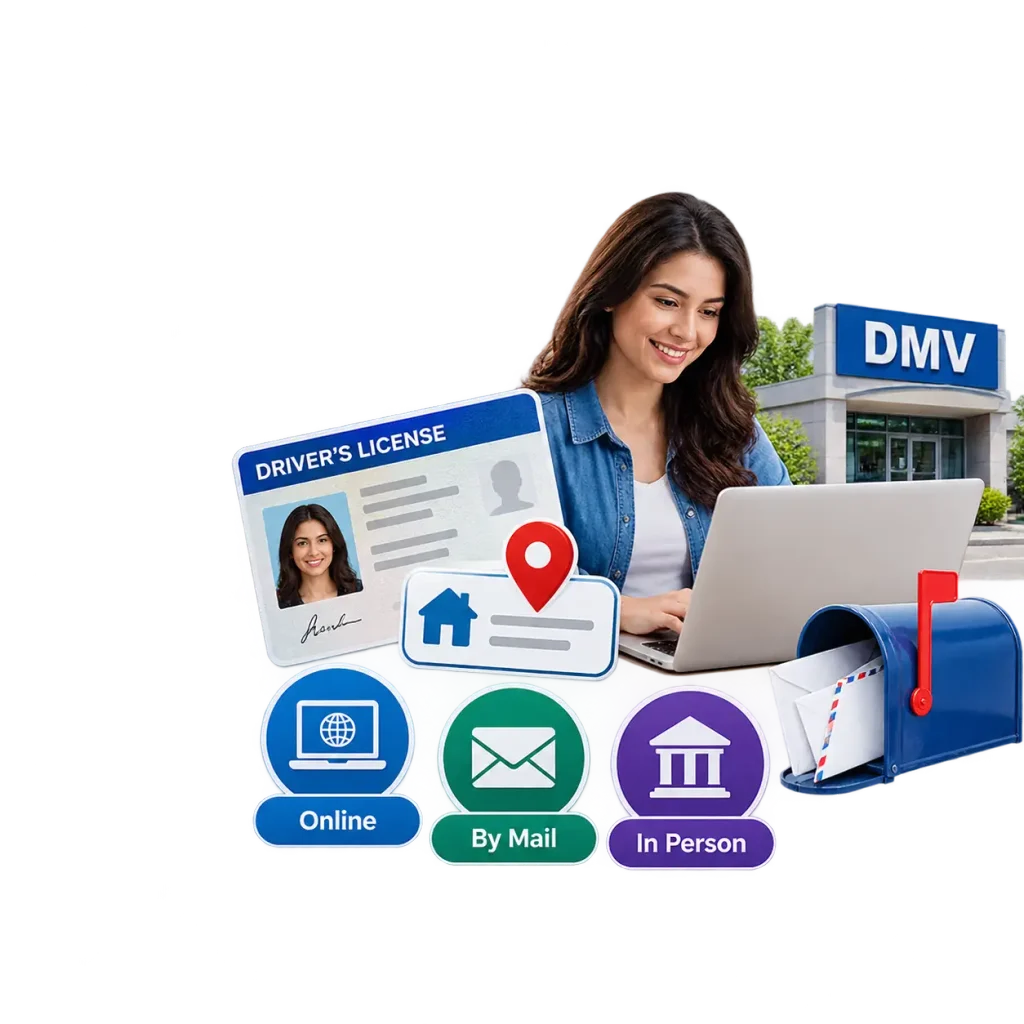
Most states let you update online, by mail, or in person. Pick the method that fits your documents and timing. The online option is usually the fastest, but not every driver qualifies.
Changing Your Address Online
Online is the quickest route. Most states let you change the address on your driver’s license through their official website in a few minutes. You usually log in or enter your license number, confirm your identity, type the new address, and pay any fee.
Some states require a state-specific account, such as a MyDMV account in New York. Others ask you to upload proof of address, and some limit online changes to people with a REAL ID or a recent in-person visit. If the website says you do not qualify, you can still use mail or an office visit.
Changing Your Address by Mail
Mail works if you do not qualify for online service. You download the change-of-address form from your state’s DMV site, complete it, and send it with a copy of your license and any required proof or fee. Many states accept a completed form mailed to a designated address, often with copies of the license front and back.
Mail is slower. Processing often takes two to three weeks before the change shows on your record, and some agencies list a shorter window. Use a trackable mail service if you can, and keep a copy of everything you send.
Changing Your Address in Person
In-person service is the most reliable when your situation is complicated. Bring your current license, proof of residency, and a payment method for any card fee. The clerk checks your documents, updates the address, and often gives you a temporary paper license that is valid for a limited period, commonly 30 to 60 days.
Many offices now require or prefer an appointment, so check your state’s booking page before you go. If you need to arrange a visit, our page on the DMV appointment process explains how to book a slot and avoid long waits.
Step-by-Step: How to Change Your Address
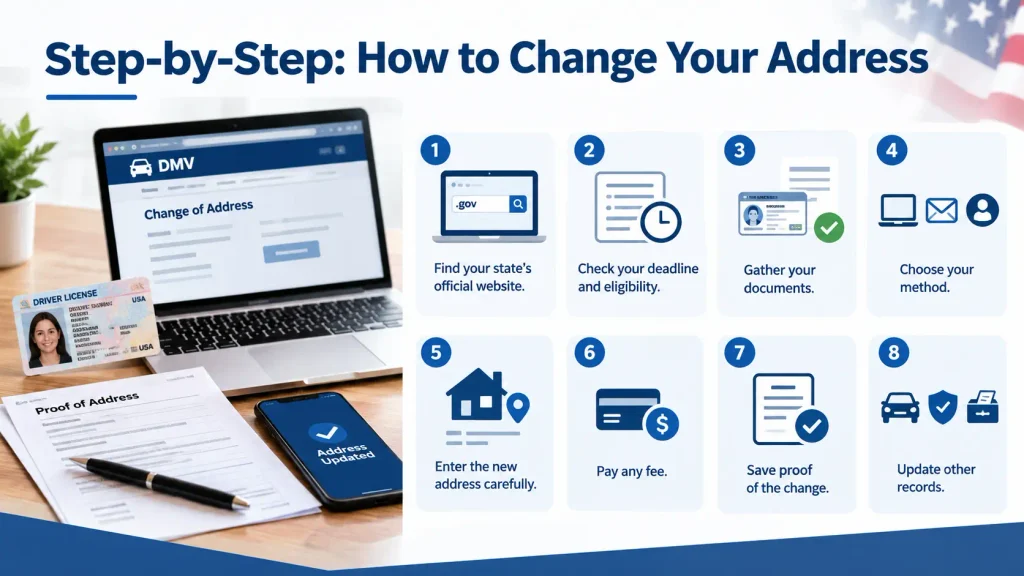
The steps below work in most states, with small differences in names and layout.
- Find your state’s official website. Search “[your state] DMV change of address” and open the result that ends in .gov. Avoid ads and third-party sites that charge extra.
- Check your deadline and eligibility. Read the page for time limits, fees, and whether you can update online.
- Gather your documents. Have your license number, date of birth, Social Security number if asked, and proof of your new address.
- Choose your method. Online if you qualify, mail if you prefer paper, or in person for complex cases.
- Enter the new address carefully. Use your full residential street address, including apartment number and ZIP code, exactly as it appears on your proof.
- Pay any fee. Keep the receipt or confirmation number.
- Save proof of the change. Take a screenshot or keep the confirmation email until your new card or sticker arrives.
- Update other records. Change your vehicle registration, insurance, voter registration, and other accounts, as covered below.
Documents and Proof of Residency
Most states ask for proof that you really live at the new address. The most common accepted documents are a utility bill, a bank statement, a lease or rental agreement, and a mortgage statement. Some also accept an insurance policy, a property tax bill, a pay stub, or official mail from a government agency.
| Document type | Usually accepted? | Notes |
|---|---|---|
| Utility bill (electric, gas, water) | Yes | Must show your name and address |
| Bank or credit card statement | Yes | Printed or official PDF |
| Lease or rental agreement | Yes | Signed, with your name |
| Mortgage statement or deed | Yes | Shows your name and property |
| Insurance policy | Often | Check state list |
| Government mail | Often | Not junk mail |
| PO Box address | Usually no | Residential street address required |
Check the date on each document. Many states want papers issued within the last 60 to 90 days. The name and address should match what you enter, and a PO Box does not count as a residence.
If you live with a roommate, family member, or landlord and have no bills in your name, ask your state about alternatives. Some offices accept a signed statement from the person you live with along with their own proof. Rules differ, and some online systems require you to visit an office in this case.
How Much Does It Cost to Change Your Address?
The fee depends on your state, and some states charge nothing for a simple address update. Others charge a small amount to issue a corrected or replacement card. Fees for a new license card after an address change vary widely.
You may also pay more if your change comes with other services. A renewal, REAL ID upgrade, or a late fee can add to the cost, and a new-state license usually costs more than an address update. A new-license fee in many states falls in the range of $25 to $50, depending on the license class, though your state may differ.
If you change your address as part of a renewal, you often pay only the renewal fee. Check the fee page on your state’s .gov site, and avoid any third-party site that adds a “service fee” on top.
How Long Does It Take?
Online changes are often instant or take a few days, while mail takes roughly two to three weeks. Processing times depend on the state and how busy the office is. Some agencies publish a window, such as 7 to 10 business days for mail, plus extra time for the product to arrive.
After the record is updated, your new card or sticker is mailed to the new address. Allow up to a few weeks before contacting the DMV, and use your confirmation number when you call. If you got a temporary paper license, keep it with you until the permanent card arrives.
What You Get After the Change: New Card, Sticker, or Nothing?
What you receive depends on the state. Some states mail a new card with the updated address, some mail a small address sticker for the back of your card, and some update only the record and let you keep your card. A few states let you choose between a new card and no card at all.
If you keep an old card, make sure you understand the rules. Some places consider a card with the wrong address invalid for certain uses, such as REAL ID verification or voter ID in some areas. If you are unsure, request a corrected card, even if it costs a small fee.
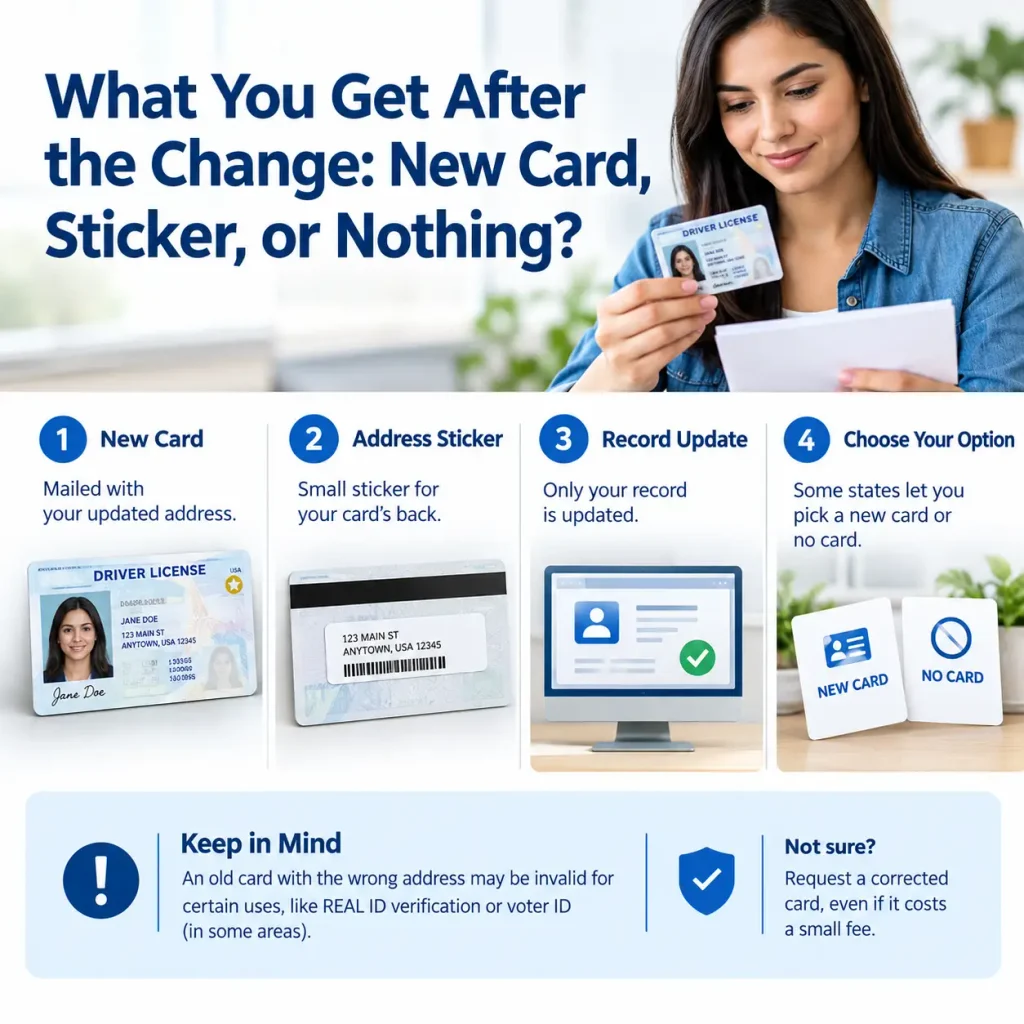
Do not throw away your old card until the new one arrives. If your state mails a sticker, place it exactly where the instructions say, and do not cover other information on the card.
REAL ID, CDL, and Special Cases
A few situations add extra steps.
REAL ID holders. If you already have a REAL ID, some agencies let you update your address online by uploading your residency documents. If you do not have one and want one, you will usually need an in-person visit with identity and residency proof.
Commercial driver’s license holders. Same-state moves follow the normal process, but CDL holders should update quickly because employers and federal rules may require current records.
Military members. Service members often have special rules for keeping a home-state license while stationed elsewhere. Ask your state about military options before you change anything.
College students. Some states let students keep a home-state license while living on campus, while others ask you to update if you consider the new state your home. Check both your home state and your school’s state.
People with safety concerns. Some states run address confidentiality programs for people at risk of harassment or abuse. If this applies to you, ask the DMV about options before you submit your new address.
Name changes. If your name also changed, update your name with the Social Security Administration first when required, then handle the DMV. Documents must match, or the update may be rejected.
Other Places You Should Update Your Address
Changing your license address does not update everything. A USPS change of address forwards mail but does not update your driver’s license. In many states, the DMV address change can update voter registration, but you should confirm that on your state’s page.
Update these as soon as you can:
- Vehicle registration and title, since many states require this separately from your license
- Auto, renters, and homeowners insurance, because wrong addresses can affect rates and claims
- Voter registration, so you receive ballots and vote at the right location
- Bank, credit card, and loan accounts
- Employer and payroll records
- IRS and state tax accounts, and the Social Security Administration if you receive benefits
- Medical providers and health insurance
- Subscriptions and delivery services
Doing this in one sitting prevents missed bills and mail sent to your old home.
Common Mistakes When Changing Your Address
Most problems are easy to prevent.
Waiting past the deadline. Late reports can lead to fines or late fees in some states. Start as soon as your proof of address is ready.
Assuming a USPS change of address is enough. It forwards mail but does not update your license or registration.
Using a PO Box. Most agencies require a residential street address for the license. A PO Box can be used for mailing in some states, but not as your residence.
Submitting documents that do not match. Different spellings, a missing apartment number, or an old name can cause rejection. Use the exact same details everywhere.
Using an unofficial website. Many sites look like the DMV but charge extra fees. Always start from your state’s .gov page.
Forgetting vehicle registration. Your license and registration are often handled separately, so update both.
Moving to a new state but trying to update only. A move across state lines usually needs a new license, not an address change.
Troubleshooting Address Change Problems
Most problems have a simple fix.
The Online System Will Not Let You Update
Check whether you qualify. Some states restrict online updates to certain license types, require a REAL ID, or need a recent visit. Try again later, use another browser, or switch to mail or an office visit.
Your Proof of Address Was Rejected
Check the date, the name, and the exact address on the document. Use a different accepted document, such as a bank statement or lease. If you have no document in your name, ask your state about a signed statement from the person you live with.
Your New Card Has Not Arrived
Wait the full processing time, then check your confirmation number on the DMV site. Confirm that the address on the confirmation is correct, since a typo can send the card to the wrong place. If it is wrong, contact the DMV right away.
You Typed the Wrong Address
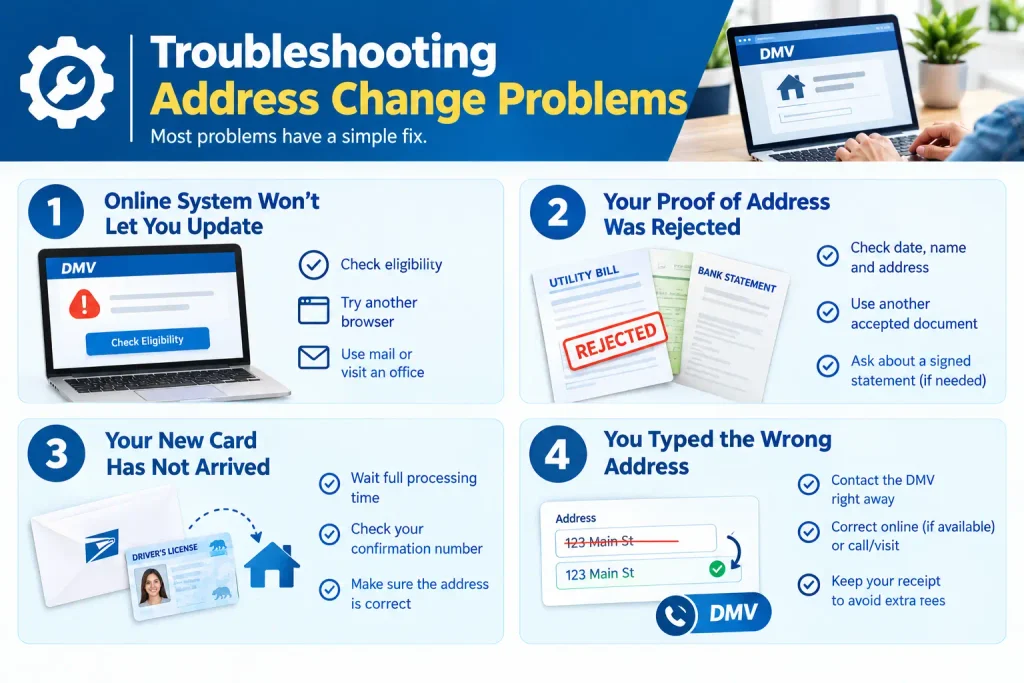
Contact the DMV as soon as you notice. Some systems let you correct it online, while others require a call or a visit. Keep your receipt to avoid paying twice.
Checklist and Tips
A short checklist helps you finish in one visit or session.
Some tips help in practice. Do the update from a computer if possible, since uploads and forms are easier to complete. Take photos or scans of your documents ahead of time. If you share a home, ask the person on the lease or bills to help with proof before the deadline.
Driver’s License Address Terms Explained
| Term | Meaning |
|---|---|
| Change of address | Updating the residence on your license and record |
| Proof of residency | Documents that show where you live |
| Duplicate or corrected card | A new card issued with updated information |
| Address sticker | A label placed on the back of your card |
| REAL ID | A federally compliant license or ID, usually marked with a star |
| CDL | Commercial driver’s license for large or hazardous vehicles |
| USPS change of address | A mail forwarding request, separate from the DMV |
| Residential address | Where you live, not a PO Box |
Frequently Asked Questions
Conclusion
Changing the address on your driver’s license is one of the simplest tasks on a moving checklist, as long as you act before your state’s deadline. Check the rules on your state’s .gov site, choose online, mail, or in-person service, and have a proof-of-address document ready. Keep your confirmation number and your temporary license until the new card or sticker arrives.
Most problems come from missed deadlines, mismatched documents, and forgetting that a USPS change of address does not update the DMV. Use the checklist on this page, update your vehicle registration and voter records at the same time, and you will keep your license accurate with very little hassle.