DMV Appointment: How to Book, What to Bring
A DMV appointment is a reserved time slot at your state’s motor vehicle office to handle a service such as a driver’s license, ID card, learner’s permit, vehicle registration, or road test.
Whether you need a first license, a learner’s permit, a REAL ID, a registration renewal, or a road test, the steps below follow the same logic. Read the sections that match your situation, then use the checklist near the end before you leave home.
What Is a DMV Appointment?
Instead of standing in a general line, you arrive at a set time and are served in a separate queue. Most states have used this system for years because it spreads visitors across the day and shortens lobby crowds.
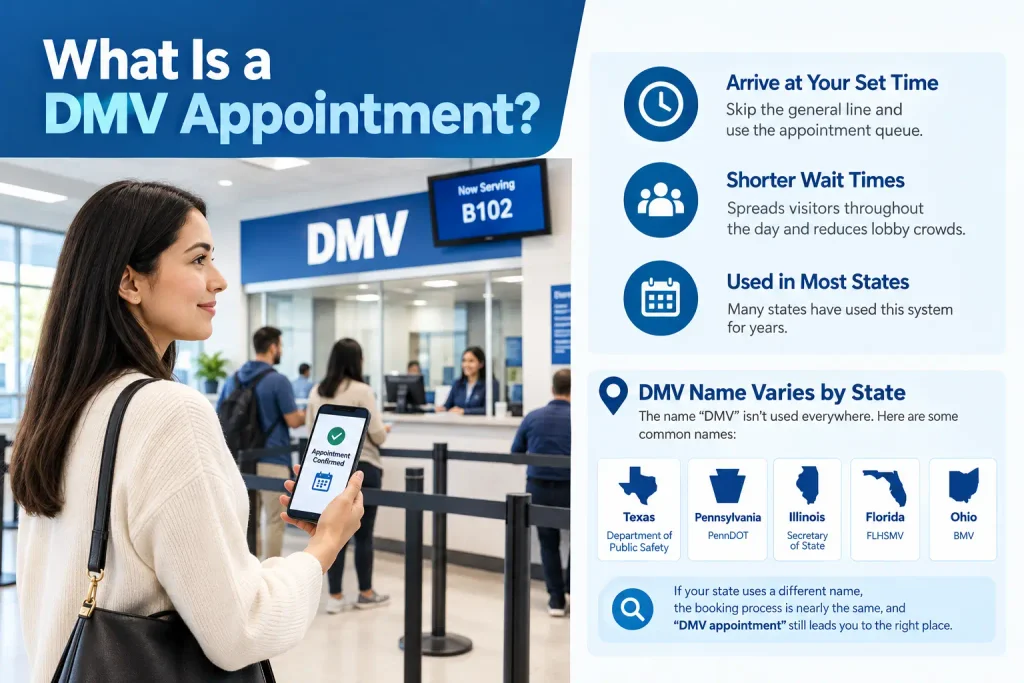
The name “DMV” stands for Department of Motor Vehicles, but not every state uses it. Texas runs licensing through the Department of Public Safety, Pennsylvania uses PennDOT, Illinois uses the Secretary of State, Florida uses FLHSMV, and Ohio uses the BMV. If your state uses a different name, the booking process is nearly the same, and the search term “DMV appointment” still leads you to the right place.
There is no single national DMV. Each state sets its own fees, document rules, office hours, and booking tools. That is why advice that works in California may not apply in Georgia, so always confirm details on your own state’s official website.
Which Agency Handles DMV Appointments in Your State?
Your state’s licensing agency may carry a different name, but it handles the same services. The table below shows how several large states label their agency, so you know what to search for. Always verify the current website and booking portal on the .gov domain, since names and tools change.
| State | Agency name | Booking tool or portal (common name) |
|---|---|---|
| California | Department of Motor Vehicles (DMV) | Online appointment scheduler on the DMV site |
| New York | Department of Motor Vehicles (DMV) | MyDMV account and online reservations |
| Texas | Department of Public Safety (DPS) | DPS online appointment system |
| Florida | FLHSMV, plus county tax collector offices | Appointment links on the FLHSMV and county sites |
| Pennsylvania | PennDOT | Driver and vehicle services scheduler |
| Illinois | Secretary of State | Facility appointment page |
| Ohio | Bureau of Motor Vehicles (BMV) | BMV online services and registrar scheduling |
| Georgia | Department of Driver Services (DDS) | DDS online appointment tool |
| Michigan | Secretary of State | Online appointment scheduler |
| Arizona | Motor Vehicle Division (MVD) | ServiceArizona appointment page |
| Virginia | Department of Motor Vehicles (DMV) | Online customer service center scheduling |
| New Jersey | Motor Vehicle Commission (MVC) | MVC online appointment system |
Some states split duties between agencies. In Florida, for example, county tax collectors handle many driver license and registration visits, while Georgia separates driver services (DDS) from vehicle tags at county tag offices. If you cannot find the booking page, call the number listed on your state’s official .gov website.
Do You Actually Need a DMV Appointment?
In many states, yes for in-person services, but not always. Some offices accept walk-ins only, some require appointments for certain services, and some offer both. Road tests and commercial driver’s license (CDL) services are the most likely to require a reservation.
Before booking, check whether your task can be done online. Many states let you renew a registration, update an address, replace a lost license, or renew a standard license without visiting an office. Skipping the trip saves time and often costs the same.
| Option | Best for | Typical downside |
|---|---|---|
| Online | Renewals, address changes, duplicates, registration | Not available for first-time licenses or new REAL ID |
| Appointment | New license, permit, REAL ID, road test, title work | Slots can be weeks out in busy areas |
| Walk-in | Quick questions, same-day needs where allowed | Long waits, no guaranteed service |
| Kiosk | Registration renewal, printing documents | Limited services |
| Some renewals and registration | Slower, and mistakes cost days |
If your state offers both walk-in and appointments, an appointment is usually the safer choice. You get a defined time, and staff can often process you faster because the reason for your visit is already on file.
How to Make a DMV Appointment Step by Step
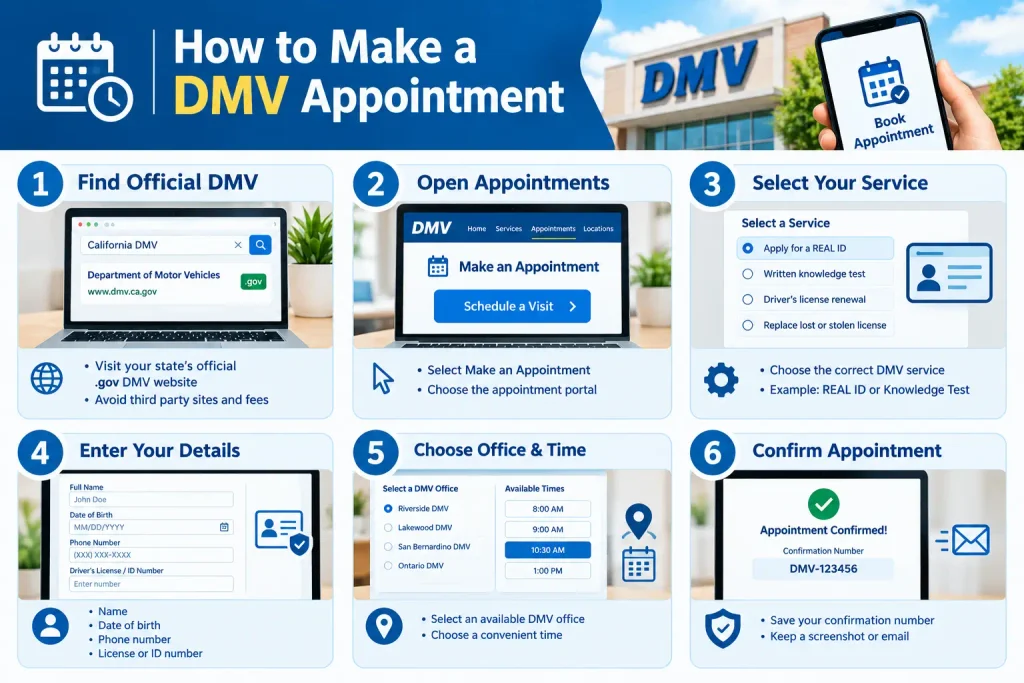
The fastest way to book is through your state’s official DMV website. The steps below work in most states, with small differences in layout and naming.
Booking Online
- Find your state’s official site. Search “[your state] DMV” and look for the result ending in .gov. Avoid ads and sites that charge a “booking fee.”
- Open the appointment section. It may be labeled “Make an Appointment,” “Schedule a Visit,” “Book Appointment,” or sit inside a portal such as a MyDMV account.
- Choose your service. Pick the exact reason for your visit, such as “Apply for a REAL ID” or “Written knowledge test.” Choosing the wrong service can lead to a turned-away visit.
- Enter your details. You will usually give your name, date of birth, phone number, and sometimes your license or ID number.
- Select an office and time. Look at several locations, not just the closest one, because a branch 20 minutes farther away may have an opening this week.
- Confirm and save the details. Take a screenshot of the confirmation, and check your email for a confirmation number.
Booking by Phone
Phone booking works when the website is confusing or has no slots showing. Call your state’s official DMV number, listed on the .gov site, and have your date of birth and the service you need ready. Phone lines are often busiest in the morning and on Mondays, so a midweek afternoon call tends to go better. Write down the date, time, office address, and any confirmation number the agent gives you.
Booking in Person
Some offices let you book a future slot at the counter or at a kiosk. This is useful if you are already at the DMV for another reason and need a second visit. Ask whether the office offers an appointment for your service before you leave, since walk-in windows can close early in the day.
Which Services Can You Book?
Most DMVs let you book appointments for licensing, ID, permits, vehicle paperwork, and driving tests. The exact menu depends on your state, but these are the usual ones.
DMV Appointment for a First-Time Driver or Teen
New drivers usually follow a staged path: permit, supervised practice, road test, then a full license. Most states use a graduated licensing system, which adds limits such as night driving rules or passenger restrictions for teens during the first months. The minimum ages and practice hours differ by state, so check your state’s teen driver page.
For the permit appointment, expect a vision test and a written knowledge test, plus proof of identity and residency. A parent or guardian often has to sign a consent form and may need to attend. Some states also ask for a school attendance form or a driver education certificate.
When the practice period ends, you will book the road test. Make sure the car you bring is insured, registered, and in safe working order, since examiners can cancel the test if a headlight or brake light fails. Bring your permit and any practice-hours log your state requires.
DMV Appointment for New Residents and Out-of-State Transfers
If you move to a new state, you typically must switch your license and registration within a set number of days. The deadline varies, and some states give 30 days while others give longer. Check your new state’s rules early so you do not drive on an expired status.
Most states ask you to surrender your old license, pass a vision test, and show proof of your new address. Some may also require a knowledge test, though many waive it for people with a valid license from another state. For your vehicle, bring the title or registration, proof of insurance, and any inspection or emissions paperwork your state requires.
Book the appointment as soon as you have a lease, a utility bill, or other proof of your new address. Waiting until the deadline is a common cause of rushed visits and avoidable late fees.
DMV Appointment for Seniors, Veterans, and Non-Citizens
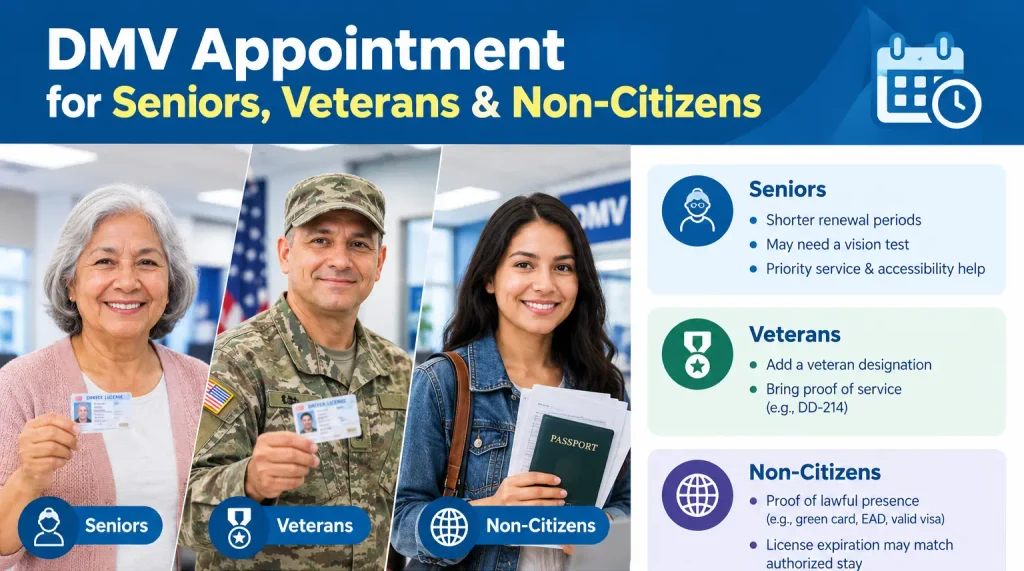
Some groups have extra requirements or special options, so ask about them when you book. Older drivers may face shorter renewal periods or vision tests in some states, and many offices offer priority service or accessibility help. Veterans may be able to add a veteran designation to a license or ID, which usually requires proof of service such as a DD-214.
Non-citizens often need documents that show lawful presence, such as a permanent resident card, an employment authorization document, or a valid visa with supporting papers. In many states, the license expiration is tied to the length of the person’s authorized stay. Because these rules are detailed and change from time to time, read your state’s checklist carefully and bring original documents.
If you need an interpreter, a wheelchair-accessible path, or another accommodation, mention it when you schedule. Many offices can arrange help, but they may need advance notice. Calling ahead is usually faster than asking at the counter.
Vehicle Appointments: Registration, Title, and Plates
Vehicle services often need a different set of documents from driver services. If you are buying or selling a car, a title transfer is the key step. You will usually need the signed title, a bill of sale, proof of insurance, and an odometer disclosure for newer vehicles.
For a new registration, bring the title or manufacturer’s certificate of origin, proof of insurance, and your ID. Some states also require a safety inspection, an emissions test, or proof that sales tax or fees were paid. Fees often depend on the vehicle’s value, weight, or age, and local taxes may apply.
If your task is only a registration renewal, check whether you can do it online or at a kiosk. Many people get a quick sticker or receipt without an appointment. Keep your proof of insurance current, because a lapse can block the renewal.
REAL ID: What It Is and Why It Matters
A REAL ID is a license or ID card that meets federal security standards, and it is now needed for boarding domestic flights and entering some federal facilities. You can usually tell by a star marking in the upper part of the card. A standard card is still valid for driving, but it will not satisfy those federal uses on its own.
Getting a REAL ID usually requires an in-person visit with stricter documents than a regular renewal. Expect to show proof of identity, your full Social Security number, and two proofs of residency, and the names on your papers must match. If your name has changed through marriage or a court order, bring the linking document.
Some travelers use a passport or another federally accepted ID instead of a REAL ID. Check the current rules from the Transportation Security Administration and your state’s REAL ID page before you plan a trip. Booking early is wise, since REAL ID visits can be longer than standard ones.
CDL and Motorcycle Appointments
Commercial and motorcycle licenses add extra tests and paperwork. A CDL requires a federal medical certificate for most drivers, a knowledge test, and a skills test that includes a pre-trip inspection and a road portion. Many states require a commercial learner’s permit first, with a waiting period before the skills test.
For motorcycles, many states add an endorsement to your regular license after a knowledge test and a rider skills test or an approved safety course. Completing a state-approved course can sometimes replace the skills test. Ask your DMV what applies, and book early because skills test slots can be limited.
Documents to Bring to Your DMV Appointment
Bring original documents or certified copies; photocopies are usually rejected. Requirements vary by state and service, but most offices ask for the same four categories. The most common reason people get turned away is missing proof of residency.
| Category | Examples |
|---|---|
| Proof of identity and date of birth | US passport, certified birth certificate, permanent resident card |
| Proof of Social Security number | Social Security card, W-2, or SSA-1099 showing the full number |
| Proof of residency (often two) | Utility bill, bank statement, lease or mortgage, insurance statement |
| Proof of legal presence | Passport, naturalization certificate, or valid immigration documents |
| Name change documents (if needed) | Marriage certificate, divorce decree, or court order |
For a REAL ID, the document rules are stricter, and the name on every document must match. For vehicle services, add your title, proof of insurance, and a signed application if your state requires one. Teenagers applying for a permit often need a parent or guardian to sign a consent form, and some states also ask for proof of school enrollment.
Check your state’s interactive document checklist before the day. A missing signature or an expired paper can send you home, and a second trip often means another wait for a new slot.
DMV Appointment Fees and Payment
Making the appointment is generally free; the service you receive carries the fee. Costs vary widely. A standard license or ID may run from roughly the low $20s to $90 or more, depending on the state and the license term, while permits, tests, and registrations have their own rates.
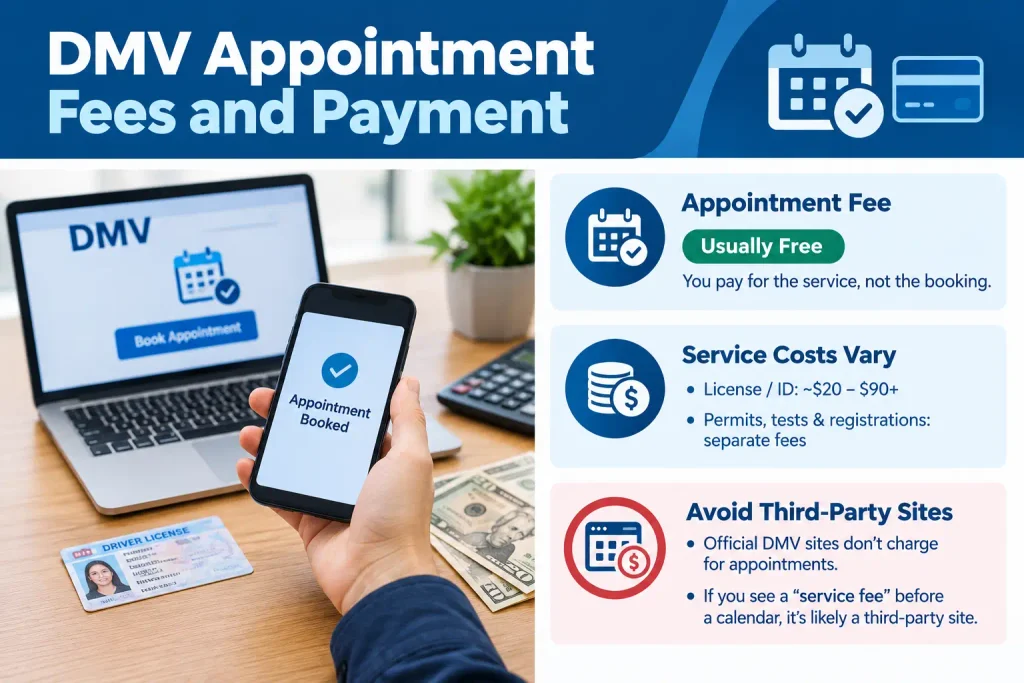
Beware of any site that charges you just to schedule a visit. Official DMV websites do not sell appointment slots. If you see a “service fee” before you reach a calendar, you are probably on a third-party site.
Payment methods differ by office. Many accept debit and credit cards, often with a processing fee, while some prefer checks or money orders, and a few still limit cash. Check your DMV’s payment page before you go, and bring a backup method in case a card reader is down.
How Long Does a DMV Appointment Take?
A typical visit takes 30 to 90 minutes, though the wait to get a slot can be days or weeks. A simple renewal or document check can be quick, while a first-time license that includes a photo, vision test, and written exam takes longer. Road tests are scheduled in their own blocks, often 20 to 30 minutes of driving plus paperwork.
Booking lead time depends on your location and the time of year. Big metro areas and the weeks around summer, the start of school, and the end of the year are the busiest. Smaller offices in rural areas often have openings much sooner, which is worth knowing if you can travel.
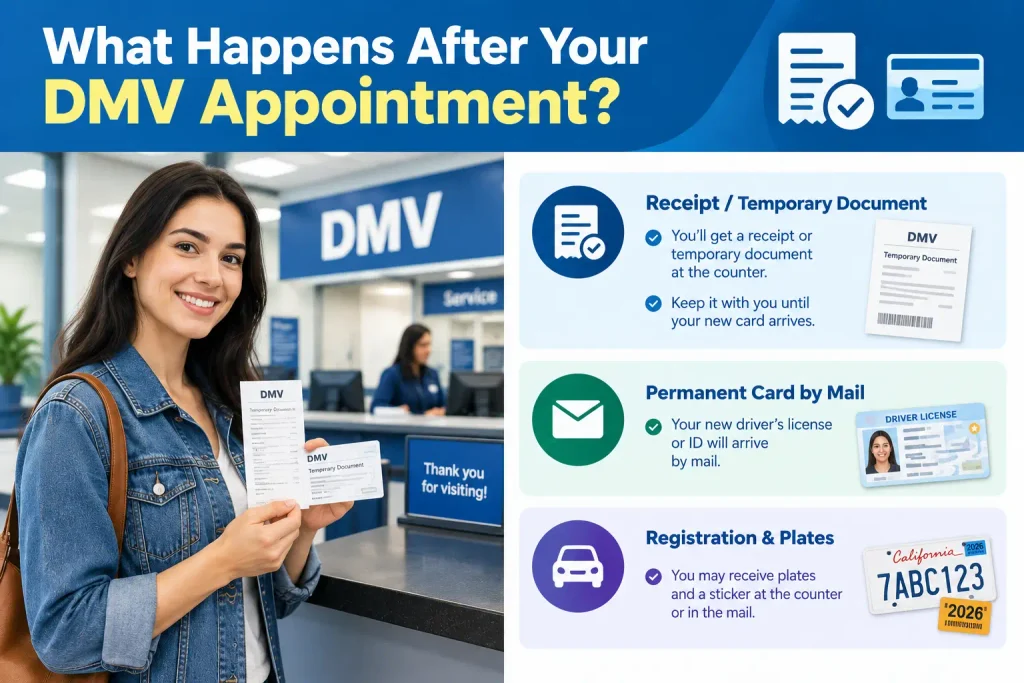
You also have processing time after the visit. Many states issue a temporary paper license on the spot and mail the permanent card within roughly one to three weeks. Keep the paper copy until the real card arrives.
When Are DMV Offices Least Crowded?
Mid-week mornings and mid-month days are usually calmer than Mondays, Fridays, and the first or last days of the month. Offices tend to fill after lunch and on the day after a holiday. Weather and school schedules can also change patterns in your area.
If you have flexibility, book the first slot of the day. Schedules tend to run behind later, and early appointments are less likely to be delayed by earlier visitors. Avoid the days when many registrations expire, since the last days of the month can bring heavy traffic.
How to Find an Earlier DMV Appointment
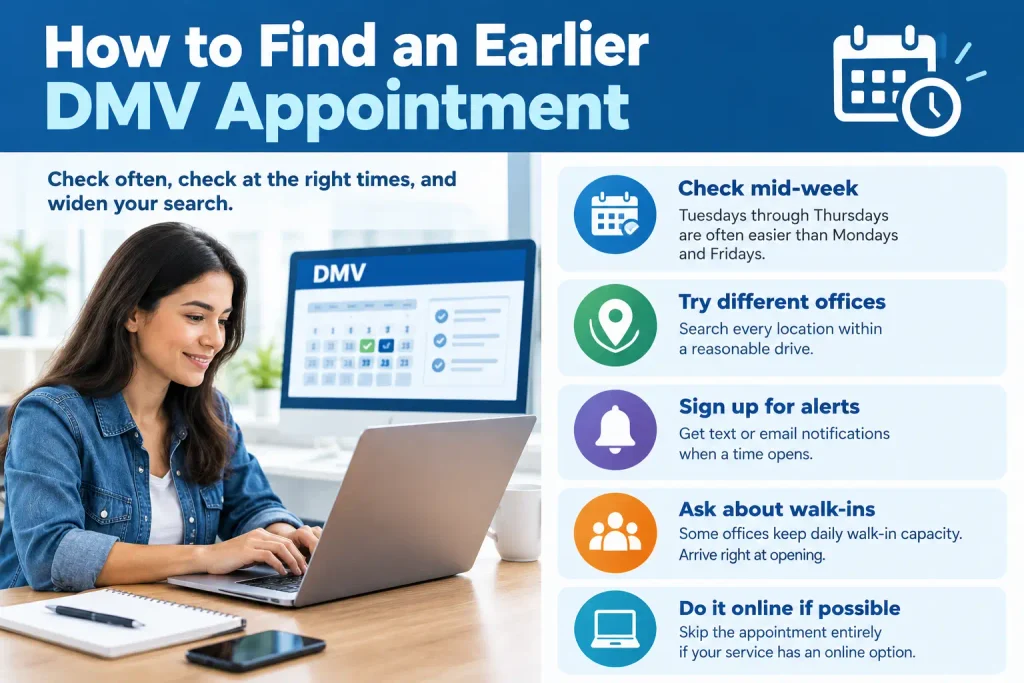
Check often, check at the right times, and widen your search. DMV systems release new slots in different ways, so no single trick works everywhere. These approaches help in most states.
Check mid-week
Tuesdays through Thursdays are often easier than Mondays and Fridays, although your state may differ.
Try different offices
Search every location within a reasonable drive, not just the nearest one.
Sign up for alerts
Some DMVs offer text or email notifications when a time opens, so check your account settings.
Ask about walk-ins
Some offices keep daily walk-in capacity, and arriving right at opening gives you a better shot.
Do it online if possible
If your service has an online option, you can skip the appointment entirely.
Do not book a slot you do not plan to use just to hold a place. Many systems limit how many appointments you can have, and a no-show can block you from rebooking for a while.
Beware of Fake and Third-Party Booking Sites
The official DMV website for your state ends in .gov. Many search results for “DMV appointment” show private companies that look official but charge fees or collect personal data. This is one of the biggest problems for people who search with spelling variations or phrases like “dmv com appointment.”
A site called DMV.com, for example, is a private business and not a government agency. Likewise, there is no single national “dmv.gov appointment” page that covers every state, because each state runs its own system. Always start from your state’s own .gov domain, even if it looks plainer than a commercial site.
Warning signs of a scam or unofficial site include:
If you think you gave details to a fake site, contact your bank and consider placing a fraud alert on your credit file. You can also report the site to the Federal Trade Commission at ReportFraud.ftc.gov.
Common Mistakes That Cause DMV Delays
Most delays come from preventable errors, not from the DMV itself. Knowing them ahead of time can save you a second trip.
Choosing the wrong service type. Booking “license renewal” when you need a first-time license or a REAL ID can lead to a refused visit. Read the service description carefully, and pick the one that matches your goal exactly.
Bringing the wrong documents. Photocopies, expired papers, or documents with a different name spelling are the most common problems. If your documents do not match, bring proof of the name change.
Arriving late. Some offices cancel or move your slot if you are more than 10 to 15 minutes late. Plan to arrive early, since parking and security checks can eat time.
Skipping the pre-visit checklist. Many state sites have an interactive document tool that tells you what to bring. Using it takes five minutes and prevents most turn-aways.
Forgetting payment. An office may not accept the method you planned to use. Having a backup card or check avoids a wasted visit.
Ignoring the confirmation email. It often contains the office address, check-in steps, and required forms. Read it, and keep it where you can find it on the day.
Waiting for the last day. An expired license, a late registration, or a move deadline can add fees or stop you from driving legally. Start the process weeks ahead, not days.
Troubleshooting DMV Appointment Problems
Most booking issues have a simple fix. Here are the problems people hit most often and what usually works.
No Appointments Are Available
Try other locations, check at different times of day, and look again after midnight, when some systems refresh. Consider a nearby county or a satellite office. If nothing opens for weeks, call the office and ask about a waitlist or a walk-in option.
The Website Will Not Load or Keeps Crashing
DMV sites can slow down during peak hours. Try a different browser, clear your cache, or switch from a phone to a computer. If the problem continues, try early in the morning or late at night.
The System Says Your Information Does Not Match
Check the spelling of your name and the date of birth. Enter your name exactly as it appears on your current license or ID. If it still fails, call the DMV and ask an agent to book the slot manually.
You Never Received a Confirmation Email
Check your spam folder, and confirm that you typed the address correctly. Many sites let you look up your booking with a name and confirmation number. If you cannot find it, call the DMV before assuming the slot exists.
You Need to Cancel or Reschedule
Use the link in the confirmation email or log in to your account and open your appointments. Cancel as early as possible so someone else can use the slot. Some states allow only a limited number of reschedules.
You Missed Your Appointment
Call or check the website right away. Some offices will let you rebook for a later day without a penalty, while others require a new booking from scratch. Do not assume a walk-in will be accepted.
Your Name or Date of Birth Is Wrong on Your Record
Fix this first, since errors can block a new license or REAL ID. Bring proof, such as a birth certificate or court document, and ask what form your state requires.
You Were Turned Away at the Counter
Ask exactly which document or step was missing and get it in writing if possible. Some offices will let you return the same day if you can fix it quickly. Otherwise, rebook and use the checklist so the second visit goes smoothly.
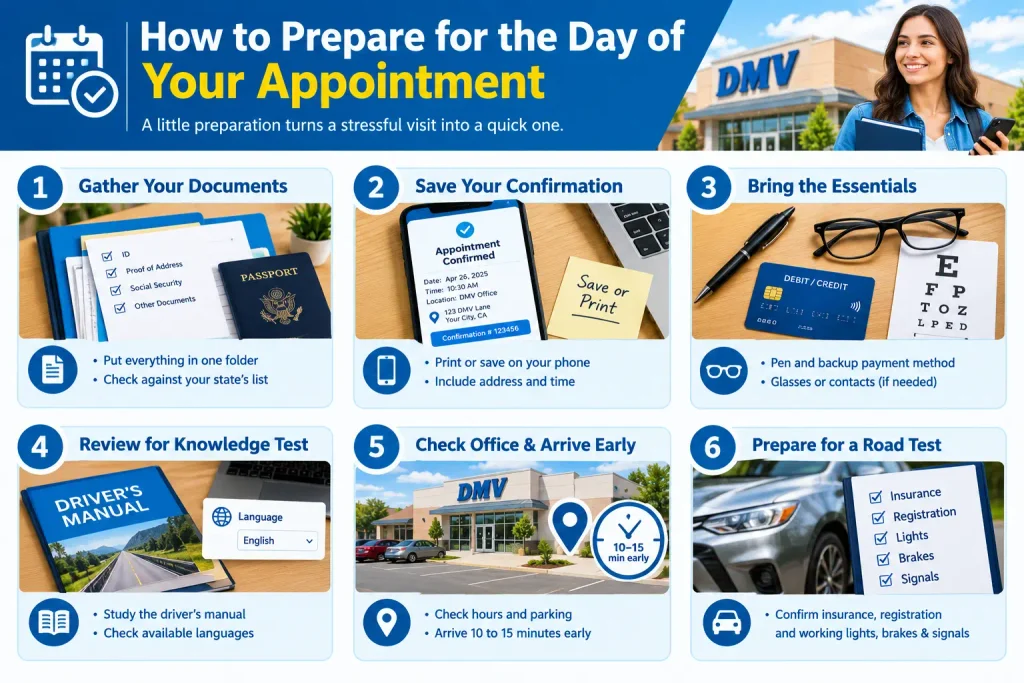
How to Prepare for the Day of Your Appointment
A little preparation turns a stressful visit into a quick one. A few habits make the biggest difference.
- Put every document into one folder the night before, and check it against your state’s list.
- Print or save your confirmation on your phone, with the office address and time.
- Bring a pen, a backup payment method, and your glasses or contacts if you need them for the vision test.
- Review the driver’s manual if you are taking a knowledge test, and check whether the test is offered in your language.
- Check office hours and parking before you leave, and arrive 10 to 15 minutes early.
- If you are taking a road test, confirm your vehicle’s insurance, registration, and working lights, brakes, and signals.
On arrival, follow the check-in steps from your confirmation. Some offices use a kiosk, a greeter, or a text-based check-in. Stay near the lobby so you do not miss your number.
DMV Appointment Checklist
Use this list the night before your visit.
Practical Tips for a Smoother DMV Visit
Small choices before and during your visit can save you real time. These tips come from the most common patterns in DMV delays rather than any one office.
What Happens After Your DMV Appointment?
You will usually leave with a receipt or temporary document, and your permanent card arrives by mail. Keep the temporary paperwork in your wallet or vehicle until the new card shows up. For registrations, you may receive plates and a sticker at the counter or in the mail.
If your card has not arrived after the timeframe your state gave you, check its online tracker or call the DMV. Do not wait months, since a returned envelope or address mix-up can be fixed faster when caught early. If you need to correct anything on your record, ask for the correction form right away.
Mark the next deadline on your calendar, such as your renewal date or the date when a probationary period ends. Many states send reminders, but missing mail is a common reason people let a license expire.
DMV Terms Explained
| Term | Meaning |
|---|---|
| DMV / BMV / MVD / DPS | Names states use for their licensing and vehicle agencies |
| REAL ID | A federally compliant license or ID, marked with a star in most states |
| Learner’s permit | A first permit that allows supervised driving |
| Graduated licensing | A staged system with limits for new, usually young, drivers |
| Title | The legal document that proves vehicle ownership |
| Registration | The record and fee that allow a vehicle on public roads |
| CDL | Commercial driver’s license for large or hazardous vehicles |
| Endorsement | An added permission on a license, such as motorcycle or hazmat |
| Proof of residency | Documents showing your current home address |
| Legal presence | Proof you are lawfully present in the country |
Frequently Asked Questions
Conclusion
A DMV appointment is the most reliable way to get licensing and vehicle work done without hours in a lobby, but it only works well when you prepare. Start with your state’s official .gov site, choose the exact service, and keep an eye out for cancellations if the first available date is far away. Bring the right documents, a backup payment method, and your confirmation, and arrive a little early.
Most problems people run into, such as no open slots, mismatched names, or fake booking sites, are easy to avoid once you know what to watch for. Use this page as a checklist before each visit, and you will spend less time waiting and more time finishing the job.