Driver’s License Renewal: When, Where, and How to Renew
Most people remember their driver’s license renewal only when a notice arrives in the mail, or worse, after a police officer points out the expiration date. Renewing on time is simple, but the rules change from state to state, and a small mistake can send you home from the DMV empty-handed.
This page explains when you can renew, which method fits your situation, what to bring, how much it costs, and what to do if your license has already expired.
You will also find a troubleshooting section and answers to the questions people ask most. Read the quick answers first if you are in a hurry, then use the checklist near the end before you start.
What Is a Driver’s License Renewal?
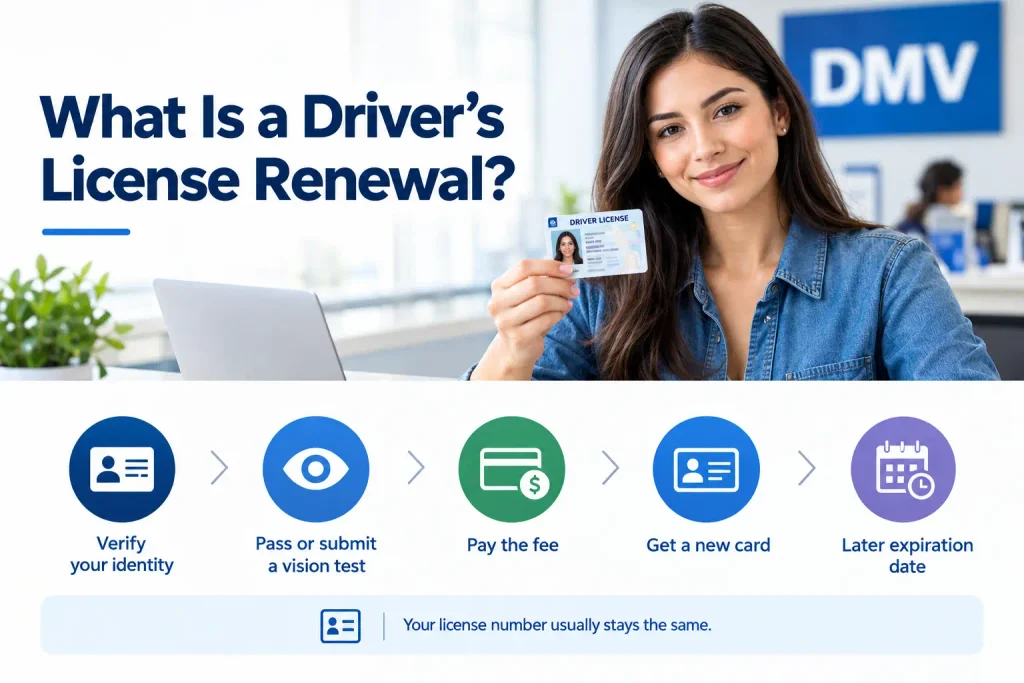
A driver’s license renewal is the process of extending the validity of your existing license for a new term, usually without retaking the full driving test. You confirm your identity, pass or submit a vision screening, pay a fee, and receive a new card with a later expiration date. The agency keeps your license number in most cases.
People search for this in many ways, including “renew driver’s license,” “driver license renewal,” “renewing my driver license,” or “renew a driver’s licence” with the British spelling. They all describe the same task. Your state may call the agency the DMV, the Secretary of State, the DPS, the MVA, or the BMV, and the page you need is usually labeled “Renew a license.”
Renewal is different from getting a replacement and different from a first-time application. A replacement fixes a lost, stolen, or damaged card and keeps the same expiration date. If you only need to update your address, see our page on how to change the address on your driver’s license.
When Can You Renew Your Driver’s License?
Most states let you renew months before the expiration date, and none let you wait forever. The renewal window differs by state. Some open six months ahead, some 180 days, and some a year or more. Your renewal notice, if you receive one, usually shows your exact window.
The earliest date matters because renewing too soon may be blocked online, and renewing too late can lead to fees or tests. If you plan to travel or live outside your state, ask whether early renewal is allowed. Some states let people renew as early as they wish when they will be away for an extended time.
A new card often keeps the same expiration date as the old one until it is renewed, so check the date printed on your card, not only the date on a notice. Set a calendar reminder two months ahead. That gives you time to book a visit, find a vision test provider, or fix any record problem before the deadline.
What Happens If Your License Expires?
An expired license is not valid for driving, but many states offer a grace period or a simple late renewal. The rules vary a lot, so do not assume you have extra time. Some states allow a short grace period of a few weeks or months, while others consider the license invalid the day after it expires.
Even where a grace period exists, it may not protect you from a ticket or from insurance and rental car problems. A grace period may also exclude certain license types, such as licenses held by non-citizens or commercial licenses.
The longer a license stays expired, the more you may need to do. Some states charge a late fee after about a month. If the gap is long, such as more than a year, you may face a vision test plus a written knowledge test, and a gap of several years can require a road skills test. Check your state’s page for the exact steps.
If your license expired a while ago, drive only if your state clearly says you may. Otherwise, arrange a ride, renew first, and then drive. This avoids fines and insurance headaches.
Where Can You Renew Your Driver’s License?
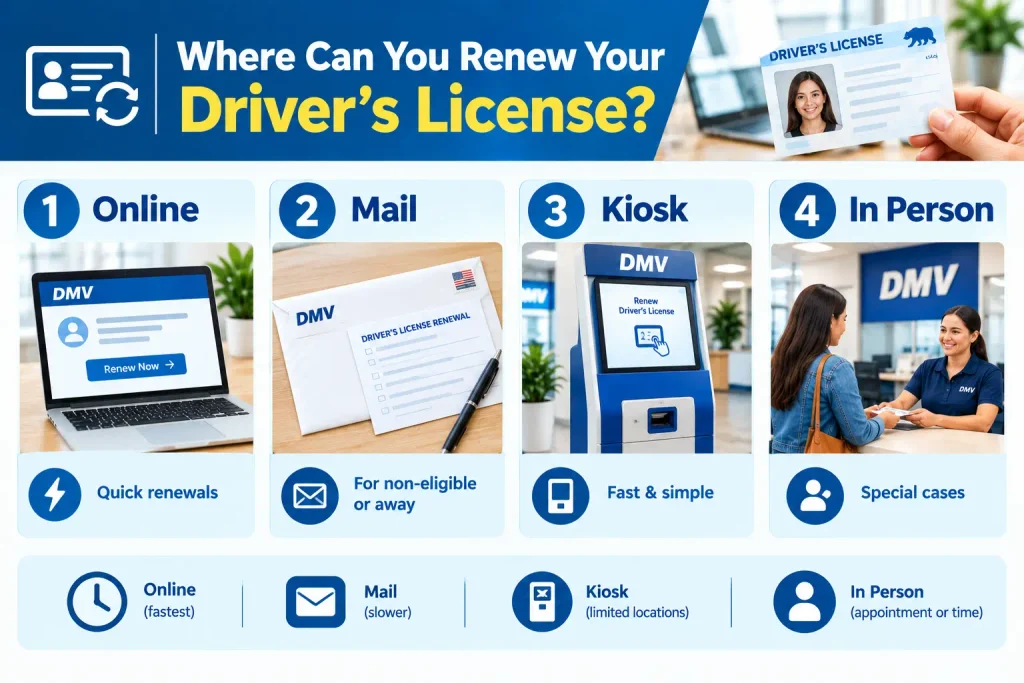
You can renew online, by mail, at a self-service kiosk, or in person, depending on your state and your record. Each method has trade-offs, and not everyone qualifies for every option.
| Method | Best for | Typical limit |
|---|---|---|
| Online | Quick renewals with a clean record | Eligibility rules apply |
| Drivers who do not qualify online or live away | Slower processing | |
| Kiosk | Fast, simple renewals in some states | Limited locations |
| In person | First REAL ID, name change, long expiration, special cases | Needs time or an appointment |
Renewing Online
Online renewal is the fastest option, but it is gated by eligibility rules. You generally need to be inside your state’s renewal window, have a valid license, and have no changes to your name or address. Many states also bar you from renewing online twice in a row, so your next renewal may need an office visit.
Renewing by Mail
Mail renewals are common for drivers who are out of state, in the military, or not eligible online. You complete the renewal notice or a state form, include any vision test report and payment, and send it to the address listed. Processing is slower, so allow several weeks and keep copies of everything you send.
Renewing at a Kiosk
Some states offer self-service kiosks at DMV offices, grocery stores, or other public places. You scan or enter your information, take a quick vision check at the kiosk if required, pay, and receive a receipt or a card by mail. Kiosks suit people who qualify but prefer not to use a computer.
Who Can Renew Online?
Online renewal usually requires a clean, simple record and an unchanged situation. The exact rules differ, but several conditions come up again and again.
You are more likely to qualify if you:
You are less likely to qualify if you are applying for a REAL ID for the first time, hold a restricted or conditional license, or have an older record without a recent in-person visit. Some states also require seniors above a certain age to renew in person.
If the website says you do not qualify, switch to mail or an office visit. The system is not telling you that you made a mistake, only that your case needs another route.
Step-by-Step: How to Renew Your Driver’s License
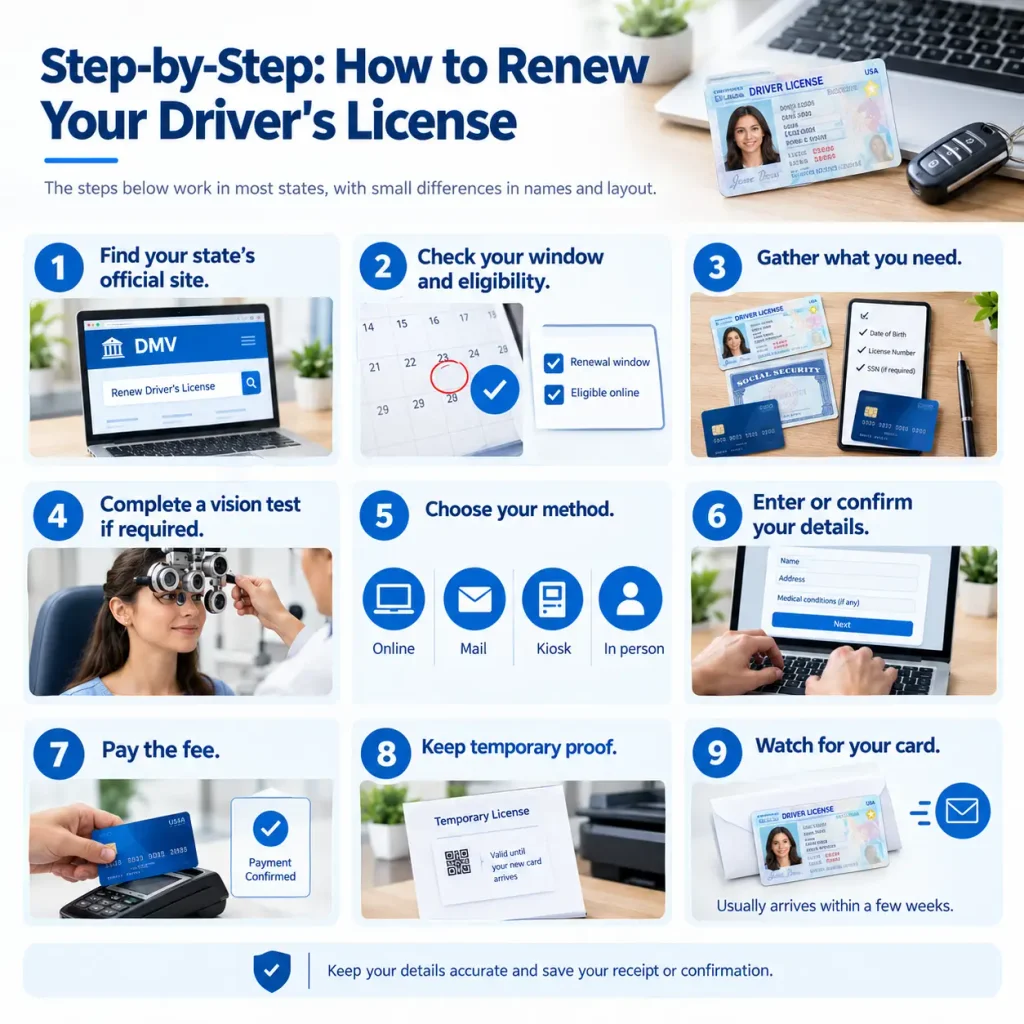
The steps below work in most states, with small differences in names and layout.
- Find your state’s official site. DMV renew driver’s license” and open the result that ends in .gov. Avoid ads and sites that add “service fees.”
- Check your window and eligibility. Read the page for your renewal dates and whether you can renew online.
- Gather what you need. Have your license number, date of birth, Social Security number if asked, and a payment card.
- Complete a vision test if required. Use an approved provider or an eye care professional who can submit results.
- Choose your method. Online if you qualify, mail, kiosk, or in person.
- Enter or confirm your details. Check your name, address, and any questions about medical conditions or restrictions.
- Pay the fee. Save the receipt or confirmation number.
- Keep temporary proof. Print or save any temporary license or receipt until your new card arrives.
- Watch for your card. It usually arrives by mail within a few weeks.
Documents and the Vision Test
For a simple renewal, you may need very little, but a first REAL ID or a gap in renewals requires more. Bring your current license, a payment method, and any renewal notice you received. Many states ask only for the license number and basic details online.
For in-person visits, you may also need proof of identity, Social Security number, and two proofs of residency, especially if you want a REAL ID. If your name changed, bring the legal document, such as a marriage certificate or court order. For non-citizens, bring valid immigration papers, since the license term may match your authorized stay.
The Vision Test
A vision screening is a standard part of renewal in most states. You can often take it at the DMV, at an approved eye care provider, or through a state registry of vision test providers. Providers can submit your results electronically, which lets some drivers renew online.
If you wear glasses or contacts, bring them. A minimum vision standard applies, and some states require a doctor’s report if you do not meet it. In some states, drivers over a certain age, such as 50, may be allowed to postpone the test when renewing online for a limited time, but this is a state-specific rule, so check yours.
Renewing and REAL ID: What You Should Know
Renewing your license online usually does not upgrade it to a REAL ID. A REAL ID is a license or ID card that meets federal standards and is needed for boarding domestic flights and entering certain federal facilities. A standard license is still valid for driving.
If your current card has the REAL ID star, a regular renewal keeps that status in many states. If it does not, you will typically need an in-person visit with extra documents to get one. Combine the upgrade with your renewal if you can, so you make a single trip.
Some travelers use a passport or another federally accepted ID instead. Check your state’s REAL ID page and the Transportation Security Administration rules before booking a trip, since requirements and enforcement dates have changed over time.
How Much Does Driver’s License Renewal Cost?
The fee depends on your state and license term, and it can range from the low $20s to $90 or more. Some states charge by year of validity, while others charge a flat amount for a set term. For example, some online systems list a per-year fee plus a small processing charge, and some places charge a flat fee for a multi-year license.
| Cost item | What to expect |
|---|---|
| Renewal fee | Set by your state and term |
| Online processing fee | Small extra charge in some states |
| Late fee | May apply after a short grace period |
| Vision test | Often free at the DMV, may cost at a private provider |
| REAL ID upgrade | Free in some states, extra in others |
| Replacement card | Separate fee if you lose your card |
Check your state’s fee page and avoid third-party sites that add charges. If your renewal comes with a REAL ID upgrade or a late fee, the total can be higher than the base renewal fee. Keep your receipt in case you need proof later.
How Long Does Renewal Take?
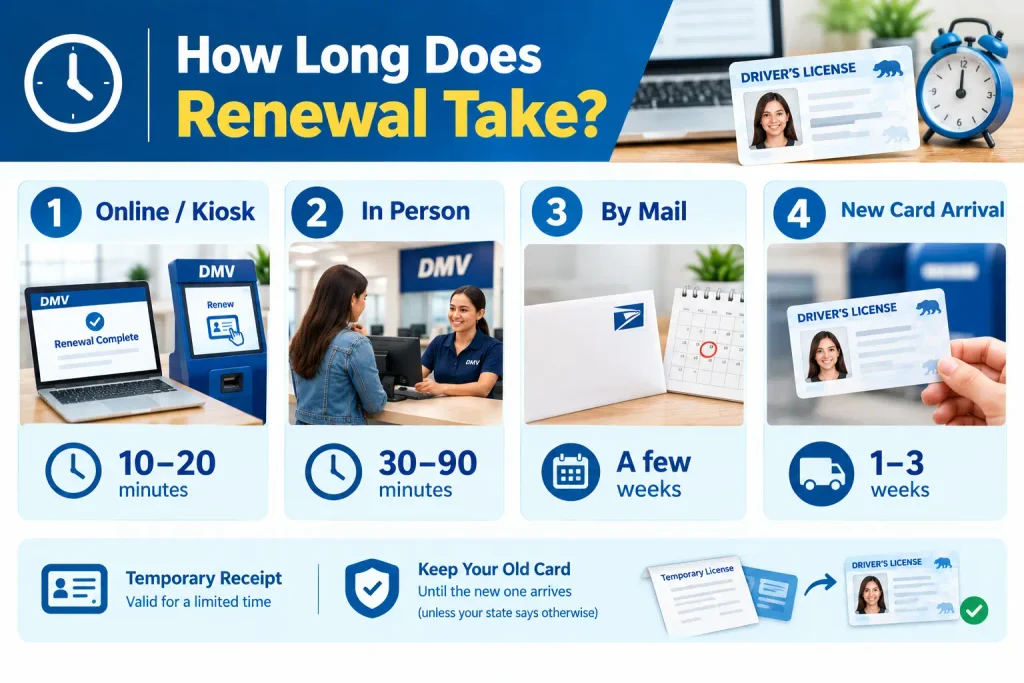
An online or kiosk renewal can take 10 to 20 minutes, and an in-person visit often takes 30 to 90 minutes. The wait for a DMV slot can be days or weeks in busy areas. Mail takes longer, often a few weeks before your record updates.
Your new card normally arrives by mail within about one to three weeks, though some states take longer. Many states give you a temporary receipt or paper license that is valid for a limited time. Keep it with you and do not throw away your old card until the new one arrives, unless your state says otherwise.
If the card has not arrived after the time your state gave you, check its online tracker or call the DMV with your confirmation number. Early action helps fix address errors before they become bigger problems.
Special Situations
Some situations change how you renew.
Living out of state. If you are temporarily away, ask your state about mail renewal, early renewal, or a temporary extension. Some states allow an extension by mail for drivers who cannot return in person. Do not assume your old license stays valid.
Military members and families. Many states offer special rules, extensions, or online options for service members stationed away. Ask your home-state DMV about military renewal before you pay anything.
Senior drivers. Some states shorten the renewal term, require an in-person visit, or require a vision test after a certain age. Check the age rules for your state.
Commercial driver’s license holders. A CDL has extra requirements, such as a current medical certificate and sometimes in-person renewal. Do not let it lapse, since it can affect your job.
Name or address changes. Update these first or during renewal. Mismatched documents are a common reason for rejected online renewals.
Moved to a new state. You do not renew your old license. You apply for a new license in your new state within its deadline.
Medical or vision conditions. Some states ask about conditions that affect driving. Answer honestly, and ask the DMV about any medical review steps.
Common Mistakes When Renewing
Most problems are easy to prevent.
Waiting until the last week. A missing document, a full appointment calendar, or a mailing delay can push you past the deadline. Start two months early.
Using an unofficial website. Many sites look like the DMV but charge extra. Start from your state’s .gov page.
Skipping the vision test step. If your state requires an approved provider’s result, the online form may not let you finish without it.
Assuming online renewal is always possible. If you renewed online last time, or your record has changes, you may need to visit.
Forgetting about REAL ID. Renewing a standard license online will not give you one, so plan an in-person visit if you need it for flying.
Ignoring your address. If the DMV mails your card to an old address, it may never arrive. Update your address first.
Throwing away the old card too soon. Keep it until the new card arrives or your state tells you to surrender it.
Missing the deadline and driving anyway. Driving on an expired license can lead to fines and insurance problems.
Troubleshooting Renewal Problems
Most renewal problems have a simple fix.
The Online Renewal Says You Are Not Eligible
Read the reason on the screen. Common causes are a missing Social Security number on file, an expired window, a change in name or address, or a prior online renewal. Switch to mail or an in-person visit.
The Vision Test Result Was Not Accepted
Check that your provider is approved by your state, and that results were submitted correctly. Ask the provider to resend them, or take the test at a DMV office. Bring your glasses or contacts.
Your Renewal Notice Never Arrived
You can still renew without it. Look up your expiration date on your card or your online account, and use the state website. Update your address so future notices reach you.
You Cannot Get an Appointment
Try other offices, check at different times, and look for cancellations. Check whether you can renew online, by mail, or at a kiosk instead. If you are close to expiration, ask whether a temporary extension is possible.
Your New Card Has Not Arrived
Wait the full processing time, then use your confirmation number to check status. Confirm the mailing address on file. If it is wrong, contact the DMV right away.
Your License Has Already Expired
Check your state’s grace period and late fee rules. If a long time has passed, ask whether you must retake tests. Do not drive until your state says it is legal.
Checklist and Tips
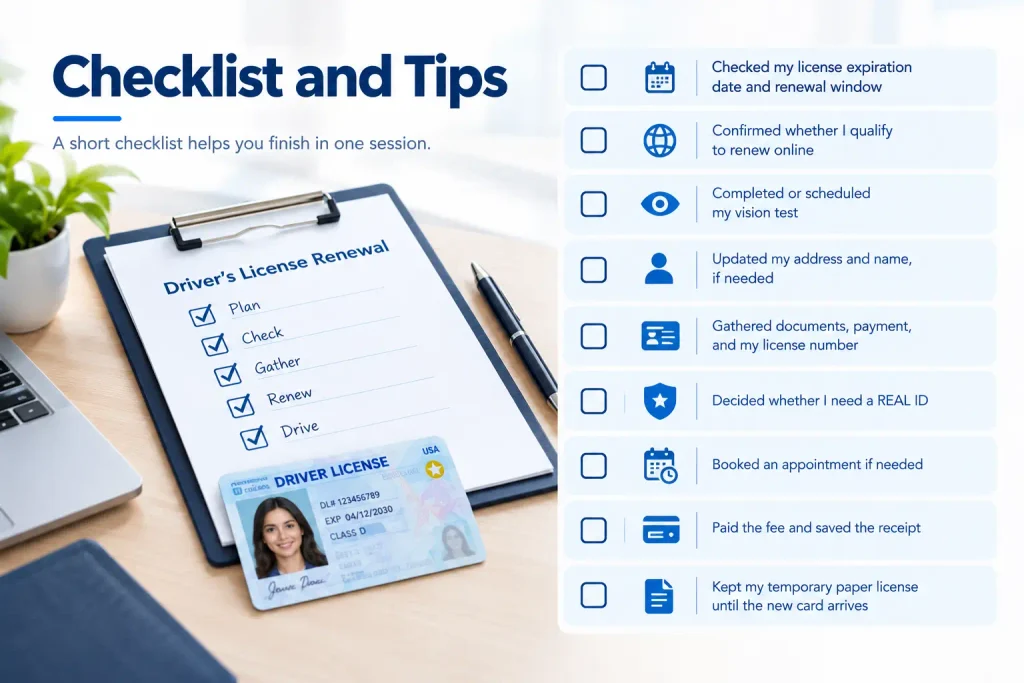
A short checklist helps you finish in one session.
A few tips help in practice. Set a reminder two months before expiration. Create an online account with your state DMV if one is offered, since it often shows your expiration date and eligibility. If you are helping an older relative, check their eligibility first and gather documents together.
Driver’s License Renewal Terms Explained
| Term | Meaning |
|---|---|
| Renewal window | The period before expiration when you may renew |
| Grace period | Extra time after expiration that some states allow |
| Vision screening | A basic eye test required for most renewals |
| REAL ID | A federally compliant license or ID, usually with a star |
| Temporary license | A paper receipt that works until your card arrives |
| Replacement | A new card for a lost or damaged license, same expiration date |
| CDL | Commercial driver’s license for large or hazardous vehicles |
| Consecutive online renewal limit | A rule that stops you from renewing online twice in a row |
Frequently Asked Questions
Conclusion
Driver’s license renewal is routine when you plan ahead. Check your expiration date, open your state’s renewal window, and pick online, mail, kiosk, or in-person service based on your eligibility. Have your license number, vision test result, and payment ready, and keep your temporary receipt until the new card arrives.
Most delays come from waiting too long, using unofficial sites, or assuming online renewal always works. Use the checklist on this page, update your address and name first, and plan an in-person visit if you need a REAL ID. A little preparation turns renewal into a quick task instead of a stressful one.